
3Blue1Brown
My name is Grant Sanderson. Videos here cover a variety of topics in math, or adjacent fields like physics and CS, all with an ...
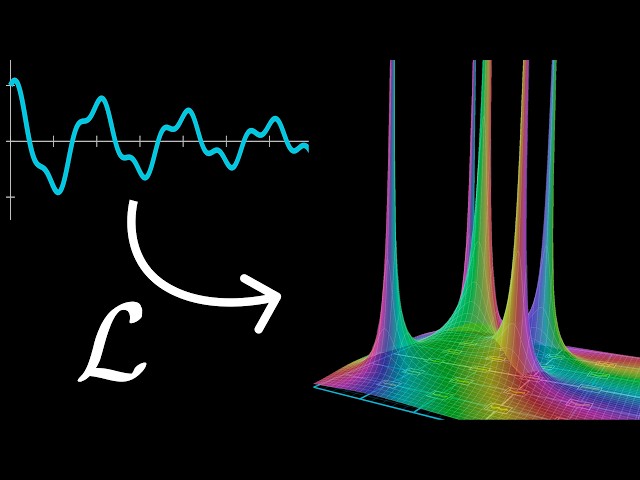
But what is a Laplace Transform?
The video introduces the Laplace transform as a powerful, intuition-rich tool for decomposing functions into exponential pieces by moving from time domain to the complex s-plane. It builds an intuition through geometric pictures of decays, oscillations, poles, and analytic continuation, explains the transform’s definition and key properties (linearity, poles, and how exponentials map to simple poles), and demonstrates how this framework connects to Fourier transforms and to solving differential equations. The overarching message is that the transform exposes the exponential building blocks behind a function, providing a bridge from time-domain dynamics to algebra in the s-domain.
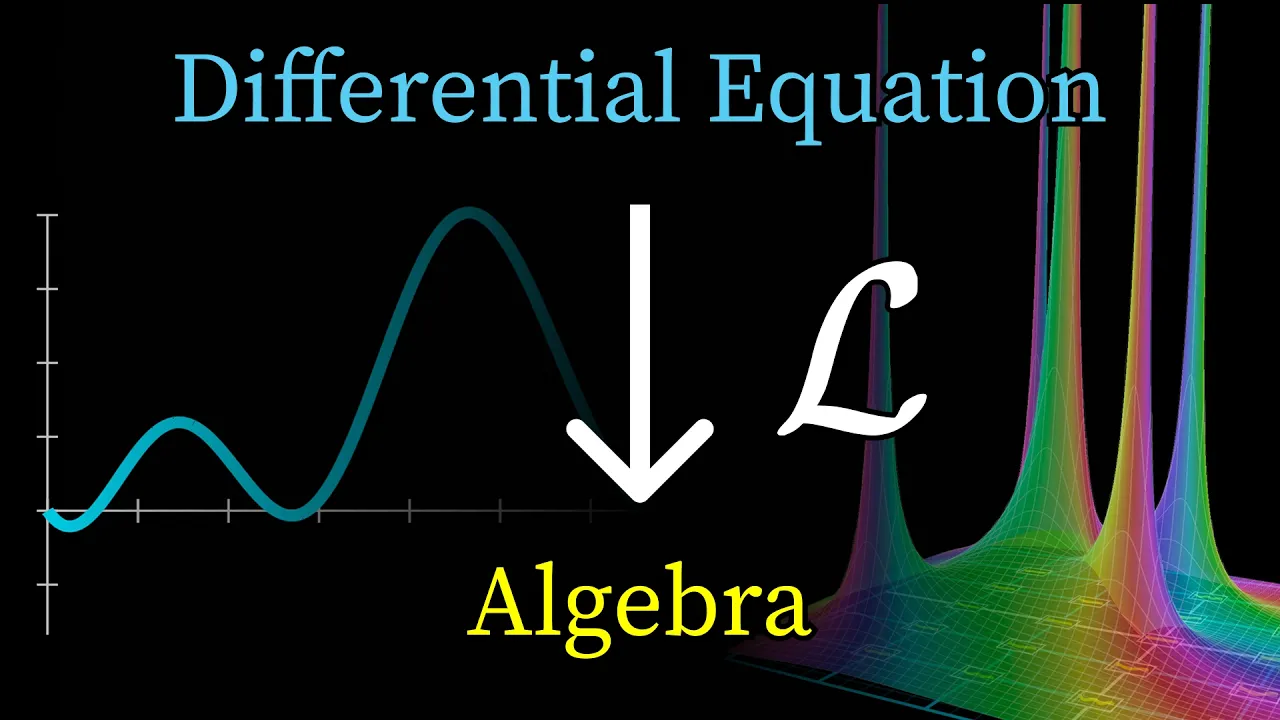
Why Laplace transforms are so useful
This chapter introduces using the Laplace transform to analyze a mass-spring-damper system driven by a periodic external force, illustrating how the external frequency can dominate and lead to a steady-state oscillation. It covers the core mechanics: how exponential pieces map to poles in the s-plane, how differentiation becomes multiplication by s (with initial-condition terms), and the practical workflow of transforming, solving, and (optionally) inverting to recover the time-domain solution.
The Hairy Ball Theorem
The video introduces the hairy ball theorem by likening it to trying to comb a fluffy sphere and showing that any continuous tangent vector field on a sphere must have a zero somewhere. It then builds up a vivid, accessible proof via a fusion of intuitive pictures and a classic contradiction argument (including flux, stereographic projection, and a half-circle deformation) before touching broader implications and related concepts in higher dimensions and practical analogies.
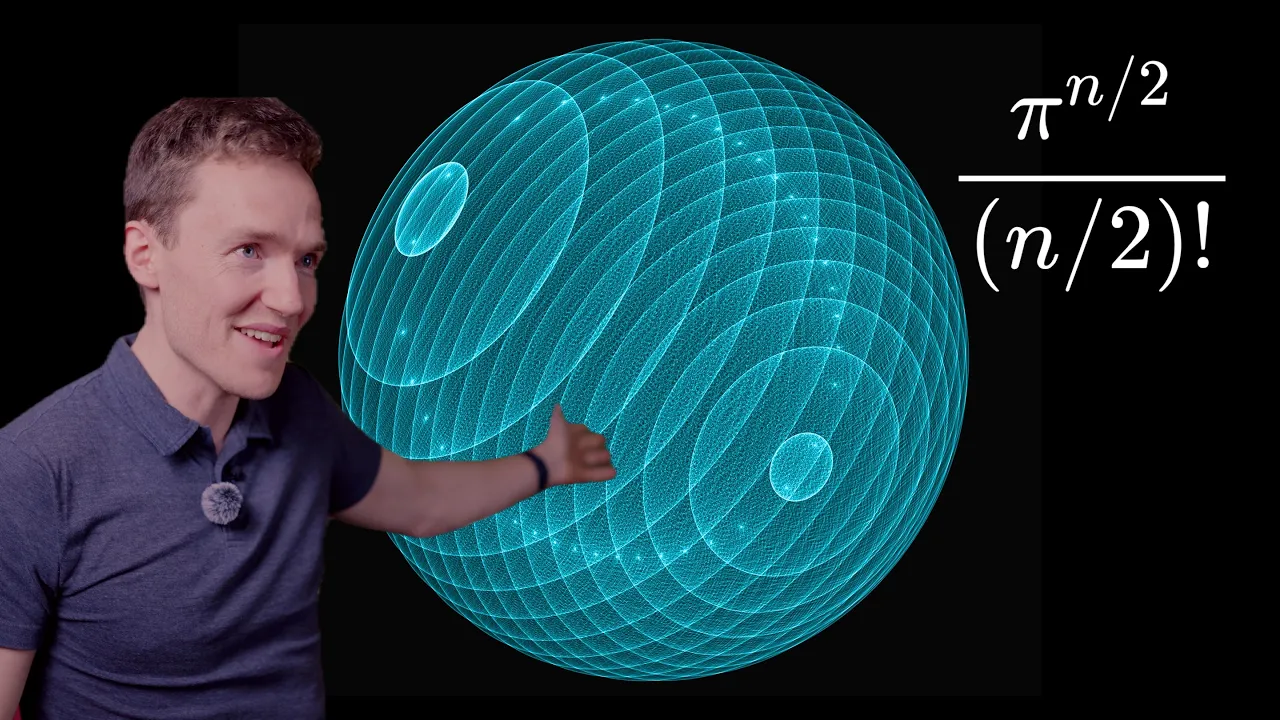
The most beautiful formula not enough people understand
The talk builds an intuition for high-dimensional spheres by starting with simple 2D/3D cases and using Archimedean ideas to relate volumes across dimensions. It shows how the volume of an n-dimensional unit ball follows a recursive, dimension-by-dimension rule (involving factors like 2π and division by n), connects to the gamma function, and reveals counterintuitive phenomena such as most volume residing near the boundary as dimensions grow. Along the way, it ties these geometric ideas to practical contexts (machine learning, cryptography) and emphasizes the beauty of seeing high-dimensional math through pictures, not just formulas.
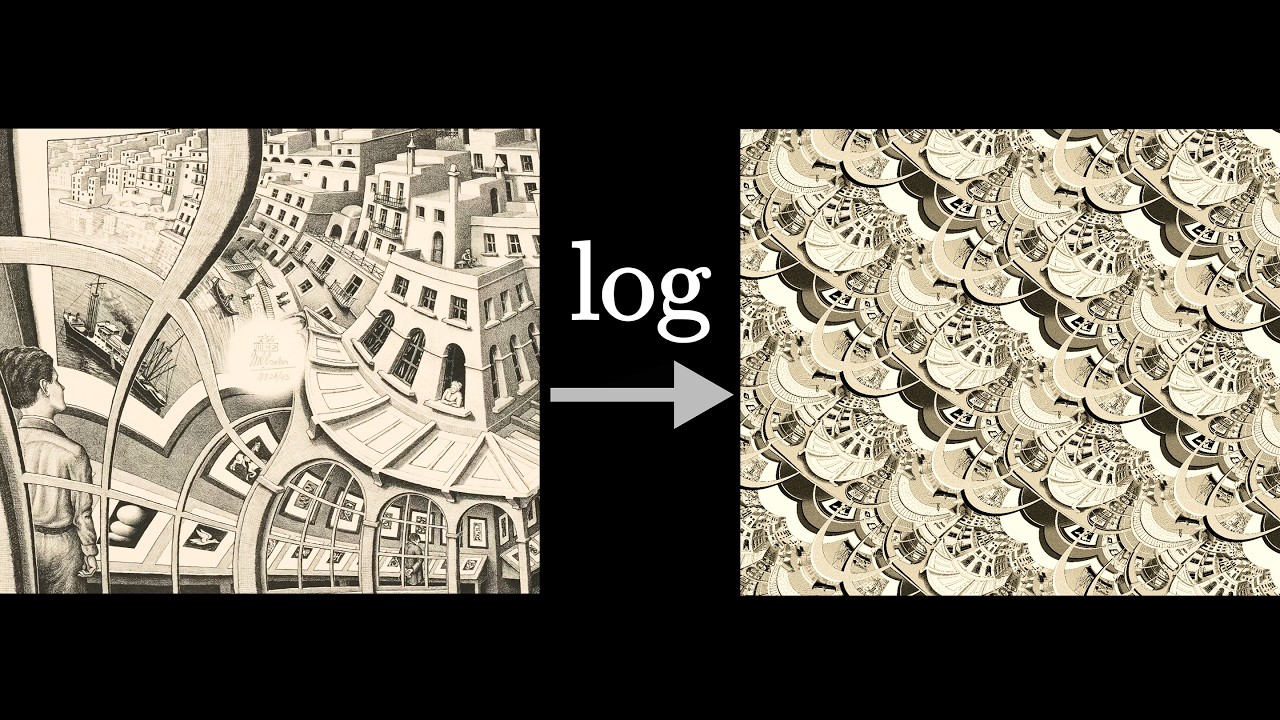
This picture broke my brain
The video analyzes Escher’s Print Gallery by building a rigorous visual and mathematical narrative around a self-similar Drosta image, showing how a looped zoom can be produced by composing log-like distortions, rotations, and exponentials. It threads together concepts from warped grids (mesh warps), conformal maps in complex analysis, and the role of logarithms and exponentials in turning circles into lines (and back), ultimately connecting Escher’s art to deeper ideas like elliptic functions and the beauty of structure in math.


Get daily AI recaps from
3Blue1Brown in your inbox
Get AI-powered summaries delivered to your inbox. Save hours every week while staying fully informed.