Why Do We Trust Google?

Chapters6
The video questions when and how we started trusting Google with our entire digital lives, highlighting the gradual trade-off of privacy for convenience and the difficulty of opting out from a highly integrated ecosystem.
A candid look at how Google quietly became the backbone of our digital lives—and what we risk by letting one company own the Internet’s foundation.
Summary
Austin Evans examines the uneasy relationship many of us have with Google, confessing how a lifetime of conveniences gradually became a hidden contract for data. He recalls Chrome’s rise from a fresh browser in 2009 to a data-collection powerhouse, and how Chrome’s Chromium foundation underpins about 70% of web browsing across nearly 30 browsers. He explains Manifest V3 and why it gutted many ad blockers, arguing that Google’s influence extends beyond search into the very way extensions work. Evans shares a personal Google Takeout deep dive that reveals hundreds of gigabytes of history—from hotels searches to YouTube subscriptions—highlighting how much of our lives is stored by a single company. He contrasts his Edge-for-a-while experiment with Chrome’s convenience and admits he’s stuck in a trade-off: privacy vs. seamless experiences. The video also weaves in browser-ecosystem dynamics (Firefox’s Google deal, Edge’s AI integration) to show how antitrust scrutiny and default-search economics shape our options. He closes by urging viewers to make privacy decisions consciously, even if complete decoupling isn’t practical, and to actually review what data Google holds on them through Takeout. In short, the browser is the Internet, and Google’s dominance is both a certainty and a risk worth questioning.
Key Takeaways
- Google Chrome commands about 65% of global web browsing, equivalent to roughly four billion users, and its underlying Chromium engine powers close to 30 browsers (Edge, Opera, Brave, Vivaldi, etc.).
- The shift to Manifest V3 significantly restricted real-time blocking power for ad blockers like uBlock Origin, weakening privacy protections in Chromium-based browsers.
- Google Takeout reveals the scale of data Google stores: the author’s account shows 527 gigabytes across 80 products, including search history, maps, and activity logs.
- Evans remembers Chrome’s early speed/stability advantage over Internet Explorer in 2009, then notes Chrome gradually became heavier and more RAM-hungry as the ecosystem expanded.
- Firefox remains the only major blocker to Chromium, due to continuing to run its own engine; Google pays Mozilla to be the default search engine in Firefox, illustrating how antitrust-style leverage shapes choices.
- Even with Edge’s tempting AI features and the allure of reduced friction, Evans found himself returning to Chrome for conveniences like tab handling on his device, illustrating the personal trade-off between privacy and usability.
Who Is This For?
Essential viewing for privacy-conscious tech enthusiasts and web developers who want to understand how browser ecosystems are built, controlled, and monetized—and what it means for everyday browsing and data security.
Notable Quotes
"When did we start trusting Google with our entire lives? Now, I mean that literally."
—Intro framing about the depth of Google’s data collection.
"Manifest V3 ... changed the rules for how browser extensions work in all Chromium-based browsers."
—Explains a core policy change that impacts privacy tools.
"527 gigabytes. That's how much of my life Google has in Takeout."
—Eye-opening data size from Google Takeout.
"The browser is the Internet."
—Austin’s closing line about the central role of the browser.
"I could sit here and tell you to switch to Firefox, and to be fair, I actually do think I need to give it another shot."
—Personal privacy decision; consideration of alternatives.
Questions This Video Answers
- How much of my data does Google Takeout really contain and how can I download it safely?
- What is Manifest V3 and why did it affect ad blockers like uBlock Origin?
- Why is Chrome so dominant, and can Firefox or Edge realistically challenge it?
- What are the privacy trade-offs when using Google services like Maps, Gmail, and Drive?
- Is there a practical path to browsing privacy without sacrificing too much usability?
Full Transcript
- When did we start trusting Google with our entire lives? Now, I mean that literally. When did you decide to trust them? At least for me, there was never really a moment where I sat down and thought, "Yeah, I'm gonna hand Google my search history, my location, my browsing habits, my email." Like, basically my entire digital life is in Google. And yet, it happened. Now, I understand the irony that I, a full-time YouTuber, who has been collecting a check from Google AdSense since 2010 is sitting on a Google-owned platform questioning Google, right? I get it.
To be clear, I do consider myself to be a privacy conscious individual. I mean, I always turn off location tagging on my phone because I'm afraid of doxxing myself. But the other day, I just started thinking about here I am, in 2026, using Chrome, syncing everything to my Google account and asking Gemini questions I would not ask any human being. Somewhere along the way, I just gave in. And I bet if you're honest with yourself, and be honest, you've done something similar. Maybe not with Google specifically, but somewhere at some point, you probably agreed to trade privacy for convenience without really thinking about it.
Back in 2009, only a few months after I started this channel, I made my first browser test. That was back in the days when Google Chrome was brand new, and honestly, it was exciting. I mean, compared to Internet Explorer, it was legitimately a huge step forward in speed and stability and security. I mean, it didn't just win because Google pushed it. It won because it was better. But over time, the narrative kinda changed. Chrome got heavier, slower, and started eating RAM like it was going out of style. And for someone like me who considers myself to be a real tech enthusiast, there was a sense of like principle?
Have you ever been a fan of a band, and they're under the radar, and really cool, but then they start to blow up and then it's kind of like really normie, and you feel like you're not interested in them anymore? That was me and Chrome. I wanted to be cool and different. It also just so happened that Google is the biggest advertising company on the face of the planet and maybe I shouldn't be handing them everything about my life just because they have a shiny browser that I wanna use. And so I left. I tried Firefox.
I actually used Opera for quite a while, but I bounced around. And then in early 2023, Microsoft invited me out to Redmond. They were launching a completely overhauled version of Microsoft Edge powered by AI. Yes, I know, AI, ugh. But this is back when ChatGPT was brand new and they promised to load a custom version into Edge that was going to be legitimately a game changer. And I'm not gonna lie, I was genuinely blown away. The way it could summarize a webpage, pull context from what you were reading, generate content right from the sidebar, it felt like a real leap forward.
I literally said on camera that I was switching to Edge. Edit team, roll the clip. This is so good to the point where I'm like, oh, I'm clearly gonna start using Bing. And I did! I've been using Edge as my main browser for almost three years now. But then slowly I started to drift back to Chrome. Not because Edge was bad, but it was the little things. Like I preferred the way that Chrome handled tabs on my Z Fold 7. There was this new Gemini feature that came out that only worked in Chrome desktop, and I figured, "Sure, let me give it a try." And that's how they got me.
One small convenience at a time. A huge thank you to the sponsor of this video, Mova. Now, it is no secret that I am not a fan of chores. I mean, who is? But honestly, the one I hate the most is vacuuming. Why haven't we invented something that vacuums for me? (off-screen coughing) Oh, oh, what's that? We did? Okay, so now that I've lived with the Mobius 60, I can tell you that it really sucks. 30,000 Pascals of sucking force to be precise. That's enough to clean up cat litter, coffee grounds, sunflower seeds, and even cigarette butts.
But what makes the Mobius really special is how smart it is. You have three different mops that it can automatically switch between. You have the Thermohold mop, which is designed for greasy kitchen floors. The Plush mop for more delicate services. And the Hyperclean mop for every day. But what I personally love are its little T-Rex arms. One of the problems with robot vacuums in the past was that they couldn't clear little thresholds between rooms. If there was a small step anywhere, forget it. The Mobius has small arms, they can lift the front up, so it can clear up to eight centimeters, or a little over three inches for those who speak in freedom units.
It is genuinely awesome, and it's no wonder why it won a CES Innovation Award. It's also maintenance-free with a hot water self-wash, as well as a quick high temperature dry feature. If you never want to worry about vacuuming again, check out the link in the description, and thanks again to Mova for making our lives just a little bit cleaner. It's funny, back in 2011, I reviewed the Cr-48. This was the very first Chromebook before Chrome OS was even really a thing. And while it was such a bizarre and weird idea of buying a laptop that was purely just a browser, and it really was just a browser back then.
There was a glimmer of something like the future. This is not too far after the iPad had first been launched, and everyone was really thinking about, like, what's the next wave? And it really feels like looking back, that was such a key moment in the, not only just the development of the Internet, but really, the development of Google's ambitions. They wanted to own every part of the Internet, your computer included. And 15 years later, it's hard not to think that they've absolutely won. So, how big is Chrome? Well, about 65% of all web browsing on the planet runs on it.
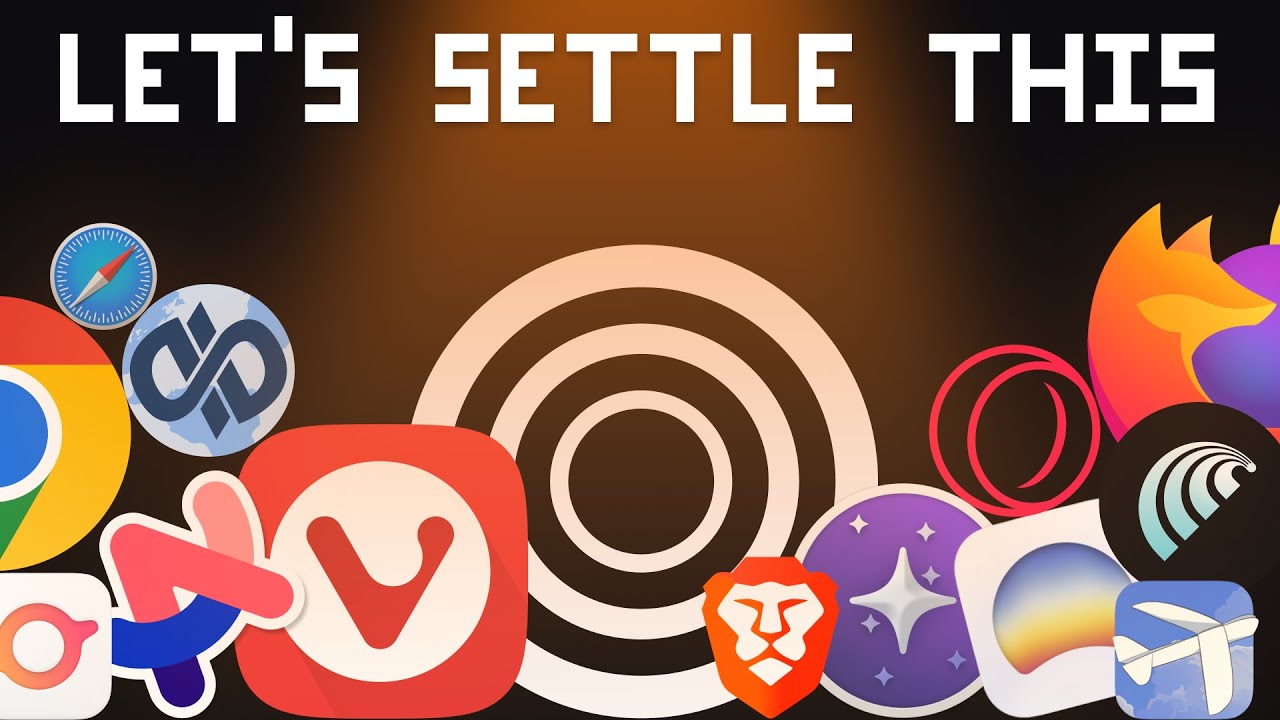
That's roughly four billion people. Now, this isn't even the whole story, because you don't even need to use Chrome to be using Chrom...ium. - [Adriana] Boo! - [Alex] That was not great. - It's Chromium! - [Alex] Yeah, we get it. - Chromium is the open source engine that many, many browsers, including Chrome, are built on. Microsoft Edge runs on Chromium, Opera runs on Chromium, Brave, Vivaldi, Samsung Internet, Arc. I mean, there are close to 30 browsers that are all built on Google's code. When you add all of those up, over 70% of all web browsing happens on a Google foundation.
Now, because I'm a nerd, I followed the steady rise of Chromium. I mean, it was a big deal when Opera ditched their own engine, and it was an even bigger deal when Microsoft, who makes Windows, and is Google's mortal enemy, gave up on their own browser engine and switched Edge over to Chromium too. Now don't get me wrong. There aren't just 100 clones of Chrome out there. Opera focuses on things such as privacy and gaming with GX. Edge has Bing and AI built in. Brave is all about blocking ads and trackers. I mean, they're all doing their own thing, just so happens to be doing that on top of Google's code.
Now, that last bit is important, because last year, Google finished rolling out something called Manifest V3. Basically, they changed the rules for how browser extensions work in all Chromium-based browsers. The biggest casualty, ad blockers. Under the old system, an ad blocker extension such as uBlock Origin could look at every single web request in real time and decide whether to block it. It was super powerful. The new system, well, extensions have a much more limited set of rules. The developer of uBlock Origin has made it clear just how big of a downgrade this has been, and the full version doesn't work at all on Chrome anymore.
There is a new lite version, but it is just a shadow of what it once was. Now, the EFF has pointed out the obvious. Google runs one of the biggest advertising networks on Earth, and they control the browser that most people use. So when Google makes ad blockers worse, I think you can see what I'm getting at here. Now, some browsers that rely on Chromium had done their best to find workarounds. Vivaldi tried to keep it alive, but by mid-2025, the maintenance was just too much. Even Brave, which went further than anyone to patch things, can only keep a handful of specific extensions working on the old system.
Although to be fair, they do maintain their own built-in blocker. But there is hope. One browser will let you run your full-fledged ad blocker. That's right, nerd. It's Firefox. Whoo! So how did Firefox get away with this? Well, it's simple. They never made the switch to Chromium. They are still developing and running their own engine. Unfortunately, Firefox is a tiny player in the grand scheme of things. Google still exerts almost total control over the browser market. Now, if this all sounds a little bit like a monopoly. Don't worry, you're not alone. Chrome is so dominant that the US government has tried to break it up.
Now, a federal judge ruled that Google does hold an illegal monopoly on search, and the Department of Justice even tried to force Google to sell Chrome off. Now, things didn't ultimately go that far, although it's still pending. There are almost certainly big changes coming for the way that Google operates. Google's defense? Well, they're not a monopoly. No, of course not. I mean, look at all these competitors! There's Apple Safari, which of course only runs on Apple products, and Firefox. We should put a little asterisk beside Firefox, because they've gone from 32% of the market in 2009 to about 2% today.
They're neck-and-neck, really. I mean, it's hard to tell difference between 2% and 65%. - [Alex] Yeah, I love my 65% milk. (Austin laughing) - Not even this can be taken at face value, because Firefox isn't a traditional business. Like Mozilla is not making money from selling you a product or a service. Instead, nearly 90% of their revenue comes from a deal that Google pays for to be placed as the default search engine inside of Firefox. Why, you might ask, would Google fund a competitor? Well, there's a lot of potential reasons, but I think my answer would be to say that they have a competitor at all.
Man, this is maybe not good. To really understand just how much data Google has on you, there's an easy way to do it. Google Takeout. This is a way for you to download a copy of every bit of data that Google has on you. For context, I created my Gmail account in 2004. And so when I went to Google Takeout, it gave me a 80 product list of items that is 527 gigabytes. - [Alex] My God, did they call it Google Takeout 'cause they're gonna violate you before taking you out to dinner? (Austin laughs) - [Adriana] What??
- It also just goes without saying that this is full of very private, sensitive information. So if you do do this, they ask you like a million times, "Are you sure?" They give you notifications, you have to wait a few days. I've been a very good boy. I've been staring at this. - [Adriana] Ew, ew. - [Alex] Sounds so sus! - Okay, you know what? - [Alex] Is this where it confirms that you're a furry? - No! And you can see here, I have stuff from alerts, assignments, calendar, Chrome, contacts. Google Drive, Fit, Gemini, Google Account, Google Chat, Google Fi, Google Finance, Google Meet, Google Pay, Google Photos, This is just the top level.
How about my activity? Oh, Jesus Christ. Each one of my activity has another giant amount of folders. - [Alex] Oh, you never wanna hear. - How about my activity for hotels? - [Alex] Whoa, whoa, whoa, whoa. - [Adriana] Whoa, whoa. - I'll open it, I don't care. Used hotels. Search for hotels near- - [Alex] Wait, what's a used hotel? What? - [Adriana] Wait, yeah, wait! - So this is a hotel I looked for near Apple Park? Oh, my God. I found my search history. It is a 35 megabyte text file. - [Alex] Ooh. - [Adriana] Let's go.
- 99,000 searches. - [Alex] That's it. That's a thumbnail face. - What was my very first Google search? It is for Airsoft. I searched Airsoft! - [Alex] Oh, that's actually worse. - November of 2007. It also, I searched for Pokemon advanced map download. I searched for the word name. I searched for mail.google.com. - [Alex] Oh. - [Adriana] How do we spell mail? - M-A-I-L. How dare you. How dare you! I maybe downloaded a song that was not from the official source. Keep scrolling through that. - [Alex] Wow. - Piracy is illegal. We do not condone it.
In 2013, I searched Xbox 720 leak. Oh my God, that's amazing. - [Alex] Hey, let us know when you get to 2014 and- - What? No, what? - [Alex] Yeah. - What did I do in 2014? Nothing, nothing bad. - [Alex] I don't know. Did you perhaps search for insurance fraud or anything of the sort? - How dare you? How dare you? Oh, okay, I've got a nine megabyte file with my YouTube search history. What do you think the first video I watched on my account is? Why DSLRs remain an essential tool from 2013? So in September 1, 2013 is when the search history begins.
I apparently subscribed to the Motor Trend Channel in 2008. I subscribe to Ashens in 2009. Jon Rettinger in 2009, Community Channel, Phil DeFranco. - [Alex] Jesus, how many of these are still around? - I subscribed to Marques, November 26, 2009. - [Alex] Aw. - What, okay, what should I look for? There's so much. Voice match? What the hell's voice match? Oh my God, it's like recording me talking. Oh, Jesus Christ. Hey, Google. (Austin shouting) What the (duck quacking) For context, I don't have anymore, but I used to have a Google smart speaker at my house.
Okay, Google. What's the weather tomorrow? The (duck quacking) - [Adriana] Most generic question ever. - The first time I use Google Maps, I searched, oh, yeah. I can't show any of literally none of this. It saves a PDF that I uploaded to Gemini? - [Matt] Language! - [Kid] Yeah, I got you. - Is this like from like a voice chat with Gemini? Dude, what the.. Oh, it's just my, not my search history, my browsing history. This is my browsing history from two days ago. What? What do you mean? What? Oh, interesting. This is what it thinks of me.
I identify as a white, non-LGBTQ man? - [Alex] I mean- - The (duck quacking) What? - [Adriana] I mean, what part is wrong? - No, no, but I- - [Alex] It is the most accurate description we've had of you so far. - Maybe is that like something I filled out at some point? Good Lord, okay. There is literally thousands and thousands and thousands of pages of this stuff. Logically, you know that this stuff is on, but I think it's such a just visceral feeling to actually look at it all in one place. I, gonna go delete some stuff.
- [Alex] Yeah, we're just gonna burn that Surface right now. - You know what? So, 527 gigabytes. That's how much of my life Google has. I think the thing that really gets me, I keep coming back to this, is that I never decided to say yes to any of this, right? There was never a single moment in which I decided that, yes, I'm going to trust Google with everything. It was just 1,000 tiny little, well, yeah, I guess. Of course, I wanted to sync my contacts with my Google account. I mean, GChat was the reason I made a Gmail, and who doesn't use Google Maps?
Every single one of those was a reasonable choice in the moment. It didn't feel like I was giving anything up. And yet, when you zoom out, and you realize that you've handed one company two decades of your search history, your location, your browsing habits, what you watch, what you buy, what you ask an AI when no one else is around. (Austin exhaling) And look, this isn't even just a Google thing. It is a pattern. When I first got my Ray-Ban Metas, I was careful. I really liked the glasses, but I turned off the Wi-Fi, I turned off the location.
I mean, I wasn't gonna let these glasses track me everywhere. But then after a little while, manually syncing them to Wi-Fi every time there was an update got irritating. Then I'm walking around Disneyland. I go to ask the glasses a question about a ride I see them building, and there it goes. Yeah, sure. Turn on location services. I would bet that a lot of you have done some version of this before. Like, there's no way I'm alone, right? Maybe it's a smart speaker in your living room. Maybe it's an app that needs your location to function, even if it probably doesn't.
Maybe it's AI that reads your email to give you better recommendations. I mean, every time the trade is the same. Give us a little more data, and we'll make your life a whole lot more convenient. Keeping privacy first in 2026 is genuinely practically difficult. I mean, it's not just about willpower or caring enough. I mean, these products are designed so that the path of least resistance is always the one that shares the most, and it works. It worked on me, and I'm a giant nerd who goes through all the settings and usually turns stuff off.
So what do you actually do about this? I could sit here and tell you to switch to Firefox, and to be fair, I actually do think I need to give it another shot. I mean, it is the last truly independent browser. But I'm also not going to pretend that it's that simple. Firefox has 2% of the market for a reason. Google's ecosystem is just deeply integrated into how most of us use the Internet, and walking away basically just isn't even possible, at least not entirely. And I want to be clear here. Google makes some great products.
You've got Gmail, Google Drive, YouTube, Google Photos, Maps. But look, I just want to be clear. I'm not pretending that Google's some evil company just harvesting data from us. It's a trade that I don't judge anyone for making. Look, I don't have a clean answer for you. I'm sitting here right now as I'm making this video, thinking about while I like the idea of using this moment to rethink some of the privacy decisions, I honestly don't know how far I'm willing to make real changes because I'm going to be actively having to trade off a lot of the convenience I'm used to for privacy, which has dubious value in 2026, if I'm honest with you.
But I think the least we can do, and I'm including myself in this, is to make it an actual conscious decision. Download your Google Takeout data and decide how much of this are you comfortable with. Consider just how much you want to share with Facebook, with Instagram, with your Microsoft account, with TikTok. Here's the thing. Back when I reviewed the very first Chromebook, the browser was just how you got to the Internet. But in 2026, the browser is the Internet. And when one company controls the foundation that almost everything is built on, that's pretty dangerous.
Maybe you're fine with it. A lot of people are. But you should at least know and make your privacy a decision, not just a pop-up you wave away. If you enjoyed this video, definitely be sure to subscribe to the channel and ring-a-ling that ding-a-ling. I will say that there's probably a follow-up on this whole topic, but in the meantime, I would highly encourage you, go check out your Google Takeout definitely. Let me know in the comments below... Actually, no, no, wait, wait, no. Don't do that. Don't tell me what you find in there. I don't wanna know.
Keep it to yourself. I'm looking at you, Jonathan.
More from Austin Evans





Get daily recaps from
Austin Evans
AI-powered summaries delivered to your inbox. Save hours every week while staying fully informed.