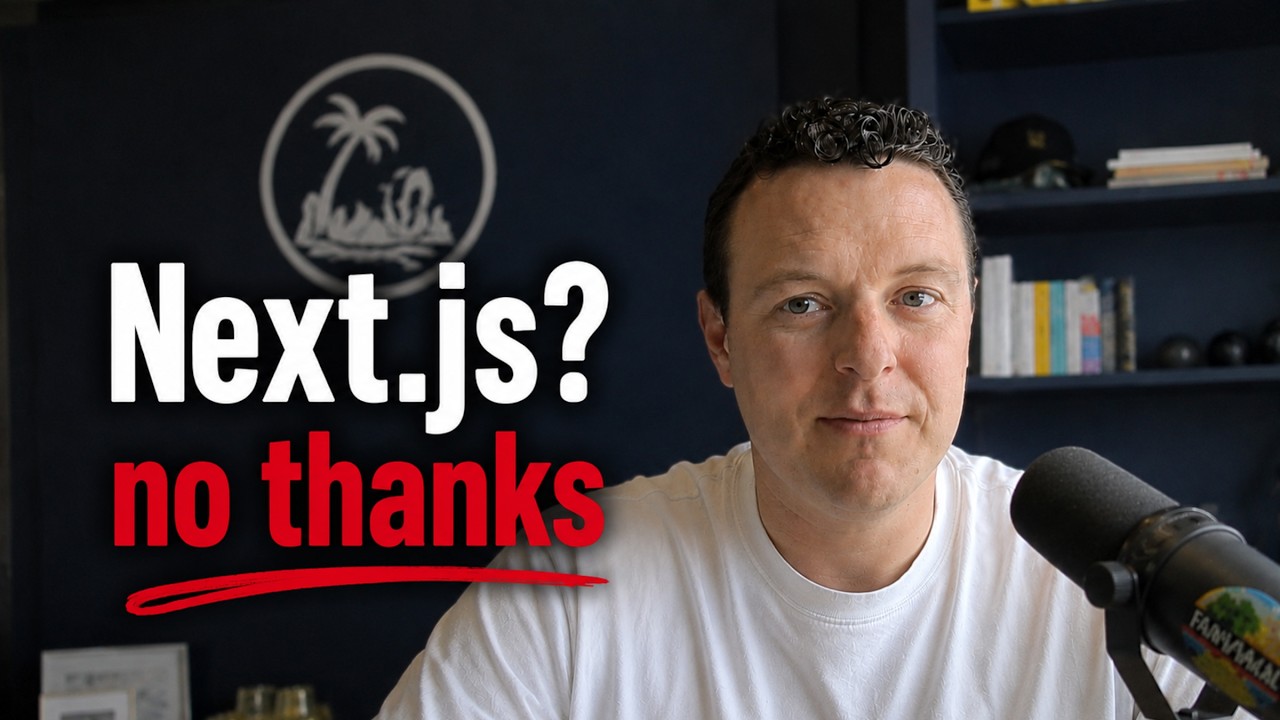
Cloudflare just slop forked Next.js…

Chapters7
Introduces historic and current rivalries in the dev world, focusing on Versell vs Cloudflare and the context for V-Next.
Cloudflare’s V-Next rebuilds Next.js on Vit, promising faster builds and smaller client bundles, but real-world value remains to be seen.
Summary
Fireship’s video dives into Cloudflare’s audacious move to re-implement Next.js on the Vit stack, dubbed V-Next, in a public rivalry with Vercel. Germo from Vercel (Verscell) and Matthew from Cloudflare put the drama on display as Cloudflare aims to liberate Next.js apps from traditional deployment targets. The host notes that Next.js’s enduring limitation isn’t the API but where you can actually run it—Vercel makes this easy, while other platforms require hacks like the Open Next approach. Cloudflare’s bold approach is to rebuild the framework from scratch on Vit, rather than patching the existing Next.js output. The team reportedly achieved basic SSR, middleware, server actions, and streaming in one day, with full client hydration by day three, then spent the week expanding tests and boosting API coverage to 94% using AI tokens totaling about $1,100. Since it’s built on Vit, V-Next leverages Rolldown, a Rust-based bundler, to deliver faster builds and smaller bundles. Verscell public commentary calls the project a “slop fork,” while Cloudflare touts performance gains in Trust Me Bro benchmarks. The host even wires up a live trial using a newsletter app (bys.dev) to show a basic migration flow with Cloudflare’s agent tool, highlighting compatibility tweaks like ES modules and JSX extensions. The verdict? switching to V-Next may not be worth it yet, but the experiment raises compelling questions about open-source trajectories, edge deployments, and how AI tooling can accelerate radical reimplementations. The video closes with a reminder that bleeding-edge software often bleeds the user, while promising to revisit the project in a few months to see real-world impact.
Key Takeaways
- V-Next is a ground-up rebuild of Next.js on the Vit stack, not a patch to the existing output.
- Cloudflare achieved SSR, middleware, server actions, and streaming within one day, with full client hydration by day three.
- Edge deployment was enabled by deploying to Cloudflare Workers, showcasing a path beyond traditional Next.js hosting.
- API coverage rose to 94% of the Next.js API after a week of testing and AI-assisted development, costing around $1,100 in AI tokens.
- Vit’s Rolldown bundler contributed to performance gains and smaller client bundles in Cloudflare’s benchmarks.
- VerscellLabel: the CTO framed the effort as a “slop fork,” signaling serious rivalry and skepticism about compatibility and downstream impact.
- A practical migration demo using the bys.dev newsletter app showed how Cloudflare’s agent tool can refactor a Next.js project for V-Next, including ES module and JSX file tweaks.
Who Is This For?
Frontend and full-stack developers curious about radical open-source reimaginings of Next.js, edge deployments, and the practicality of AI-assisted builds. Ideal for those tracking Cloudflare, Vercel, and Vit-based tooling.
Notable Quotes
"In one of my favorite niche tech rivalries, Versel versus Cloudflare."
—Sets the stage for the rivalry narrative that frames the entire video.
"the big question is, was it worth it to switch to be honest, probably not yet."
—A cautious verdict on the practicality of moving to V-Next for now.
"the crazy folks at Cloudflare got together and thought, what if instead of building on top of the output, we just entirely rebuilt the next framework from scratch on Vit."
—Describes the core approach of V-Next.
"All for about a grand total of $1,100 in AI tokens."
—Gives a concrete cost figure for the AI-assisted build effort.
"Because it’s built on Vit, it can take advantage of Vit's architecture, which includes rolldown, the Rust-based bundler for improved performance."
—Highlights the technical rationale and benefits behind the choice of Vit and Rolldown.
Questions This Video Answers
- How does Cloudflare's V-Next compare to traditional Next.js deployment in terms of edge execution?
- What is Rolldown and how does the Rust-based bundler impact Next.js-like projects built on Vit?
- Can a Next.js app truly run on Cloudflare Workers with full hydration, and what are the caveats?
- What does the Open Next approach involve, and why is Cloudflare choosing a full rewrite instead?
- Is moving to V-Next cost-effective or worth it for production apps right now?
Full Transcript
Throughout history, there have been some rivalries that have shaped our lives as developers. Rails versus Django, SQL versus NoSQL, web components versus feeling the love and embrace of a woman. And just a few days ago, we got another update in one of my favorite niche tech rivalries, Versel versus Cloudflare. If billionaires passive aggressively having a downtime measuring contest on your timeline isn't your thing, you may have missed that Germo from Verscell and Matthew from Cloudflare really don't like each other. And that rivalry got amped up even more last week when Cloudflare released V-Next, a re-implementation of the Nex.js API built on V, essentially freeing up your Next.js app to be deployed anywhere.
In this video, we'll break down how they did it, what it may mean for other open- source projects in the future, and find out if it actually works. It is March 2nd, 2026, and you're watching the code report. Love it or hate it, Next is still the most popular way to create a React app. But despite that, historically its biggest weakness has had nothing to do with its API, but rather its lack of deployment targets. If you have a next app and you want to deploy it on Versell, cool. Everything will work nice since Verscell essentially provides a bespoke runtime for things like routing, middleware, ISR, and image optimization.
But if you have a next app and you want to deploy it somewhere not on Verscell, like Cloudflare, or Netlefi, it gets a little trickier. If you've had this constraint, odds are you've used the Open Next project to get around it. The way Openext works is it takes the traditional output you get from running next build and then repackages it to run on whichever platform you'd like. And as you might imagine, this process of needing to reverse engineer and build on top of next output is fragile and prone to errors as the build output changes over time.
So the crazy folks at Cloudflare got together and thought, what if instead of building on top of the output, we just entirely rebuilt the next framework from scratch on Vit. Now this isn't a novel idea and it's not the first time it's been tried. Cloudflare themselves had even tried it in the past and failed. So what makes this time different? Well, obviously AI. It took them just one day to get basic SSR, middleware, server actions, and streaming to work. But by day three, they were able to deploy to Cloudflare workers with full client hydration. And then they spent the rest of the week fixing edge cases, expanding the test suite, and bringing API coverage up to 94% of the next API.
All for about a grand total of $1,100 in AI tokens. And because it's built on Vit, it can take advantage of Vit's architecture, which includes rolldown, the Rustbased bundler for improved performance. So what does Verscell think about all this? As you can imagine, they're not the biggest fans. The Verscell CTO tweeted about it being a quote slop fork, and Gromo himself tweeted a Cloudflare to Verscell migration guide and some critical vulnerabilities that they found in the project. Those vulnerabilities make it feel like a true Nex.js clone, but since I know you don't have any actual users, that doesn't matter.
So, let's find out if it actually works. Here's the app for our newsletter, byes.dev. It's a pretty generic next app that allows people to sign up for the newsletter and displays an archive of our past issues, which it gets from disk. We also have an endpoint that spits back HTML that we can paste into our email platform for sending. For basic apps, you could probably just install V-Next and swap out the next command for it in your package JSON and it may work. But for this one though, we'll need some refactoring to get it working with V.
Thankfully, Cloudflare also built an agent skill to make it pretty simple. Since I'm using cursor, I can install it with this command and then once it's installed, the agent can use it when it helps migrate the project to V-Next. The biggest thing to look out for is compatibility with V. For example, it'll add type module in our package JSON so that all the JS files in the project will be treated as ES modules. And it'll refactor any JS files that have JSX in them to use the JSX extension since it's required by V. And my favorite part is when it says it's done, even though half the app is still broken.
But after some follow-up begging, it did eventually figure it out. And we now have our next app running entirely on V. The big question is, was it worth it to switch to be honest, probably not yet. Always remember, when it comes to bleeding edge software, you're the one who bleeds. Beyond the slop narrative, though, I think the more interesting part is how great V is. In Cloudflare's own Trust Me Bro benchmarks, they found that production build times with V-Ex were up to 4.4 four times faster than next and the client bundle size was 57% smaller both almost entirely because of vit and rolldown and in my own I probably screwed something up so don't trust me pro benchmarks I was able to achieve 5x faster builds on the bites website with v- next build times are never something I really care to optimize so I'm not going to ship it to production but it's interesting enough that I'll check back on the project in a few months and no matter how much code agents write for you still need to understand how that code works under the hood and the best way to do that is by mastering computer science science fundamentals with Brilliant, the sponsor of today's video.
I'd highly recommend their algorithmic thinking course where you'll learn how to design algorithms from first principles to solve classic computer science problems. The best part was learning how to implement greedy optimizations which are built to make the locally optimal choice at each step in order to reach the overall global optimum. And you'll learn all these techniques by solving actual problems created by MIT professors, not just watching videos. Then scan the QR code or use the link in the description for a free 30-day trial and 20% off their premium subscription. This has been the Code Report.
Thanks for watching and I will see you in the next one.
More from Fireship








Get daily recaps from
Fireship
AI-powered summaries delivered to your inbox. Save hours every week while staying fully informed.