The Download: Claude Fable 5, new Copilot features, Microsoft Build recap & more

Chapters11
A headlining roundup of news from Microsoft Build, Anthropic, and GitHub Universe, plus a nostalgic pick-of-the-week, all introduced by the host.
Microsoft Build highlights, Claude 3.5 in Copilot, Copilot desktop and sandbox updates, and retro-computing fun with Gentoo OS—all in one brisk GitHub recap.
Summary
Christina Warren kicks off The Download with a rapid-fire Microsoft Build recap, spotlighting the Surface RTX Spark Dev Box and the surface laptop Ultra announced at Computex. She notes the Dev Box delivering up to one petaflop of AI compute and 128 GB of unified memory, enabling locally fine-tuned, large-model workflows. Windows users gain core utilities as a Microsoft-maintained package, plus a preview of an intelligent terminal with native agent integration. Cassidy from GitHub gives Copilot a desktop app upgrade, introducing canvases, bidirectional workspaces, and on-device voice conversations, while keeping sessions isolated in their own work trees. A sandboxed Copilot experience is teased to provide safe, isolated environments for tool execution. Anthropic’s Claude 3.5 lands in GitHub Copilot, touted for long-horizon autonomous coding tasks, but with a 30-day data retention window for safety classifiers. The show also teases GitHub Universe’s fall return and unveils Gentoo OS 16/32 as a playful project spotlight. Finally, there’s breaking news on Claude 3.5’s pricing implications and a Pokémon Emerald WASM project that lets you play the classic in a browser.
Key Takeaways
- Surface RTX Spark Dev Box can run up to 1 petaflop of AI compute and 128 GB unified memory, enough to handle 120B+-parameter models locally.
- Windows core utilities (75 commands like env, head, tail, touch) are now provided by a Microsoft-maintained build, improving cross-platform dev flow.
- GitHub Copilot desktop app expands to canvases, voice conversations, and synchronized work across the app and CLI, with isolated sessions per work tree.
- Claude 3.5 is available in GitHub Copilot and is optimized for long-horizon autonomous coding, with Anthropic data retention of up to 30 days for safety classifiers.
- Copilot sandboxing and local/remote sandboxes are promised to give safe, isolated environments for Copilot tool execution.
- Anthropic pricing for Claude 5 (Babel 5) is $10 per million tokens input and $50 per million tokens output, signaling high costs for day-to-day use.
- Gentoo OS 16 runs on 8086 CPUs with 192K RAM; Gentoo OS 32 runs on i386 CPUs with 4 MB RAM, showcased as retro-computing projects by Luke 8086.
Who Is This For?
Developers excited about the latest Copilot features, Windows devs eager for native core utilities, enterprise teams evaluating Claude 3.5, and retro-computing enthusiasts who enjoy edgy projects like Gentoo OS on vintage hardware.
Notable Quotes
"The core utilities is now coming to Windows, and this is a Microsoft-maintained build of core utilities."
—Highlighting Windows integration for common command-line tools.
"Canvases are bidirectional workspaces for humans and agents."
—Describes the new Copilot app feature that pairs human and agent workflows.
"Claude 3.5 is basically the version of that, but for regular people."
—Christina references Anthropic’s Claude 3.5 release for general use.
"I am AI code one flash delivers best in class quality for its size outperforming other small models."
—Summarizes Claude 3.5’s positioning among coding models.
"There were some big new features in the Copilot app release, too, including support for voice conversations."
—Notes the new voice input capability in Copilot app.
Questions This Video Answers
- How does the Surface RTX Spark Dev Box compare to other AI developer workstations in 2024?
- What exactly are Copilot canvases and how do they affect my daily workflow?
- Is Claude 3.5 safer for general use and what data retention does Anthropic require?
- When is GitHub Universe 2024 and what can attendees expect from the new 'Source' open source zone?
- How can I run retro OS projects like Gentoo OS 16 or 32 on modern hardware?
Microsoft BuildSurface RTX Spark Dev BoxWindows core utilities intelligent terminalGitHub Copilot DesktopCopilot canvasesvoice conversationssandboxed CopilotClaude 3.5Anthropic Babel 5 pricing/retention policy? (Claude 3.5) - safety classifiers review?
Full Transcript
All the news from Microsoft Build, new models from Anthropic and Microsoft, GitHub Universe news, and a pick of the week that will make you yearn for the past. [music] All that and more on this episode of The Download. [music] Welcome back to another episode of The Download. I'm your host, Christina Warren, senior developer advocate at GitHub, and this is the show where we cover the latest developer news and open source projects. Please like and subscribe. Now, there is tons of news this week, including some stuff that broke as I was recording this video. So, let's go ahead and get into it.
Microsoft Build was last week. Notice my jacket. And there were tons of announcements and updates, and I've got a link to a roundup of all the major announcements in the show notes and the description, but let's do a little bit of a recap. Microsoft showed off the Surface RTX Spark Dev Box. Now, this is a compact developer PC engineered with the NVIDIA RTX Spark superchip for local first AI developments. Its travel-friendly sibling, the Surface Laptop Ultra, was also introduced at Computex last week. So, this is like the the desktop equivalent. And look, this thing looks hot.
It puts up up to one petaflop of AI compute and 128 GB of unified memory right on your desk. And so, that's enough to run 120 billion-plus parameter models with a million token context locally at interactive [music] speeds. And you can even fine-tune models that used to demand a cloud GPU. And under the hood, it's got an NVIDIA Blackwell RTX GPU paired with an efficient NVIDIA Grace CPU, and all that is wrapped in aluminum chassis, which is cleverly engineered to double as a heat sink. And then it ships with Windows 11 Pro preconfigured for developers.
You know, dark theme is on. You've got like PowerShell 7 set as your default shell, VS Code, GitHub Copilot, Git, Python, Node. And it'll be available later this year in the United States exclusively on microsoft.com. Now, speaking of Windows, during the Build keynote, Kayla showed and even as a Mac user, I was just really blown away. One of my favorite features is the core utilities is now coming to Windows, and this is actually a Microsoft-maintained build of core utilities. So, this is 75 command line utilities like env, head, tail, touch, and these are now going to be available inside Windows.
And so, this is really great if you're used to working on a Mac or Linux system and you're annoyed that your tools don't always exist on Windows, especially you know, if you're using Windows tools where you might want to take advantage of some more powerful hardware. Kayla also showed off preview of the intelligent terminal, an open-source experimental fork of Windows Terminal, and this has native agent integration. And so, I've got a link to the GitHub repos for core utilities and the intelligent terminal in the show notes, as well as a link to a cool Windows developer script that will get you from a fresh Windows install to a fully configured dev box with just one command.
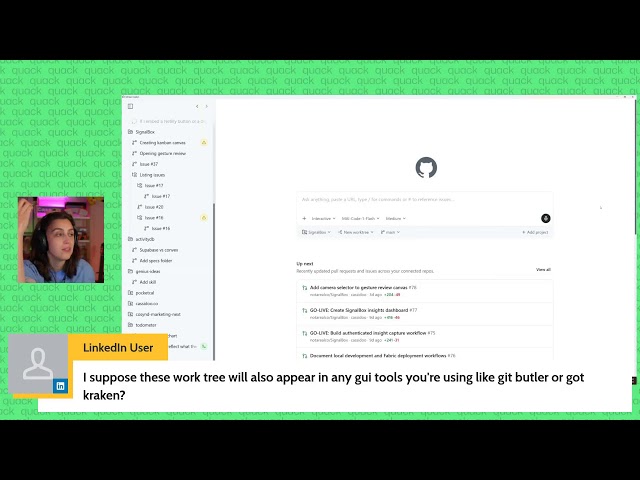
Now, GitHub was also a Microsoft build, and Cassidy, we love Cassidy, she showed off the new GitHub Copilot desktop app, and this is now an expanded technical preview, and so it's available to all existing Copilot Pro, Pro Plus, Business, and Enterprise customers. Now, if you have not had a chance to use the Copilot app yet, you definitely should because it's really, really fantastic. It's an agent-native dev experience, and it has actually become my favorite service to do work from. So, every session that you work on runs in its own isolated get work tree. So, you never have to worry about agents stepping on each other's toes, which is great.
And updates are happening all the time, um but there are some big new features that are now available in the app, including canvases. And canvases are bidirectional workspaces for work surfaces, rather, for humans and agents. And so, an agent will update the work, and you can edit, reorder, approve, or redirect it on the same surface, turning intent into inspectable work. And there are some other big features in the latest Copilot app release, too, including support for voice conversations. So, you can use the on-device speech-to-text to talk to Copilot and this is the same way that it works on the Copilot CLI and speaking of the Copilot CLI sessions that you start in the Copilot CLI will now appear in the my work view in the Copilot app.
So both services will show you the same source of truth. I love that. And there were some more announcements from Microsoft Build 2 including cloud and local sandboxes and get up Copilot. This has actually been one of my most requested features because my fear always when I do a lot of agentic work on my machines is that I'm giving it access to do things that maybe it will delete or or do stuff that I don't want it to do. And so a sandboxed Copilot experience will basically provide isolated environments for Copilot's tool execution locally as well as fully isolated sandboxes hosted by GitHub and and more details about that are in the show notes.
Microsoft AI also announced a slew of new models including I am AI code one flash which is now available inside GitHub Copilot and this is Microsoft's latest small tier coding model and it's the first of a new wave of purpose-built coding models from Microsoft designed and tuned specifically for GitHub Copilot. I am AI code one flash delivers best in class quality for its size outperforming other small models and it's been rolling out to GitHub Copilot first in VS code to Copilot free student pro pro plus and max plans. Moving on from Microsoft Build GitHub Universe will be back in the fall October 28th and 29th at the Fort Mason Center in San Francisco and we're cooking up some new stuff for this year including new lightweight talks with a time for built-in for Q&A and a bigger open source zone which we're just going to be calling the source.
And until July 9th if you register early you can get a pass at our super early bird discount which are best prices of the year. I'm biased but GitHub Universe is always my favorite event of the entire year and we can't wait to see you there. Now it's time to talk about our GitHub project spotlight where we highlight a project on GitHub. And this week I want to talk about Gentoo OS 16 and Gentoo OS 32. And these are two projects from the same developer, who Luke 8086, and it's basically just a hobby operating system for older computers.
And gentle OS 16 runs on vintage 16-bit PCs, so it only requires an 8086 CPU and then 192K of RAM and a CGA 320 by 200 display. And you can see some photos that Luke put on the repo of the OS running on an old Tandy 1100 FD, and that thing only had a whopping 640K of RAM. But, if you have access to more powerful hardware, Luke also created gentle OS 32, which, like the name suggests, is 32-bit, but it only requires an i386 CPU, 4 megs of RAM, and a VGA-capable display of 640 by 480.
And Luke got this running on a bunch of different machines, too, as you can see from these photos. Now, I do not have any hardware that is old enough to run on these OSes, but I'm super tempted to go to Goodwill this weekend and try to seek out something because I'm totally gagged by how cool this project is. And now some news that broke literally as I was recording this episode. Anthropic has released Claude 3.5, which is a mythos-class model that they claim they've made safe for general use. And mythos, if you're not familiar, is what Anthropic is deeming a tier above the opus-class of models.
Now, the first mythos model was Claude mythos preview, and it was only released to certain companies and researchers as part of their defensive security work, basically so they could use the model and then address potential security issues. And Claude 3.5 is basically the version of that, but for regular people, and then Anthropic said they made some adjustments on the safety end. And Claude 3.5 is designed for long-horizon autonomous coding and knowledge work tasks. At GitHub, in our internal benchmarks on autonomous coding workflows, 3.5 completed equivalent work with fewer tool calls and lower token consumption than previous opus-tier models.
It is now available in GitHub Copilot, but there are a couple of things that you want to keep in mind. Unlike other Claude models in GitHub Copilot, Claude 3.5 requires data retention to operate Anthropic safety classifiers, and so Anthropic will retain prompts and outputs for up to 30 days to operate safety classifiers that detect harmful or abusive use. And then after 30 days, they delete the prompts and the outputs. Retained data is not used to train Anthropic's models, but we just want to point this out. And look, I'm not going to lie to you. The API pricing on Babel 5 is expensive.
It costs twice as much as Opus 4.8, which was already expensive, and so that means it is $10 per million token input and $50 per million token output. So again, this is not a model that you're going to want to use for day-to-day tasks, but for you know, specific workflows, long long-running, [music] you know, stuff, or if you're really, really rich. Our early testing is really positive, so let me know what you think of it in and and the pricing that that Anthropic has set in the comments down below. And this week, I want to give a shoutout to GitHub user Triple Lions for creating a Pokémon Emerald WASM or WebAssembly.
They recompiled the original Pokémon Emerald decompilation, which came out a few years ago, to WebAssembly and then put a browser front end for running a Pokémon Emerald on the web. So if you go to pokemerald.com, you can play Pokémon Emerald in your browser. Now look, is this sanctioned by Nintendo? Almost certainly not. Is it a fun way to relive our childhoods anyway? Absolutely. If you liked this episode, let us know in the comments down below and give us your thoughts on Microsoft Build, the new Claude model, retrocomputing, or Pokémon. And if you liked this episode, give us a like to help out the algorithm.
It really does actually help us out, and stay tuned to GitHub for all your nerd needs. See you next time.
More from GitHub




Get daily recaps from
GitHub
AI-powered summaries delivered to your inbox. Save hours every week while staying fully informed.