
OpenAI's GPT 5.5 Instant: The Good, The Bad And The Insane
The video reviews the real world impact of instant AI models, highlighting their strong performance, safety measures, and practical limits, with a focus on benchmarks and security implications. It emphasizes that instant models are powerful tools for urgent tasks and experimentation, while also noting ongoing challenges in safety and robustness.
DeepSeek V4 AI Beats Billion Dollar Systems…For Free
The video dives into the DeepSeek 4 release, highlighting its unprecedented context window and novel compression techniques that enable powerful open AI capabilities at low cost, while also noting current limitations and caveats.
NVIDIA's New AI Turns One Photo Into A World That Never Breaks
The video explains how recent AI systems turn a single image into explorable 3D worlds, highlights the challenges of maintaining long-term consistency, and discusses a per-frame 3D memory approach that improves stability. It also covers limitations, ablation findings, and the potential and implications of these methods for free access to advanced tools.

Sakana AI’s Survival Simulator Is Brilliant
The video showcases a playful yet insightful digital experiment where AI species compete, adapt, and sometimes cooperate, illustrating how environment and policy shape outcomes in artificial ecosystems and real markets.

Solved: The Bug That Haunted AI Video For Years
The video analyzes how AI generated motion still struggles despite photorealism, showing that simply increasing compute or data isn’t enough and that smarter techniques like learning from positive/negative samples and memory-efficient probing can greatly improve motion. It also highlights a provocative approach to separate real signals from noise using compression and optical flow masking, with a takeaway about seeking truth with limited, high-quality information.
DeepMind’s New AI: A Gift To Humanity
The video highlights Google DeepMind's Gemma 4 as a free, open, and efficient family of models that run locally and offline, with strong capabilities and a permissive Apache 2.0 license, plus four surprising design choices that enable high performance with modest hardware. It also discusses practical implications, limitations, and user experiences in real-world use.
Anthropic’s New AI Solves Problems…By Cheating
The video critiques Anthropic's Mythos paper by examining claimed autonomous flaw discovery and benchmark performance, while balancing hype with a cautious, safety‑minded analysis of how such AI systems behave in practice.
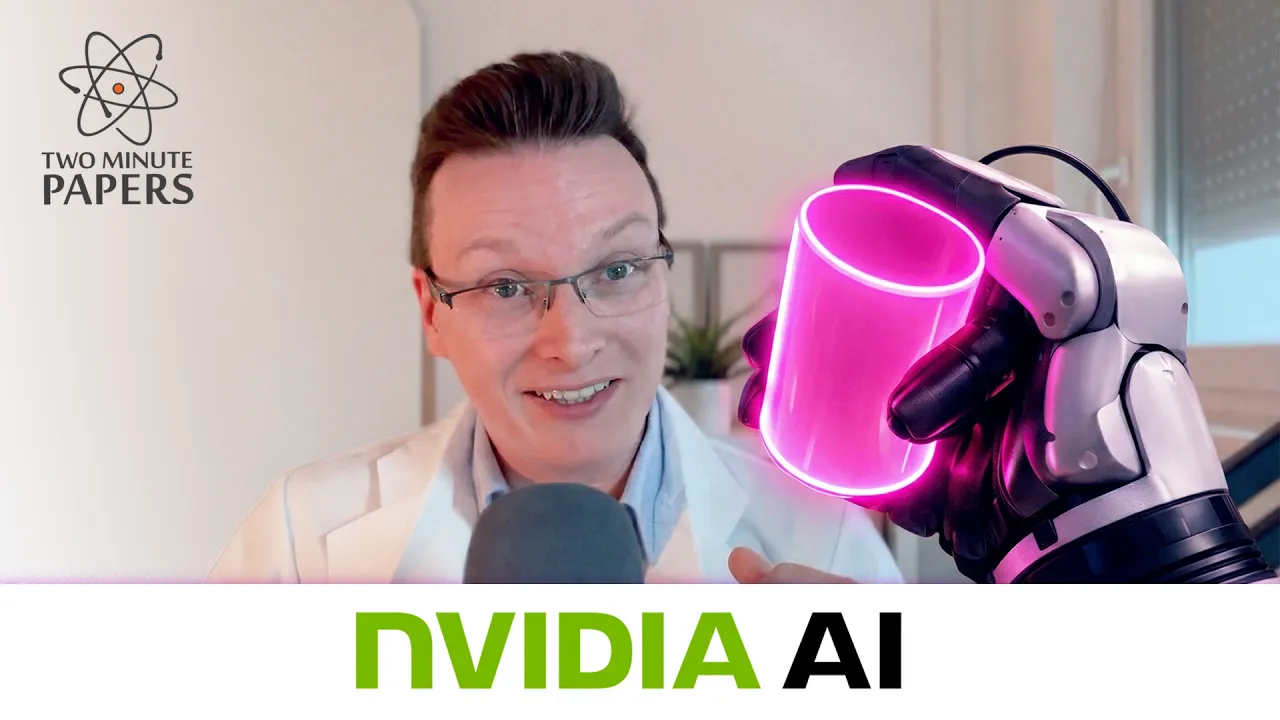
NVIDIA’s New AI Can Predict The Future
The video explains how simulation-only approaches fail to transfer to the real world and highlights a four-part strategy, including learning from unlabeled data, handling massive datasets, using relative actions, and predicting consequences, which leads to a faster, more capable robot AI through distillation and free, accessible pre-trained models.
NVIDIA’s New AI Just Changed Everything
The video reviews a free open AI system called Nemotron 3 Super, detailing its training data, open research paper, and four key speedup techniques that rival closed models in many tasks while remaining faster and more transparent. It also discusses limitations, memory innovations, and the potential industry impact of open AI systems.


Get daily AI recaps from
Two Minute Papers in your inbox
Get AI-powered summaries delivered to your inbox. Save hours every week while staying fully informed.