LG's Cancelled Rollable Phone is BROKEN

Chapters4
A look at the LG Rollable as a historic concept, detailing its development, the intrigue around its prototype status, and how LG’s mobile division fate intersected with the device’s release and public exposure.
LG’s once-revolutionary Rollable barely edged into reality, but fragile OLED tech and durability hurdles kept rollables from going mainstream—even five years later.
Summary
Austin Evans dives into the LG Rollable, a five-year-old prototype that finally surfaced in real hardware. He recalls LG’s bold wild-form-factor era, from the Wing to the Rollable teased at CES 2021, and explains why LG ultimately shuttered its mobile division. The video contrasts the Rollable with contemporaries like the Galaxy Z Fold and Motorola Razr, highlighting the Rollable’s unique ability to resize the display mid-use. Evans tests the device’s mechanics, notes a disturbing left-edge scratch, and points out the constant tension between an exciting concept and long-term durability. He also draws a parallel to Motorola’s Razr reboot and the Rizr concept, suggesting rollables hinge on breakthroughs in flexible display tech rather than just hinge engineering. While acknowledging the Rollable’s engineering charm, he argues that durable, scalable flexible OLEDs are still the missing piece preventing mass adoption. The piece closes on a wistful note: this prototype lives on as a landmark “what could have been,” hinting that rollables may someday arrive—just not from LG this generation.
Key Takeaways
- LG's Rollable is a real, working prototype from 2021 that expands a single display instead of folding it.
- The device used a Snapdragon 888, 12 GB RAM, and 256 GB storage, showing solid mid/high-end specs for its time.
- Physical durability concerns are the key obstacle for rollables: a visible edge scratch appeared quickly, and the display remains exposed when closed.
- Rollables promise variable screen sizes (in-between open/closed states), but the engineering challenge lies in flexible OLED longevity and debris resilience.
- LG’s mobile division losses (>$4B) undercut any potential rescue by the Rollable, which likely wouldn’t have saved the company.
- The Rizr concept (vertical roll) is presented as a potentially more feasible path than a wide, horizontally expanding Rollable.
- Five years later, no major manufacturer has shipping rollables, mainly due to display tech gaps rather than hinge mechanics.
Who Is This For?
Tech enthusiasts and mobile hardware developers curious about why rollable phones haven’t taken off, with a focus on display durability and historical context around LG’s ambitious projects.
Notable Quotes
""This hardware, this prototype was somewhere between like six and maybe up to nine months before this actually would've shipped.""
—Evans notes the Rollable was very far along but not fully finished, hinting at the prototype status.
""the rolling mechanism underneath… you can feel the roller underneath. I don't think it's as bad as… creases, but it is very noticeable.""
—Describes the tactile imperfection and durability concerns along the roll line.
""I just can't imagine that would hold up long term… the front of the display, it is always exposed.""
—Highlights a core durability risk of a rollable: persistent exposure of the flexible display.
""This is such a cool idea and it's something that foldables straight up cannot do.""
—Emphasizes the unique value proposition of rollables—variable screen size.
""It is a phone from an alternate timeline where LG actually figured it out. I mean, they didn't, but, man, they sure came close.""
—Wraps up with a nostalgic note on what could have been for LG's Rollable.
Questions This Video Answers
- Why did LG cancel its Rollable phone and what were the main durability concerns?
- How do rollable phones differ from foldables in terms of screen protection and hinge design?
- Could Motorola Rizr have been a more viable path to a rollable-like form factor?
- What are the current barriers to commercial rollable phones, and has display technology advanced since 2021?
- Is there a future for rollable screens, or will we see only foldables in the mainstream?
LG RollableLG WingSnapdragon 888Flexible OLED durabilityFoldables vs rollablesMotorola RizrZ Fold 2/7 comparisonCES 2021 announcementsLG mobile division closureGorilla Glass-like protection for flexible displays
Full Transcript
- This is one of the coolest phones I have ever gotten my hands on. It's a concept phone shown off five years ago that never saw the light of day until now. This, my friends, is the LG Rollable. (phone humming euphorically) Come on, that's so cool. And there is quite the story behind how this phone came to be, why it ultimately failed, and how I got my hands on it. But that last one will not be spoken about in this video. Don't worry about it. For years, LG was one of the biggest competitors to Samsung.
They brought out a ton of wild form factors like the LG Wing which is actually a phone that I have a special attachment to because I hosted the launch event for LG. I mean, the Wing is an incredibly cool concept. Instead of being a folding phone, you could rotate out a secondary display from behind. It is such a cool idea. Now, the reason I bring this up is that at the very end of that launch event, they teased something else, something rollable. (soft, mysterious music) LG officially announced the Rollable at CES of 2021 saying that they hoped to release it by the end of the year.
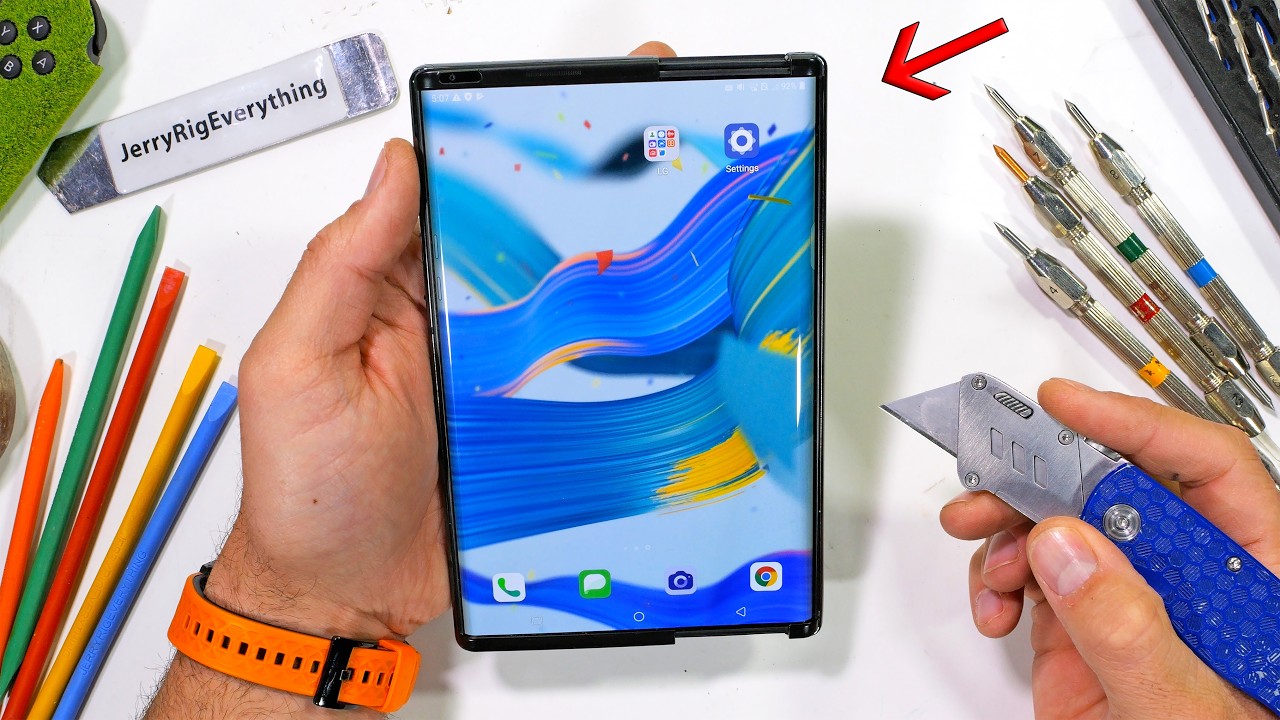
But it seems like some wires got crossed because just three months after CES, LG announced that it would permanently close its mobile division. But what, you might ask, about the Rollable? Well, as you can see, it wasn't just a concept. They manufactured real working units. There are a couple of videos out there, including an unboxing of the phone itself. But until very recently, none of these prototypes had properly made it out into the wild. And while we were in the middle of working on this video, a certain JerryRigEverything also got his hands on a Rollable and he did a full breakdown showing off the incredibly cool engineering behind it.
You should actually go check his video out. But I want do something a little bit different. What's it like to actually live with the Rollable? So let me give you a little tour of the LG Rollable. So it is a really weird phone. The more I spend time with it, the more it kind of breaks my brain. So at first glance, from the front, it looks like a fairly standard early 2020 style flagship. The main thing that does jump out from this side is just the fact that you do have the curved edges, kind of like the old school Samsung Edge phone, something like the S7 Edge.
But when you look at it on the side, you can see it's actually like fairly chunky. And on the back, that's where it looks super wacky. So the way it works is if you tap and hold the button, it expands. This hardware, this prototype was somewhere between like six and maybe up to nine months before this actually would've shipped. So clearly it was not finished by any means. But I think from a hardware perspective, this was actually fairly close short of the little final sort of tweaks that they would've done before actually shipping it. There are some very strange things they've had to do here.
So on this side, there are volume rockers. So these are haptic buttons, which is weird. I don't fully know why. Maybe they just didn't have the physical space for buttons. So that does feel a little prototype-y to me because it works, but when you push it, it just vibrates the phone. And it only works maybe like a small handful of times. When you open it up though, it's actually not wildly different than a Z Fold of the time. You can see that the Z Fold's a little bit wider, but it does give you that similar kind of feel where you're getting like, I don't know, maybe like 30% more screen real estate.
There is some kind of sensor built into the actual motor, whether it's a torque sensor or whatever, so that if you try to, say, open the screen and then squish it, yeah, it stops and rewinds and it goes, "Hey bro, don't do that." I will say that that feels really bad and I don't wanna do that that many times because it does feel like you might break it. Now, if I close it, what you'll see is if we do a little three finger on it, it will take that extra bit of screen that I no longer have on the front, and of course roll it to the back, right?
So now, if I double tap this, you'll see that this part of the screen is actually now protected. So it has actually rolled that OLED underneath an existing panel of glass. So this glass feels like it's pretty durable. I will say something, I like the little split keyboard when you open it up. That actually feels kind of similar to like if you're typing on like a Fold or something. So this has a Snapdragon 888, 12 gigs of RAM, so actually pretty good. 256 gigs of storage. Shall we open up the YouTube app? So you put them side by side, if we expand them, yeah, there's a lot more screen real estate on this guy.
I mean, you can see just how much bigger the screen is here 'cause there's all this wasted space on top and bottom. Wow, okay. - [Alex] I don't know, I feel like it could have given foldables a run for its money. - It honestly, dude, look how cool this is. And then just, like that's legitimately really cool. So after a few days with the LG Rollable, I have some thoughts. Now, would you believe me if I told you that living with a five-year-old prototype phone was more than a little bit complicated? So first things first, I was not able to get this activated on the Verizon network.
So I ended up tethering it to my Fold 7. And, yes, the irony is not lost on me that my foldable was supporting my Rollable. But I do like that sound, so it's worth it. I would just do this all day long. It is the most lovely sound ever. So here's the thing, while this is a pretty usable phone from 2021, I mean the screen is not like massively bright or anything, but most apps work. However, when you take this thing outside, it is the most reflective surface known to mankind. Now, that being said, it's a prototype, maybe they would've put a film or something on it.
But for the most part the phone works well. - [Ken] You know, you don't to have to, you don't have to get that deep. - Ooh, look at that. - [Ken] You don't have to hit it, but like it's, it- - Oh, I'm hitting it, I'm hitting it right now. I will say that the rollability of the phone itself is actually really cool. Everyone I've showed this phone to had a very similar reaction to it. "Oh my god, that's a magic folding phone, "except it's floating. "What the heck?" (production beeping) Now, on paper, going from 7.4 to 6.8 inches doesn't sound like much.
I wouldn't know. But in practice, (laughing). Now on paper going from 7.4 to 6.8 inches doesn't sound like a big difference. I wouldn't know (laughing). But in practice, when you open it up, you are looking at roughly three quarters of the size of the Z Fold 7's inner display. And the aspect ratio when it's expanded, it's close to 16 by 9, which means the video really fills the screen nicely. It looks especially good when you're watching high quality Austin Evans productions. I haven't made one of those a long time though, sorry. And I think that this is the real selling point around the concept of a Rollable.
With a foldable, the display is locked into two states, closed and open. That is it. A Rollable can theoretically stop anywhere in between. You can have a phone that's exactly the size you need for whatever you're doing. It is such a cool idea and it's something that foldables straight up cannot do. But here's the thing, within an hour of using this phone, before I'd even finished setting it up, I found a scratch on the left edge of the display. So the thing is, that is not only just like a physical thing that you can feel, but more importantly, especially in person, you can really clearly tell that it is like a small chunk of white pixels.
I really don't understand how it happened. All I did was put the phone in and out of my pocket maybe a couple times to show people the mechanism and that's it. The scratch is now permanent all the way down to the OLED. Now, this is a huge problem. A foldable display is fragile too, but when you close the Fold, that soft display is inside, protected by the actual phone chassis itself. On the Rollable, the front of the display, it is always exposed. It's just there. I honestly can't imagine how you would ever put a screen protector on this.
I mean, even if LG applied one themselves at the factory, the idea that that screen has to be able to be flexible underneath this little bezel and roll all the way to the back, I just can't imagine that would hold up long term. That's not the only display issue either. It doesn't have a crease, which is great, but there is a noticeable patch on the right side where you can feel the roller mechanism underneath. I don't think it's as bad as like one of those early creases in foldable phones, but it is very noticeable. I mean, it just, it's like, bump, bump, bump, bump.
I'll get you with my solar death ray. - [Ken] No, that's not gonna help. That's, that doesn't show. Oh, actually it kind of does. - See? My solar death ray shows you exactly where the lump is. You know, all this really reminds me a lot of when Motorola rebooted the Razr back in 2019. The launch was exciting, although it was a complete mess in person. But the big catch was that it was a very, very first generation kind of product. There was this big gap under the display when it folded. It was like a little teardrop thing, and the performance was very mid range for how expensive that phone was, even for 2019 standards.
And here's the thing, look at where the Razr is now. We're five, six generations later and the Razr works great. The tech has gotten refined, especially when it comes to the hinge and the ultra thin glass. And while it did take time, foldables are having a real mainstream moment right now. But I'm not entirely sure it's an accident that no one has shipped a Rollable since LG tried back in 2021. So in 2023, Ken and I got hands on of one of the other rollable concepts that were around at the time, the Motorola Rizr, not to be confused with the Razr, that's the one that goes like this.
The Rizr is the one that goes like this. Sorry, sorry. (production beep) Now, I kind of think that that might be a little bit more of a feasible form factor because instead of going wider, the Rizr extends vertically. It's a small phone that becomes a tall phone. Now, that extra display rolls around to become a back screen when it's retracted, very similar to the Rollable. And I think that's a very interesting comparison with the Z Flip or the Razr. It's a full-sized phone that shrinks down. So here's the question I keep coming back to. Even if LG had shipped this, would it have even mattered?
Honestly, maybe, but definitely not for LG. By the time they wound things down, LG Mobile were over $4 billion in losses. It is hard to argue your way out of 23 straight quarters of losses. Now, the last few days of LG were chaotic. They tried to sell the mobile division to Volkswagen as well as a Vietnamese conglomerate, and both deals fell through. As cool as it is, the Rollable was never going to fix that. But I think the thing that really frustrates me is that the people who built this thing were so, so clearly trying to make it work.
I mean, you look at that last stretch from LG and the hardware team were on a genuinely incredible run. The Velvet was a beautiful phone. The Wing was one of the most creative devices anyone has ever shipped, even to this day. And the Rollable? I mean, this thing was almost ready to at least be that first generation of a brand new form factor. But here's the real issue. Any flexible OLED screen has serious durability issues. For a rollable to actually work, you need a flexible screen that can handle being exposed to like pocket lint and all kinds of random debris.
It needs to be able to open and close tens if not hundreds of thousands of times. And it also needs to resist scratches at something close to the level that the Gorilla Glass on a normal smartphone will give you. Now, we're not even close to that today, much less in 2021. I think this is the real answer to why nobody has shipped a rollable phone yet. It's not the motors or the mechanism or the software, it's the display tech that just hasn't caught up to what the rolly boy life needs. I'm incredibly happy I was able to get my hands on the Rollable.
It is a genuine piece of history. And, yeah, it probably wouldn't have saved LG, but it might, just might have proven that rollable phones could actually work. Eventually. Now, this phone was never supposed to leave the building, and yet here it is five years later, mostly functional. It's a phone from an alternate timeline where LG actually figured it out. I mean, they didn't, but, man, they sure came close. (upbeat music)
More from Austin Evans


Get daily recaps from
Austin Evans
AI-powered summaries delivered to your inbox. Save hours every week while staying fully informed.