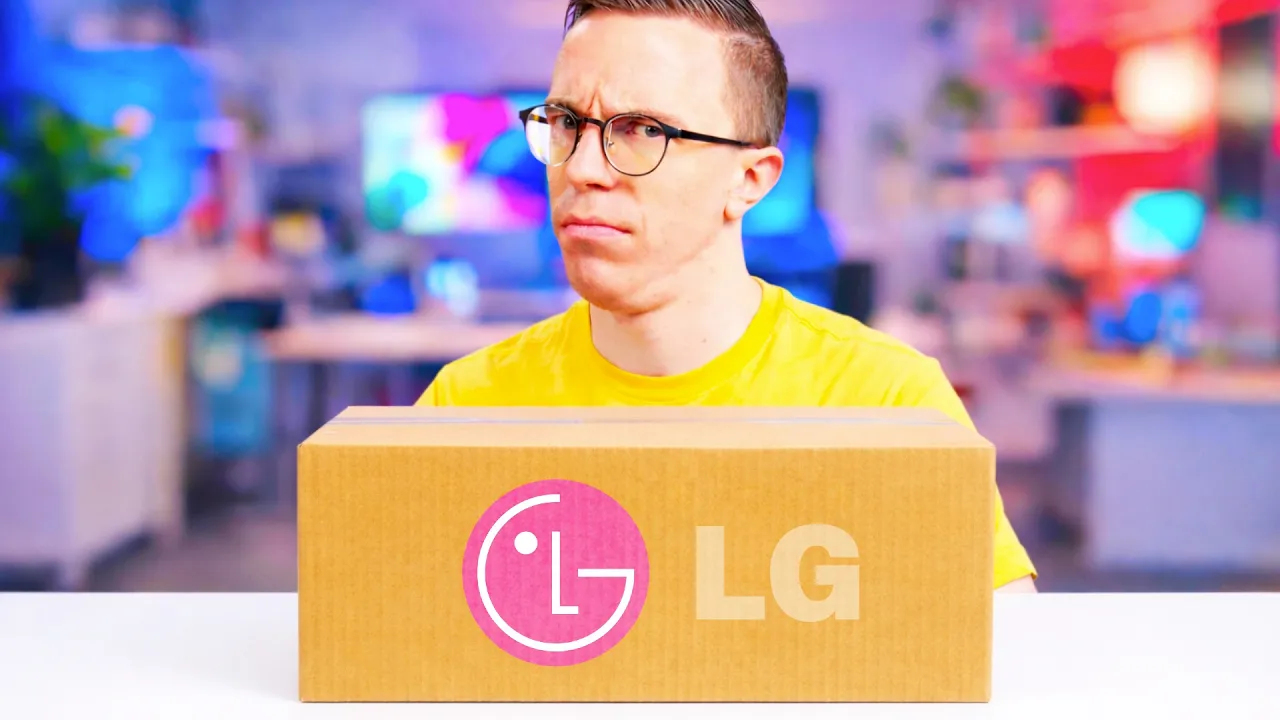
I'm not supposed to have this...

Chapters7
Introduces the LG Rollable and explains its scroll-like display and the device's unique, unreleased status.
JerryRigEverything reviews LG’s unreleased Rollable, marveling at its dual-motor extension, rugged build, and the bittersweet vision of a phone that never made it to market.
Summary
JerryRigEverything presents a rare, hands-on look at LG’s unreleased Rollable smartphone. He highlights the device’s bold concept: a display that slides out to nearly tablet size, extending from 5.5 inches to about 7.5 inches and even rivaling an iPad mini in footprint. The review walks through the hardware, including dual geared motors and a 4,500 mAh battery, and details the clever rear-glass design where the screen retracts underneath the back while staying functional. He notes the soft front screen material, the zipper-like edge guides, and the dust-shedding bristles beneath the back glass. The teardown reveals a meticulously engineered mechanism: three spring-loaded arms, a motor rack, and screws that hold the entire assembly together. LG’s forward-thinking approach is tempered by the harsh reality that the company shut down its mobile division, making this “most innovative phone ever made” feel almost mythical. Jerry also shares small observations like live backgrounds that scale with the extension and the device’s surprisingly robust ability to move heavy objects when extended. The video mixes reverence with a dash of humor as he dismantles and reassembles the device, underscoring both the triumph and the tragedy of a phone that could have reshaped mobile design. He closes with a plug for Dbrand’s Touch Grass skins, a tongue-in-cheek nod to the outside world after an “autopsy” of a phone that remains officially unfathomable in 2026 terms.
Key Takeaways
- LG planned to release the Rollable in 2021, but LG Electronics’ mobile division was shuttered before it could hit shelves.
- The rollable uses dual geared motors connected to a straight gear rack, enabling simultaneous extension and retraction of the flexible display.
- The display extends from 5.5 inches to roughly 7.5 inches, and the phone’s depth remains compact thanks to the back-rolled screen under a rear glass panel.
- Internal design includes three spring-loaded arms and metal guides that keep the screen tight against the back as it extends, plus a zipper-like edge for stability.
- Battery capacity is 4,500 mAh, with the main camera system listed as a 64 MP main sensor with OIS and a 12 MP ultrawide.
- LG fortified the device with a robust build that could push objects on a desk during testing, illustrating its mechanical strength.
- The device’s exterior includes a rear fingerprint sensor, USB-C port, and visible screws, signaling a deliberately serviceable design for a phone that never reached mass production.
Who Is This For?
Essential viewing for tech enthusiasts and hardware hackers curious about radical form factors, especially fans of LG’s experimental devices and teardown aficionados seeking deep, concrete mechanical details.
Notable Quotes
"There is a fine line between graverobing and forensic archaeology, and it feels kind of illegal to hold this, but I'll do my best to keep it functional throughout the review, but no promises."
— JerryRigEverything frames the rarity and risk of handling an unreleased prototype.
"LG’s Rollable slides open, the internal motors are surprisingly strong."
— Highlights the mechanical power behind the rollout action.
"The internal motors of LG's Rollable are actually two motors."
— Reveals the dual-motor understanding essential to the device’s function.
"With the motor back in place and screwed in tight, I can reattach the display and the battery ribbon cables."
— Describes reassembly steps that imply a thoughtful teardown process.
"LG was so far ahead of its time, and we definitely didn't appreciate what we had until they were gone."
— A reflective closing note on LG’s innovation and the subsequent company fate.
Questions This Video Answers
- How did LG's Rollable's dual-motor system work compared to current foldables?
- Why did LG cancel its mobile division and what happened to the Rollable prototype?
- What are the mechanical components inside LG's Rollable and how do they extend the display?
- How does the rear glass design protect a rollable screen while remaining functional?
- Could a modern phone recreate LG's Rollable concept with today's tech?
LG RollableLG Rollable teardowndual motor mechanismfoldable vs rollable phonesAndroid hardware teardownmobile design history64MP cameraOISrear glass designDbrand Touch Grass
Full Transcript
Today in front of us, we have an unreleased smartphone that you were never supposed to see. It's called the LG Rollable. Like an Egyptian Scroll, it rolls out an extended display in what's arguably the most uniquely operating smartphone of all time. Alas, LG did indeed pass away before releasing this phone to the world, but I managed to snag one from out of their grave. There is a fine line between graverobing and forensic archaeology, and it feels kind of illegal to hold this, but I'll do my best to keep it functional throughout the review, but no promises.
It is interesting that the phone plays music to hide the opening hum of its internal motors. And when it's opening, you can see some of the internal linkages at the edge of the display. They look kind of like a zipper. And it's going to be fascinating opening this guy up to see how it works from the inside. Also, when the LG rollable slides open, the internal motors are surprisingly strong. LG said the opening process was good for about 200,000 extensions. And if I happen to squeeze it during the opening process to restrict its movement, it'll pause and ask me nicely not to do that anymore.
There is a minor pinch point on the backside when the sections come back together, but it's not large enough to nip at my fingers. So, I'm not too worried about it. And I'm not going to lie, if I had to choose between the folding phone and a rollable phone, I would probably choose the rollable cuz look how cleanly it expands my video to go full screen. And going from a 5 and 1/2 inch diagonal video to nearly a 7 and 1/2 inch diagonal screen, it's a grower. And it ends up being almost the same size as an iPad mini, which is 8.3 in.
No folding, no unfolding, just a simple stroke of the finger and it instantly gets larger. Insane. Seeing how cool this is makes me all the more sad that we lost LG f in chat for our friends. Nobody will ever be able to touch a phone as cool as this except for me. One misconception that I had about LG's rollable phone was that it was going to have the soft exterior plastic screen on both sides of the device. And I was right about the soft screen, at least the part about it being on the front. LG is using the same fingernail scratchable most two-level plastic as Samsung does on their folding phones.
But that soft screen does not in fact end up being exposed on the back side of the device. LG cleverly designed the phone so that the screen rolls under a rear glass panel, yet while remaining fully functional, kind of like LG's transparent TVs that we see at CES every year. Here on the back, we can see your calendar, a few widgets, and even open up the rear cameras for selfies. Then, when we go to unroll the rollable, it brings the flexible screen back out to the front as it extends into tablet mode. LG had plans to release this phone back in 2021 before they decided to close their smartphone division.
And it just goes to show how far ahead of their time they were since this phone from 5 years ago feels more futuristic than what Samsung and Apple both dropped this year. The internal motors of LG's Rollable are strong enough to push my metal channel locks across the desk, and it can even propel two of my textbooks stacked on top of each other. It is an extremely strong phone. LG included a few live backgrounds that expand out with each of the unrollings. And for the most part, it feels like a very finished device, ready for public release, which makes the cancelling of the phone all the more depressing.
On the back, we have our two cameras, a 64 megapixel camera and a 12 megapixel ultrawide, right above a rear fingerprint scanning power button. And lucky for us, I can see some screw holes in there underneath the transparent back glass panel, which will probably make the tear down slightly easier. There's a USBC charging port in the bottom left and an externally visible screw on the bottom right. There is a curved edge for the screen and then another screw up top that holds the area where the flexible screen starts to retract. This is going to be the first screw I take out.
There are some capacitive volume buttons along the left side. I'm not the biggest fan of those, but who am I complaining to? LG Mobile isn't around to listen. It's time to open it up and see how the rollable works from the inside. Nobody has ever done this before, so let's hope I don't ruin the only rollable smartphone in existence. I'll pop off the two Phillips head screws, one on either side of the roller, and then I'll warm up the back glass with some hot air. The goal here is to try to remove it from the phone in one piece, but glass is glass, though, and we know how that sometimes ends up.
With the glass completely removed successfully, might I add, the whole side of the rollable pops off, revealing that just inside the metal covering is a long thin line of bristles, which I assume helps keep dust and debris from getting inside the rear portion of the screen. Getting dust inside the back would not be easy to clean out. And of course, it's obviously not water resistant in the slightest. With the glass and the complete right side of the phone removed, I'll try to retract the display. Oh, shoot. Which then completely releases the flexible screen from its constraints.
It's cool seeing how the software turns on and off that far portion of the screen depending on how extended the hardware is. We also notice how tight that radius is for the curve. Obviously, a folding phone would have an even tighter crease in the center. So, LG is still playing it pretty safe curve-wise, or was playing it safe, I guess. I miss them so much. The screen has its zipper-like supports in both the top and the bottom edges and two metal guides along the side, which help keep the screen tight against the back of the phone.
This knowledge will come in handy when it's time to reassemble the phone later, assuming it lives that long. With the rollable screen fully extended, it reveals several more Phillips head screw locations on the movable back half of the panel. I'll remove these nine visible screws and then we can use even more heat and my pry tool to pop off the glass around the camera lenses and fingerprint scanning power button. This is the main 54 megapixel camera that does have optical image stabilization. And the 12 megapixel ultrawide does not have OIS, which is normal. I'll remove seven more screws back in here and then make my way up to the super tiny front-facing 3 megapixel selfie camera and pop off the upper and lower bezels.
This is what allows the whole flexible display to lift up and away from the phone body. I'm so nervous right now I'm actually shaking. Flexible screens are incredibly fragile. So removing it successfully from one of the most rare and exclusive phones on the planet definitely deserves a thumbs up. And there it is. The internals of the unrivaled LG Rollable. The flexible screen has supportive slats on the back like an escalator. And if I hold it just right, we can still swipe on the screen while it's removed to activate the opening mechanism. And that is amazing.
It looks like the big motor itself is up near the top. We'll take a closer look at that in a second. But there are three spring-loaded mechanical arms below that motor which help the whole panel extend linearly uniformly. Absolutely fascinating. LG was so far ahead of its time, and we definitely didn't appreciate what we had until they were gone. I'll be turning the phone off for this next part. Now that he's safely asleep, we can disconnect the battery and pop off the screen ribbons just like little Legos. The engineering that went into this thing is wild.
There's still no dogs allowed on the battery, which is good to know. It's got 4,500 mAh, and the motor itself is held in place with six silver screws. With the screws gone and the motor rack detached from the frame rail, you can see how spring-loaded the lower arms are. They want to retract or constrict and add resistance to the extension as it gets opened. I'll pull away the loudspeaker which is screwed in with the main motor. It does have balls inside. And then moment of truth, the motor of the LG Rollable is actually two motors.
We'll get to them more in a second. These springy arms are just so fun. Anyway, the dual geared motors on the rollable are attached to a pretty standard straight to gear rack. Roll it out to extend the screen and roll it back in to retract the screen. Two motors with two gears explains how I was able to move whole textbooks across my desk while opening. LG overengineered this rollable phone to be extremely beefy, and it's been super cool to see how it's assembled. Probably the most innovative phone ever made, but the world back in 2021 was just not ready to receive it.
and I would feel more than just a little guilty if it didn't work anymore because I took it apart. So, cross your fingers. With the motor back in place and screwed in tight, I can reattach the display and the battery ribbon cables. I'll physically collapse or retract the phone back into its closed position so I can slot in the flexible folding screen to the moving backside without damaging the edges. I'll put the screws back in under the camera glass and then take the screen back out since I forgot to screw in the nine screws underneath that back panel.
After reslotting the flexible screen for the second time, look at that. He's alive. It's always a testament to durability if a phone can survive being completely taken apart. I'm both impressed and depressed. The coolest phone on the planet is one that literally no one gets to have. And I think I need to go out and touch some grass. Literally. Thanks to Dbrand's new Touch Grass skins, I can take grass with me wherever I go. And you might be like, "Hey, Jerry, that's not real grass." As if you would know. But this time, you're actually kind of slightly right.
Dbrand has taken polyethylene strands thinner than a human hair, dyed them a variety of green to mimic the actual appearance of grass, and then leveraged the art of electrostatic flocking to stick them to a sheet of vinyl. I've calculated that there's about 600,000s of these real strands of fake grass on every single smartphone. But when you factor in all the devices that Dbrand's grass needs to cover, we're looking at billions and billions of strands of real fake grass. Is electrostatically flocking billion strands of fake grass as cool as a rollable smartphone? All I know is that only one of these companies is still around to sell their products.
So, I guess that answers that question. Dbrand also has their flat earth Rubik's cubes. And speaking of Earth, while supplies last, every Touchgrass order is going to include one of these new blue sky skins complete with 3D printed clouds. It's as close as you can get to going outside without actually going outside. And I imagine they're going to sell out again real quick. So get yours at dbrand.com/touchgrass. I'm glad you joined me on our autopsy today. Definitely subscribe for more and thanks a ton for watching. I'll see you
More from JerryRigEverything

Get daily recaps from
JerryRigEverything
AI-powered summaries delivered to your inbox. Save hours every week while staying fully informed.