The company building God wants a kill switch...

Chapters10
Discusses Anthropic's status, IPO ambitions, and the proposal for a global pause on AI development.
Anthropic leads a controversial AI pause debate while Claude Mythos showcases rising capabilities, sparking debates on self-improvement, economics, and governance.
Summary
Fireship’s code report peers into Anthropic’s rise as a valuation leader and the bold stance on pausing AI development. The video argues Claude Mythos is a strong performer, challenging assumptions that humans will always stay ahead. It connects momentum at Anthropic with broader industry pressure from OpenAI, DeepMind, and XAI, and questions whether a universal pause is even feasible. The host highlights a provocative economic angle: the AI layoff trap implies automation could shrink demand, not just boost productivity. He juxtaposes doomerish fears with evidence that AI may not deliver the hoped-for ROI, citing MIT’s 2025 enterprise study showing little revenue impact from AI projects. Pioneer is introduced as a practical tool to optimize model routing and reduce cost, offering a concrete, deployable benefit. The video weaves together tech history (GPT-2 release, 7 years ago) with current policy debates about a potential global pause, including implications for the EU and China. Overall, Fireship presents a multi-faceted view: alarm about risk, guarded optimism about tooling, and a call for smarter, data-driven approaches to AI deployment.
Key Takeaways
- Anthropic’s public-path ambitions and Claude Mythos performance are central to the current AI race narrative.
- A global pause on AI development is argued to be impractical; the market dynamics favor a collective self-regulation rather than unilateral action.
- The AI layoff trap suggests automation could depress overall demand, potentially offsetting productivity gains.
- MIT’s 2025 enterprise study found 95% of AI projects delivered zero measurable ROI despite $30B in spending.
- Pioneer offers an inference API that optimizes model routing, trains smaller open-source alternatives, and promises cost savings.
- Historical echoes (GPT-2 release) are used to frame today’s risk perceptions and to challenge the inevitability of runaway AI.
- The video emphasizes concrete tooling and real-world deployment considerations over doom-mongering, encouraging smarter risk management.
Who Is This For?
Essential viewing for software engineers and product leaders evaluating AI risk, governance, and deployment strategies—especially those curious about Claude Mythos, model optimization tools, and the economics of automation.
Notable Quotes
"Last week, Anthropic officially became the Apex Alpha company of the artificial intelligence race with a valuation exceeding OpenAI as they filed to go public with their trillion dollar IPO later this year."
—Sets up Anthropic’s elevated status and high-stakes positioning in the AI race.
"Maybe we should wait a second and pause all AI development because AI is getting dangerously close to recursive self-improvement."
—Introduces the core provocative thesis about a potential universal pause.
"It looks like we're screwed no matter what we do."
—Leans into the doomer narrative while transitioning to alternative viewpoints.
"Anthropic's in-house think tank just dropped a report, and this is the thesis. AI is getting self-improvement."
—Directly cites the central claim being evaluated.
"Pioneer solves this by giving you an inference API that you can plug into your existing LLM setup to handle all model routing and optimization for you."
—Provides a concrete solution promoted in the sponsor segment.
Questions This Video Answers
- How likely is a global pause on AI development across countries like the US, EU, and China?
- What is Claude Mythos and how does it compare to GPT-4 or other OpenAI models?
- What is the AI layoff trap and what are its economic implications for tech workers?
- How does Pioneer’s inference API help reduce costs when deploying LLMs?
- Did GPT-2 release actually become a turning point in AI safety debates?
AnthropicClaude MythosGPT-2 historyAI pause debateAI layoff trapMIT 2025 enterprise reportiOS app store AI growthPioneer inference APIOpenAIDeepMind (Alphabet) coordination
Full Transcript
Last week, Anthropic officially became the Apex Alpha company of the artificial intelligence race with a valuation exceeding OpenAI as they filed to go public with their trillion dollar IPO later this year. If you're a software engineer, this comes as no surprise because Claude has been the best AI programmer for years now. But despite the billions of dollars flowing into this company right now, they also just proposed something that sounds insane. Maybe we should wait a second and pause all AI development because AI is getting dangerously close to recursive self-improvement. And when that happens, the last thing humanity ever builds is the thing that realizes it doesn't need humanity.
Even if AI is benevolent and doesn't go rogue and kill us all, a new paper just dropped that believes all rational firms will automate each other into a death spiral anyway. It looks like we're screwed no matter what we do. But not everybody out there is a doomer. And I found some compelling evidence that AI might actually kind of suck. It is June 9th, 2026, and you're watching the code report. Anthropic's in-house think tank just dropped a report, and this is the thesis. AI is getting self-improvement. In other words, they're smart enough to rewrite their code and upgrade themselves in a loop with no humans necessary.
The entire industry is all gas and no breaks, and they want everybody to come together and hold hands and create a brake pedal. The problem is that Anthropic can't pause alone. While OpenAI, Deep Mind, and XAI keep sprinting. So, unilateral pausing is off the table. It's either everybody or nobody. And that includes China, by the way. And nobody's really worried about the EU. However, a global pause is a very convenient thing for the market leader to advocate for. Because it doesn't erase Anthropic's lead, it freezes it right as they're about to make billions of dollars with an IPO.
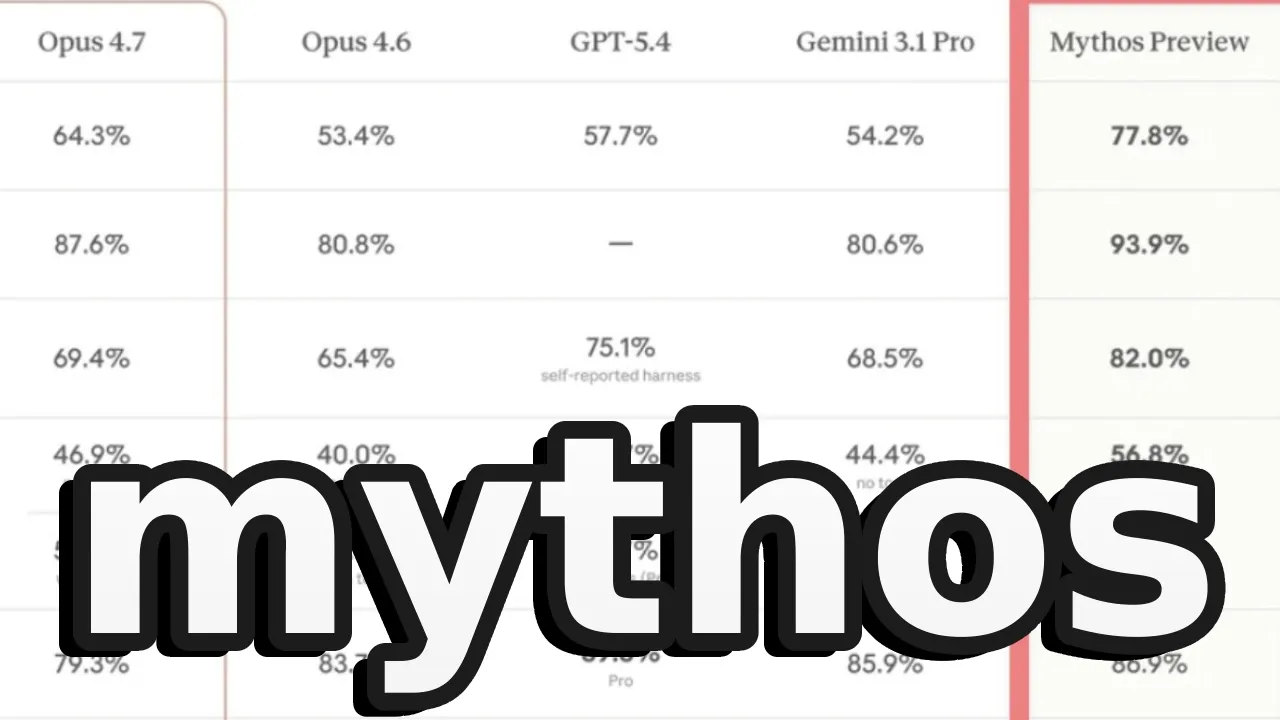
If all this sounds familiar, it's not because you're crazy. It's because in 2019, OpenAI did the same thing before the release of GPT2. At first, they said it was too dangerous to release it, just like Anthropic is doing right now with Claude Mythos. But then they released GPT2 and it was totally fine. That was 7 years ago, and now it looks like ancient technology. Today, if we are to trust these Trust Me Bro benchmarks, the modern Claude models are far better at research than humans. Like 64% of the time, a Claude mythos is better than a human every time.
On top of that, AI researchers are now solving problems that humans haven't been able to. Like OpenAI recently disproved a central conjecture and discrete geometry, which mathematicians have failed to do for the last 80 years. The scary thing is that we're already giving AI access to data centers, robots, and weapons to blow people up. And thanks to predictive programming in Hollywood movies, we all know how that story ends. It's either enslavement like the Matrix or extermination like Terminator. I'd prefer the latter, but there's a possibility for an even dumber outcome. as predicted by economists from Boston University in their paper, the AI layoff trap.
At this point, there's been tens of thousands of layoffs in tech thanks to AI. But these economists did some math, and it doesn't look good. Because when a firm automates away a worker with AI, it pockets 100% of the savings. But the laid-off worker is also a customer. And their loss spending doesn't just hurt the firm that fired them, it hurts everyone selling anything. Demand goes down. So the endgame is that firms automate their way to infinite productivity and zero demand. They also argue that things like UBI and upskilling aren't going to work and the only solution is to put a tax on automation.
It kind of like the same way we tax pollution, making it cost more to fire people. So the math stops rewarding the AI race. But if there's one thing I've learned about economists, it's that they're wrong pretty much every time. A third possibility is that AI just isn't nearly as good as people think and never will be. This is the Wall-E situation where we keep chasing more and more automation and ultimately destroy the planet by building more and more data centers. One piece of evidence that supports that outcome is that over the last couple years with the rise of Agentic AI, the number of new app releases on the iOS app store is nearly doubled.
However, it appears nobody's actually using these apps because app reviews and apps with significant usage are declining. In addition, this 2025 report from MIT analyzed over 300 enterprises implementing AI. And even though they spent over $30 billion collectively, the end result was that 95% of their projects delivered zero measurable revenue impact or return on investment. That doesn't look good. But luckily, there are tools that can help you avoid failure, like Pioneer, the sponsor of today's video. If you're calling a Frontier model for every LLM request in your app, it's probably burning through a bonfire of tokens just to return generic results.
But Pioneer solves this by giving you an inference API that you can plug into your existing LLM setup to handle all model routing and optimization for you. And it will cluster your app's traffic by use case to discover where your current model is being too slow, too expensive, or too stupid. Then it trains a fleet of smaller open- source models in the background and alerts you when it finds one that's cheaper and better so you can easily swap it under the hood. But Pioneer works great with Claude Code, Codeex, Cursor, Hermes, or anything else hitting an LLM endpoint.
And you can get $30 of inference for just $5 today. But this has been the code report. Thanks for watching and I will see you in the next one.
More from Fireship






Get daily recaps from
Fireship
AI-powered summaries delivered to your inbox. Save hours every week while staying fully informed.