Lone Survivor (Full Episode) | Animal Fight Night Compilation | Nat Geo Animals

Chapters12
A mother cheetah stalks Gazelles on the Serengeti, balancing energy costs and risk as she chases, hunts, and fights to bring down prey.
Animal Fight Night showcases raw instinct: cheetahs, kangaroos, leopards, beetles, and more battle for food, territory, and survival in vivid, high-stakes clashes.
Summary
NatGeo Animals delivers a high-octane tour of the planet’s fiercest conflicts. The episode follows a cheetah mother on the Serengeti as she weighs energy costs against a risky hunt for gazelles, and then faces a dangerous showdown with a much bigger prey animal. The action shifts to Australia’s red kangaroos, where alpha-male politics, turf defense, and brutal kickboxing-style bouts decide who earns breeding rights. Africa’s savannas bring leopard versus lioness dynamics, hyena opportunism, and leopard escapes, while a behind-the-scenes look at ants and bombardier beetles reveals warfare on a microscopic scale. Ocean floor predators like the sarcastic fringehead and a dramatic hippo duel further illustrate nature’s relentless theater. The episode also tracks treetop predators like pumas and sloths, plus nest-defense drama among Nile crocodiles and a snake-versus-mongoose gambit. Throughout, NatGeo Animals blends dramatic narration with precise anatomical and behavioral detail to explain why these battles unfold the way they do.
Key Takeaways
- Cheetah hunting costs are body-load expensive: mom’s chase can burn calories comparable to a large pepperoni pizza in about 20 seconds, shaping decisions in real time.
- Gazelle encounters illustrate size-and-skill tradeoffs: a Grant’s gazelle’s horns and bulk can overturn a cheetah ambush if the predator misreads the risk.
- Kangaroo rivalries hinge on social dominance and mating strategy: Rusty’s bid for alpha status unfolds through a brutal, no-holds-barred exchange.
- Beetle warfare demonstrates chemical and mechanical precision: bombardier beetles unleash a two-chemical spray heated to boiling, delivering rapid 500 pulses per second.
- Mother-crocodile care under pressure shows intruder dynamics: croc mothers cradle hatchlings with precise tail thrusts while fending off rivals.
- Mongoose-versus-mamba highlights rapid decision-making and resistance: the mongoose lands a decisive bite despite venom risk.
- Osprey-versus-gull piracy showcases clever ambush tactics and multi-species hunting pressure in a shared ecosystem.
Who Is This For?
Essential viewing for wildlife enthusiasts and natural-history lovers who want fast, fact-packed battle narratives with concrete animal facts and species-specific behaviors.
Notable Quotes
"A female cheetah is on the lookout for the next family meal on the Serengeti."
—Sets up the opening perils and energy considerations of a typical cheetah hunt.
"Zero to 60 miles per hour in three seconds."
—Illustrates the cheetah’s explosive acceleration and the stakes of a single chase.
"The gazelle’s spear-like horn skews her torso."
—A dramatic moment showing why prey can turn lethal in a heartbeat.
"Rusty is a 6-year-old battle-hardened bruiser."
—Introduces the kangaroo fighter and sets stage for mob dynamics.
"A master class in big cat survival moves."
—Describes the leopard’s dramatic stand against multiple lionesses.
Questions This Video Answers
- How do cheetahs balance appetite with energy expenditure during hunts on the Serengeti?
- What tactics do kangaroos use to become alpha in their mobs?
- What makes bombardier beetles’ spray so effective against ants?
- How do Nile crocodiles defend nests from intruders while caring for their babies?
NatGeoAnimalsCheetahGazelleKangarooLeopardLionsBombardierBeetleAntsNileCrocodileFringeheadPugnacity','Mongoose','BlackGullPiracy','Osprey
Full Transcript
All over the world, species clash in nature's savage battle of survival. (growling) In tropical forests, under blue seas, and on the open plains, all are locked in deadly conflict. Animals fight tooth and claw to win food, territory and rights to the bloodline. From the plains of Australia, to the wilds of Africa, there are no rules. This is Animal Fight Night. (barks) A female cheetah is on the lookout for the next family meal on the Serengeti. ♪ ♪ The plains are packed with all manner of prey, and she has a taste for gazelle. But she has to consider her chances.
In a single chase, mom will burn as many calories as there are in a large pepperoni pizza in as little as 20 seconds. If she can't catch the gazelle, that's wasted energy. If she can catch it, she still has to bring it down and risk serious injury. She spots a Thomson's gazelle. The chase is on. And the cheetah becomes a mammal missile. Zero to 60 miles per hour in three seconds. Faster acceleration than a Mustang GT. At top speed, she's clearing 26 feet per stride and 91 feet a second. Suddenly, mom sees a much bigger Grant's gazelle and takes a gamble.
She just needs to pull it down and nail the killer bite. But this gazelle bucks the rules of cheetah fight club. It's not coming quietly. The gazelle is more than twice her weight. So the cubs try to help. They can't let the prize escape. (squeal) But it still won't go down. (squealing) And in a split second, the gazelle turns the tables. He quickly shifts his head, putting the cheetah directly in the firing line of his deadly weapons: 30-inch horns. Mom tries to stay between the deadly spikes... ...as the powerful gazelle rams her into the dirt.
But then, disaster. The gazelle's spear-like horn skewers her torso. It punctures hide and muscle, deep into an area packed with vital organs: stomach, liver and bladder. The gazelle's defensive weapons save him. (barking) But the big cat is badly gored. And a cheetah that can't sprint after prey is as good as dead. The brutal battle slaps a death sentence on this feline family. (peep) Without their mother to protect them, these two cubs will go from running with the hunter to running as the hunted. Lose the battle, and you can end up on nature's garbage pile in more ways than one.
A no-holds-barred fight between red kangaroos is never far away. Males train as kickboxers from an early age. A fearsome claw on their hind legs can disembowel dogs and humans. Winners mate. Losers are exiled to the outskirts of the mob. Their strong legs can cover over 25 feet in a single bound. And they use the same muscles to fight. Rusty is a 6-year-old battle-hardened bruiser. He wants to take over a mob, but first must whack the wise guy. In kangaroo wrestling, no moves are out of bounds. (bell rings) Short front legs wield sharp claws. They can hold an opponent close in a fight.
The wise guy leans on his tail to unload both barrels. The males have skin up to twice as thick across their abdomen to protect them from an opponent's feet. The wrestlers have retracted their testicles to guard against low blows. Now Rusty, younger and fitter, kicks back. The females pay no attention to the fight. They don't care who wins. They just want a strong male. Male red kangaroos never stop growing. As they get bigger, they become more dominant, until they challenge for the top spot. The older wise guy's bigger and stronger. But Rusty thinks he has what it takes.
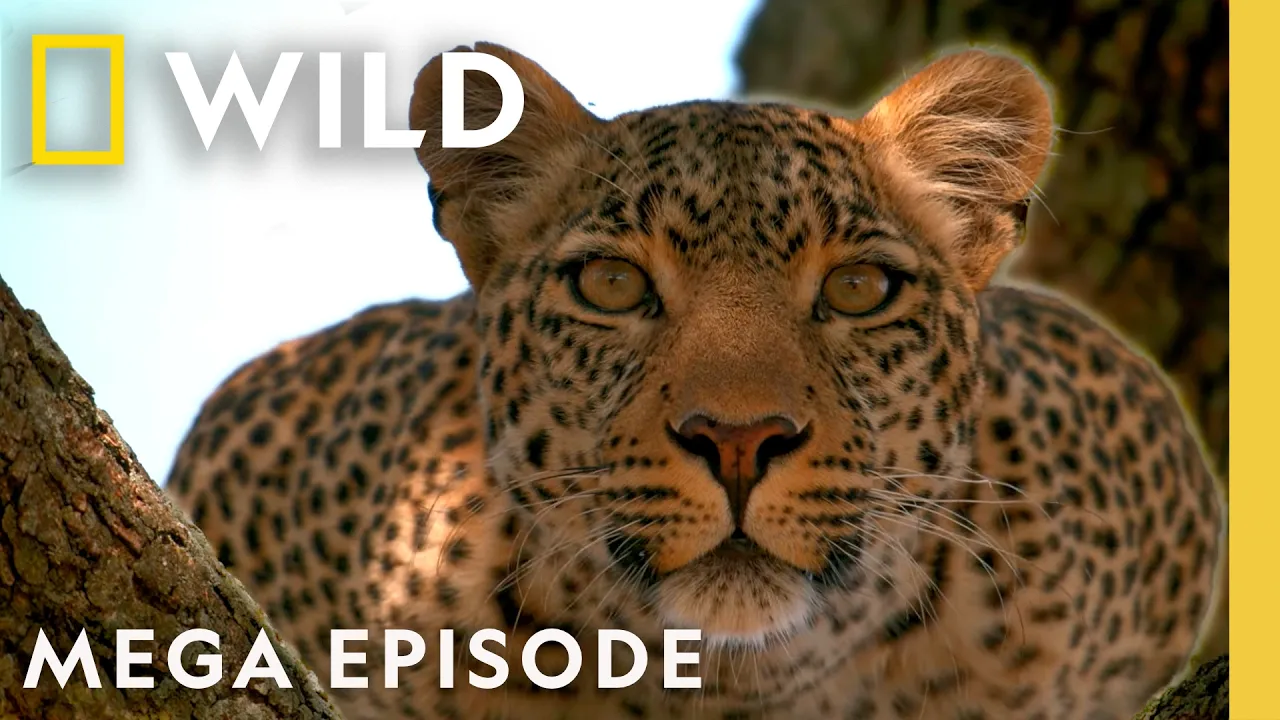
Rusty gets a powerful kick. If he loses, his chances of mating look slim. His opponent's on the ropes. Sometimes it's not the big hits that decide the fight. A sly uppercut fells Another punch sends him packing. This mob has a new alpha male. And the wise guy is on the trash pile. When running away is not an option, it's time to unleash some full-on fury. (roar) The dense woodlands of Kruger National Park, the perfect habitat for leopards, Africa's most elusive big cat. With a lean, well-muscled body, they're one of the most agile of all the big cats.
Needing over 7 pounds of meat a day, leopards are skilled ambush predators. They kill with a bite to the neck. But in challenging conditions, their kill rate can be as little as 1 in 20. They'll often target small game or even scavenge. Anything to survive. (hyena whoops) This young male hasn't had a meal in a week. But this might just be his lucky day. He's come across a half-eaten carcass, and the owners are nowhere in sight. It's a terrible mistake. In the savanna, there's no such thing as a free lunch. And sometimes, it's not even a fair fight.
(growl) This hungry leopard took a massive risk. Approaching the abandoned carcass. He'll now have to battle the furious owner. (purring) The lioness batters him with a powerful right hook. (roaring) It looks like a knock-out punch, but the leopard dodges and rolls with it. At 300 pounds, the lioness is more than double his weight, but she needs to land a clean bite, and to do that, she's got to get past his lethal claws. Like all big cats, leopards have five claws on the front paws, and four on the back. Their claws are two inches long, and are constantly sharpened when climbing trees.
But then, the cavalry arrives; three more lionesses want to show him who's top cat on the savanna. A lioness' skull contains deep ridges for the attachment of powerful muscles that support her jaw and its 30 teeth. These muscles allow her to create bite pressures of around 1,000 pounds per square inch. The lionesses could kill the leopard by severing his spinal cord; to survive, he's got to stay on his back. He spins around and swipes not one, not two, but three of the lionesses. It's a master class in big cat survival moves. But the leopard's chances are slim.
He's running out of options. He can't eat, and he can't risk turning his back on the lionesses to retreat. The lionesses launch into round two. He slashes at one with his front claws, one with his back; his blows sting, buying him another minute of life. Just enough time for an even more ambitious predator to close in. The lionesses turn their attention to the hyena. It's the moment the leopard has been waiting for. A lioness gives chase, but his natural agility pays off, and he vanishes into the thick bush. He's one lucky leopard. Up against four of his deadliest enemies, and this guy gets away, hungry, but alive.
But even luck can only get you so far when you face death by a thousand bites. In the jungle underworld, there's a biological weapon so devastating that some believe it defies evolution. A lumbering giant looks for lunch, but finds other hunters. Foraging ants in attack mode. The beetle's 60 times their size. But they call in backup from a near-indestructible army. Ants have survived for about 140 million years. They lived through the mass extinction that wiped out the dinosaurs. The real secret to their success is their organization. They live in million-strong colonies, but can behave... like a single organism.
Some even unite and form rafts to survive floods. It makes for an army of hyper-efficient killers. Foragers divide into specialized units. If the first unit finds large prey, it releases chemical trails for backup to follow. These foragers send their message. The beetle is on borrowed time. But it has its own message. (gunfire) Total annihilation. It's a bombardier beetle, one of a family of insects with boiling toxic chemicals in their arsenal. This is truly a weapon of mass destruction. The spray is so hot, it should cook him alive from the inside out. But evolution has an answer to everything.
Inside the beetle, two types of gland produce two different chemicals. They're harmless, until released together into a reinforced chamber. As the chemicals combine to form a toxic cocktail, the reaction heats it to boiling point. Pressure, caused by the heat, blasts the spray out in 500 pulses per second. And each pulse allows the chamber to cool so the beetle doesn't burn up. He can even rotate his cannon 270 degrees, for precision firepower. The chemical spray burns an ant's tough chitin exoskeleton. Even nature's doomsday survivors... ...can't handle a bombardier's biological warfare. (gunshot) Bloody battles don't just happen on land.
Down here, they involve teeth, temper, and one very big mouth. Down below the waves of the Pacific Ocean live blenny fish. The resident cuties of the ocean floor. Dainty, mild-mannered and timid. But meet the black sheep of the family: the sarcastic fringehead. Cuties, they are not. They open their jaws wide to bare an arsenal of thorn-like teeth, which aren't for empty threats. This old crank may be the size of a human forearm, but he knows how to pack a punch. He'll take on anything that swims onto his property, whatever shape or size. So what happens when an equally grouchy fringehead moves in next door?
A turf war on the ocean floor. The old crank starts his eviction campaign using some brute force. But the pesky neighbor won't give up his home that easily. So the crank turns to bully tactics. The neighbor finally cracks. He's not going to stand for such low-life behavior. The fringeheads go cheek-to-cheek in the world's most ferocious make-out session. But there's no kissing here. They interlock teeth as they shove each other over and over again. It's an ultimate contest of aggression and authority. But then, the old crank bites. The neighbor returns fire, sinking his teeth into his rival even harder.
This fringehead's not budging. After a dogged 20 minutes, there's still no sign of resolution. Being neighbors might be way too close for comfort, but it looks like they'll just have to grin and bear it. (bellowing) Animals battle hard to protect their turf. And when it comes to protecting your family home, even a muddy pool is worth dying for. In central Africa, only half of newborn hippos survive their first year. Females can only have one calf every two years, so each child is precious. Heading up this family is the pod-father. The leader of the pod has a constant entourage of youthful admirers, but this young bull wants his crown.
The pod-father is going to teach the upstart a lesson, right in front of his calves. The hippo is one of the most feared animals in Africa. These two and a half-ton heavyweights have the strength to launch themselves out of the water, run 30 miles per hour, and lay waste to those who stand in their way with their bone-crushing jaws. The pod-father makes the upstart an offer he shouldn't refuse. He flicks dung with his tail: a stinky display of dominance that says, "It's not too late to back down." (grunting) The upstart says a few choice words in return.
As his calves jockey for position, the pod-father launches his attack. Hippo fights make for an extreme spectator sport. It's first blood to the newcomer. A hippo's jawbone hinge is set far back, allowing the mouth to open 150 degrees. The upstart is stronger, but the pod-father has experience. He gores the challenger's upper palate. The upstart retaliates, but the old timer is too wily. The onlookers scatter as the pod-father launches another attack. The pod-father is victorious. But his triumph is bittersweet. A victim of friendly fire, one of his calves strayed too close to the action. It pays the ultimate price.
Being at the wrong place at the wrong time can land any animal in big trouble. Hidden in the highest branches the Amazon jungle lurks a mysterious creature. Boasting 4-inch, scythe-like claws and a smile that could light up the darkest of rooms, this is the three-toed sloth. Hooked claws allow sloths to do everything while hanging from treetops. Except poop! This angel-faced tree hugger drags herself to a neighboring tree to perform her weekly motions. But sloths are the world's slowest mammal, and every second she's on the ground, she's open to attack. Her scent is picked up... ...by a hungry predator!
When it comes to small cats, pumas are the biggest, with a range that stretches across much of the Western Hemisphere. They can leap as high as a two-story building, and run up to 45 miles an hour. Powerful legs and sharp claws disable and control their prey, while vertebrae-splitting jaws seal the deal! The sloth's greatest defense is camouflage. They're so slow that algae grows on their fur, blending in with the treetops, which is where she needs to be. But sloths don't do fast! It's natural born killer versus natural born dozer. The puma weighs the options... ...then decides to go for sloth!
Pumas climb trees with ease. But this cat will have to aim high to catch the sloth. The sloth holds on tight. But the predator does something extraordinary. A puma's 2-inch claws aren't as long as a sloth's, but by making them sharper he'll be able to climb higher. Close, but not close enough. She's one lucky sloth. But this is one clever puma! The 88-pound cat has gravity on his side. If the sloth loses her grip, she loses her life. This is a treetop tug-of-war. But the puma is tired of hanging around. The cat's sharp claws allow him to climb up the sloth.
And his large canine teeth slot between her vertebrae. The puma is ruthlessly efficient. The sloth's end is mercifully quick. Some chance encounters can end in a meal. Others can have a surprise ending. Nile crocodiles are apex predators. But once a female croc lays her eggs, the hunter becomes the hunted. A female crocodile guards her buried eggs. Uninvited visitors like monitor lizards and baboons wait for her to drop her guard. (screech) To them, her precious eggs are a delicious meal-to-go. The surviving eggs hatch. Now she needs to get her precious infants to the safety of the water.
Nile crocodiles have one of the highest bite force of any living animal, but today she uses her jaws for the most delicate of tasks. Along with their 68 flesh-shredding teeth, crocodile jaws are packed with delicate sensory organs. When hunting prey, they can detect the slightest change in water movement. But the most responsive sensors are found near the croc's teeth, allowing her to cradle her baby, safe and sound. Mother croc spots another unwanted visitor. In a crowded nesting area, baby croc calls sound similar. (chirping) The intruder seemingly mistakes the babies' cries for her own brood. She thinks mother croc is a kidnapper.
(hiss) Mother croc still cradles the baby in her mouth. (hissing) Mother croc increases her attack with the momentum gained by thrusting her powerful tail muscles. The battle moves to the water's edge. Mother croc blocks the intruder's path to the nest. She still delicately nurses the baby. The intruder clamps down with a 3,000-pound bite. That's the same weight as a small car. Mother croc is forced into submission. The intruder steals her babies down to the river. But there's a twist in this crocodile's tale. This bask of baby crocs is now being shared between two caring mothers.
A happy truce is rare in the wild. When mortal enemies collide, it can be a fight to the death. The black mamba. Long, fast and aggressive. With their lethal venom, they paralyze their prey, then eat it whole. It is one of the world's deadliest snakes. The slender mongoose is one creature that's famously prepared to take on this slithering assassin. Weighing just over one pound, he looks outmatched. But don't be fooled. With lightning speed and razor-sharp teeth, snake dinners are a rare treat. (hiss, squeak) This mongoose has cornered the mamba. The mamba's defense is to go high.
Lifting a third of her body off the ground, spreading her neck flap and opening her mouth often scares off attackers. Not the mongoose. He toys with the snake. (squeak) Staying just out of reach. She's not falling for it... yet. If she lands a bite, she'll inject a lethal shot of venom through her needle-sharp fangs. Usually, it's the kiss of death. The mongoose has some resistance. If bitten, the venom would weaken him, but probably not kill him. So, the mongoose avoids the snake by changing direction mid-leap. He can spring over 3 feet vertically. Each lightning strike tires the snake.
The mongoose needs to land one killer shot. A bite to the back of the mamba's head. The mamba is exhausted. She tries to get away. But with one bite, the mongoose wins. And now it's time for a well-earned lunch. But a predator's lunch can become another's meal, for catching and keeping are two different things. 130 feet above the water, an osprey scans for prey. He spots movement. He hits the water at 44 miles an hour. Armed with perfect feet for fishing: two digits facing forwards, one backwards, and one that can change orientation. His talons snap shut in two-hundredths of a second, roughly 12 times faster than a human blink.
An impressive catch. (squawk) Which hasn't gone unnoticed. A great black-backed gull, the largest of all gulls, watches from the shore. An opportunistic predator and scavenger, there's little it won't eat. (squawking) Its main weapon is its curved bill which it uses to stab, smash and tear. And it's not above a little piracy. The gull lines up for an interception course, and attacks. At the last second, the bird of prey takes evasive action. (bird chirping) The gull's persistency is more than a match for the osprey's maneuverability. And the gull knows it. Gulls are excellent fishers... ...and ruthless pirates.
The osprey's faster than the gull, but weighed down by his fishy cargo, he can't escape. The pirate changes tactics. It goes high, to dive-bomb its target. The osprey tires. The gull moves in for the kill. The bird of prey tries to shake him. But the pirate is ready for him and grabs his wing. Outgunned and exhausted, he drops his catch. And to the sly victor go the spoils. (howling) Cunning can lead you to victory, even when the competition is fierce. On the island of Madagascar, the undergrowth rings with eerie calls. They come from lemurs, known as the ghosts of the forest.
Ring-tailed lemurs are lean and athletic, built for leaping over 30 feet from tree to tree. They stand around 18 inches high and weigh less than 8 pounds. Scaled up to human size, they'd be 6 feet and 32 pounds. Tails are up to 2 feet long and are flight stabilizers, helping them glide through the trees. Ring-tailed lemurs live in troops of up to 25. And the females are in charge, headed by a warrior queen. Adult lemurs are armed with sharp claws and long, slashing canines. The females use them in bitter brawls with rival troops and in vicious fights to rise up the pecking order.
The handful of males in a lemur troop are at the bottom of the heap. They're happiest just chillin', taking in the rays. But they are vital to the troop for breeding. When a female is ready, she may mate with all the troop's males. But the question is who's first? This lemur is feeling lucky, because he smells. And supremacy is decided by a stink-off. The male lemurs emit a pungent liquid from a gland in their wrist and rub it into their tails. Then they waft it towards their love rivals. Stinky has the champion stench, so wins the chance to mate first.
(howls) But a rival interrupts him. He overrules the odor's rule and challenges Stinky to a real fight. It's kung fu combat, flying kicks as the lemurs jump-fight. Stinky's tail helps him twist as he kicks. The rule-breaker aims for an appropriate target: the crown jewels. But Stinky gets in a head shot. The rule-breaker needs to change tactics. Soften him up with a body slam, then keep him on the deck. He takes Stinky down. And brings his teeth into play. He strips the flesh clean away. Stinky's savaged hand is a technical knockout. His rival senses victory and claims his mating rights.
Stinky is down but not out. He can't fight, but he wants justice. He swings back into the trees and tempts his rival to break off the nuptials and give chase. A third male spots his chance, and sneaks in to bag first mating rights. Stinky's revenge is complete. And he lives to mate another day. Captioned by Side Door Media Services
More from Nat Geo Animals

Get daily recaps from
Nat Geo Animals
AI-powered summaries delivered to your inbox. Save hours every week while staying fully informed.