Chasing the Equinox (Full Episode) | DOCUMENTARY SPECIAL | National Geographic

Chapters8
Introduces the Equinox as a universal solar event that civilizations around the world celebrated with monuments and timing tied to the sun.
Ancient civilizations aligned monumental architecture to the Equinox, revealing centuries of solar knowledge and meticulous engineering across Angkor Wat, Mnajdra, Malta, Chaco Canyon, Chichen Itza, and more.
Summary
National Geographic’s Chasing the Equinox takes viewers on a globe-spanning journey to reveal how diverse cultures—Angkor Wat’s Khmer builders, Malta’s Mnajdra temples, Malta’s Mnajdra, Ireland’s Loughcrew, Chaco Canyon, and Maya sites like El Caracol and Chichen Itza—engineered monuments to mark the Equinox. Fabio and Tore Lomsdalen guide us through the mathematics, astronomy, and practical techniques behind these alignments, from a half-degree correction at Angkor Wat to the Pleiades-based markers at Mnajdra. The film emphasizes that astronomy was the first science and that timekeeping, agriculture, and survival depended on cornestone solar knowledge. We see how Greek, Egyptian, Malian, and Native American sites encode the sun’s path into stone, using tools as simple as an Indian circle method or shadow-casting lines to orient horizons. Dr. Sarah Klassen demonstrates modern measurement on Angkor Wat, while archaeologists like Anna Sofaer illuminate Pueblo Bonito and Chaco’s sun-centered landscape. The Equinox is portrayed not just as a sunrise event but as a global, historically cross-cultural ritual that linked kingship, survival, and cosmic order. The documentary culminates in Maya spectacle at Chichen Itza, where Kukulkan’s descent is elevated to a three-dimensional shadow play—an enduring reminder that ancient builders crafted calendars in stone, with the sun as their inexhaustible clock.
Key Takeaways
- Angkor Wat’s alignment places the sun over the central tower at the Equinox by rotating the layout about half a degree off due east, a deliberate mathematical choice rather than a mistake.
- Mnajdra’s three temples form a clover of orientations; the Equinox sunrise can be traced using the horizon and, for the later design, star markers like the Pleiades to calibrate solar position.
- The Great Sphinx-Khafre complex at Giza achieves an unusually precise 1/15th of a degree alignment to the setting sun on the Equinox, possibly using the Indian circle method to establish cardinal directions.
- Pueblo Bonito and the Chaco canyon ritual landscape align to the Equinox, with kivas and walls oriented to east–west and a broader solar calendar embedded in the canyon’s architecture.
- El Caracol at Chichen Itza embodies Maya astronomy as a calendar made in stone, featuring slits that encode key solar events and a three-dimensional shadow play on the Equinox.
- Maya solar effects at El Caracol and Kukulkan at Chichen Itza illustrate how elites maintained power through astronomical knowledge and architectural precision.
- The documentary argues that the Equinox marks a global, cross-cultural moment of humanity’s reliance on and celebration of the sun for agriculture, survival, and cosmic order.
Who Is This For?
Essential viewing for archaeologists, historians of science, and architecture enthusiasts who want concrete examples of how ancient builders encoded astronomical knowledge into monumental settings and why the Equinox mattered across civilizations.
Notable Quotes
"The sun is important in all cultures, particularly in ancient cultures, because the sun is the thing that allows people to survive."
—Fabio underscores the sun’s practical role in ancient life.
"The one thing that's really unusual about Angkor is it's not built exactly on the cardinal directions. It's actually half a degree off."
—Sarah Klassen explains a deliberate design choice to achieve Equinox alignment.
"At the Equinox this corridor has just the right length to create this effect where the sunlight just hits the bottom of this altar in the back."
—Fabio describing the Malta Mnajdra solar corridor alignment.
"The basic shadow was a line of triangles, but if the Maya changed the shape of the sloping edge, it would change the shape of the shadow."
—Explanations of El Caracol’s solar-shadow dynamics at Chichen Itza.
"What they must have done is create a small scale 3D model, made of maybe wood or clay, and actually go out there and use the actual light of the sun on the day of the Equinox to cast light on this model and play with it until they found exactly the effect they were looking for."
—Fabio on Maya shadow engineering at El Caracol.
Questions This Video Answers
- How did ancient civilizations align temples to the Equinox across different continents?
- What engineering tricks did Angkor Wat use to capture the Equinox sun?
- Why is the Equinox considered a calendar-making moment in archaeology?
- What is the Indian circle method and how does it help find east-west directions?
- How do Maya pyramids create the Kukulkan shadow serpent during the Equinox?
EquinoxAngkor WatMnajdraGiza SphinxPueblo BonitoChaco CanyonChichen ItzaEl CaracolMaya astronomyAncient calendars
Full Transcript
NARRATOR: Hidden in the world's iconic monuments is an incredible ancient knowledge of the sun. FABIO: This connection with the sun and the sky is actually timeless. NARRATOR: Twice a year as light breaks across the earth their secrets are revealed. SARAH: This entire space is engineered around this one moment in time. NARRATOR: Across thousands of years and unrelated civilizations, ancient monuments unite in perfect alignment to the sun on the same single day. The Equinox. TORE: They go and build this fantastic temple, unique in the world, so there must be a driving force. NARRATOR: Each a miracle of engineering and astronomy.
FERROZINE: With the technology that they had at the time it's amazing how much they could have achieved. NARRATOR: But how did the ancient astronomers create this global event? The human race in a simultaneous celebration of the sun on the Equinox. NARRATOR: It's 6:15 am in Cambodia. Today is the Equinox, an event that happens only twice a year, when day and night are almost the same length all over the world. South East Asia waits for the sun. Huge crowds gather at the world famous temple of Angkor Wat. They've come to witness an ancient but spectacular special effect.
The sun is up and rising, just to the east behind the central tower. But the real moment of truth is still to come. FERROZINE: The sun is important in all cultures, particularly in ancient cultures, because the sun is the thing that allows people to survive. Without the sun there is no survival. It's not a coincidence that it has been defied in ancient cultures throughout the globe. FABIO: We still find this connection very deep. Every society that we have studied all over the world and since pre-history seems to have had an interest in the sun, the moon or the stars.
NARRATOR: And on the Equinox our human obsession with the sun is revealed in ancient sites around the world. 2000 miles to the west the windows of the Indian temple of Sree Padmanabhaswamy frame the setting sun with exquisite precision. In Egypt more visual fireworks from the setting sun, as it merges into the shoulder of the sphinx, with the Pyramid of Khafre directly behind. In Europe the megalithic temples of Mnajdra pre-date the pyramids by 1,000 years. Here too is a solar phenomenon that occurs only on the Equinox. In the Americas, at Chichén Itzá in Mexico, dating back 1,000 years an hour long light show as a snaking shadow form slithers down the side of the snake God's temple.
Peoples from different continents, centuries and cultures all independently celebrated the sun. FABIO: They were keen observers of natural cycles, keen observers of what was happening in the sky. And they built that knowledge into these structures themselves. FERROZINE: When we examine these sites, what we see is not just the skill that these cultures had, but also the importance of time and astronomy and the sun in human life. It's mind boggling that they had the capability to make these monuments. NARRATOR: In the modern world, it's easy to forget that since the dawn of humanity every culture on earth has relied on the sun.
FABIO: Pre-historic societies, before the invention of writing or farming, we're already interested in the sky. And we find evidence for that all over the world. NARRATOR: Astronomy was the first science. Only astronomy makes a reliable calendar possible. FERROZINE: You can't perform agriculture farming practices, you can't sew, you can't plow unless you know what time in the year it is. They had to know the movement of the sun in order to be able to survive. NARRATOR: In summer the northern hemisphere tilts towards the sun and the days are longer. In winter it's tilted away and it's cold and dark.
But when the seasons change the sun is directly over the equator, and both halves of the planet face our star equally. Everywhere on earth, day and night are almost the same length, 12 hours. FABIO: The word Equinox comes from the Latin equinotium, which encapsulates the idea that the night has the same length as the day. FERROZINE: You come out of the darkness of the winter and your days now from the Equinox onwards start to grow and become longer, because light brings life. The Equinox is the reaffirmation that the world is waking, the cosmos is waking up again, the earth is waking up again.
And your survival can carry on. NARRATOR: Ancient civilizations develop the astronomical knowledge to plot the sun's movements with precision. And then the engineering skills to celebrate those movements in stone. The mystery is how did they do it? For archaeologist Dr. Sarah Klassen, the alignment with the sun at the Equinox is one of the most spectacular features of the temple at Angkor Wat. Sarah is using new technology to discover the secrets of ancient structures. SARAH: This is a total station and we use it in the field to collect very high precision geographical locations for points of interest.
So we can use it for architecture, like here at Angkor Wat. And we can then load into a computer to understand how the temple was built, what angles, what the different lengths are between the different features. NARRATOR: The temple of Angkor Wat was built 800 years ago by emperor Suryavarman II, and stood at the heart of his empire. SARAH: You can tell that the ancient Khmer were extremely sophisticated when it came to their engineering, both in terms of the scale and the precision of the types of things that they engineered. NARRATOR: It's on the Equinox that this sophistication becomes clear.
Angkor is a line towards the rising Equinox sun. One set of grid lines runs north to south. The others run west to east into the rising Equinox sun. From the western gate a dead straight avenue leads directly to the heart of the temple. But modern measurements reveal that the alignment is not quite due east. SARAH: The one thing that's really unusual about Angkor is it's not built exactly on the cardinal directions. It's actually half a degree off. NARRATOR: So these ancient masters of geometry half a degree would be a huge margin of error. But in fact, it's no mistake, it's a deliberate stroke of mathematical genius.
SARAH: It's actually quite ingenious. We think they did this so that during the Equinox the sun would rise directly over that central temple. NARRATOR: The trick is that the Equinox sun rises at due east. But in the minutes it takes to rise to the height of the tower, it also moves right across the sky, half a degree off due east. If the tower was due east, the sun would be out of line when it reached the top. So the architect solution was simple, they rotated the entire layout to compensate by exactly half a degree. FABIO: To create an alignment between the western gate, the top of the tower and the sun on the day of the Equinox is a huge amount of skill.
NARRATOR: Eight centuries later it's still a calculated mathematical miracle, one that proves the Equinox was a vital moment for which the entire temple was constructed. FABIO: The beauty of Angkor Wat is in the mathematics of it. It looks and feels like everything was minutely planned and, and detailed to a mathematical level of precision. SARAH: After working here for over five years it's really exciting to kind of finally be here for this moment, that this entire structure was built around. The energy of the crowd, all the excitement of everyone being here, it's a very special moment.
NARRATOR: A fraction, half a degree makes all the difference. FABIO: To actually capture the sun right at the top of the central tower of Angkor Wat, they were using the sun to make a statement about their own beliefs, and in this case their own power and their place in the cosmos. (cheering) SARAH: The temples that we see today are not what the temple would have looked like in the past. The temple may have been coated entirely in gold, so you can imagine what it would look like with the sun rising over the central tower. A powerful moment to experience.
NARRATOR: The emperor's architects had got it right, to the last tiny detail. Angkor Wat is one of the world's greatest ancient sites. But just one of many across the earth that celebrate the Equinox sun with a spectacular light show. NARRATOR: As the Equinox sun leaves Cambodia it continues its journey around the globe. In Kerala, 2000 miles to the west on the south coast of India, the crowds have to wait for sunset to witness the effect. The stunning temple of Sree Padmanabhaswamy has a beautifully carved tower dated 400 years after Angkor Wat. Through its series of precisely aligned windows, the Equinox sun sinks into the west like an elevator, lighting up stories at five minute intervals.
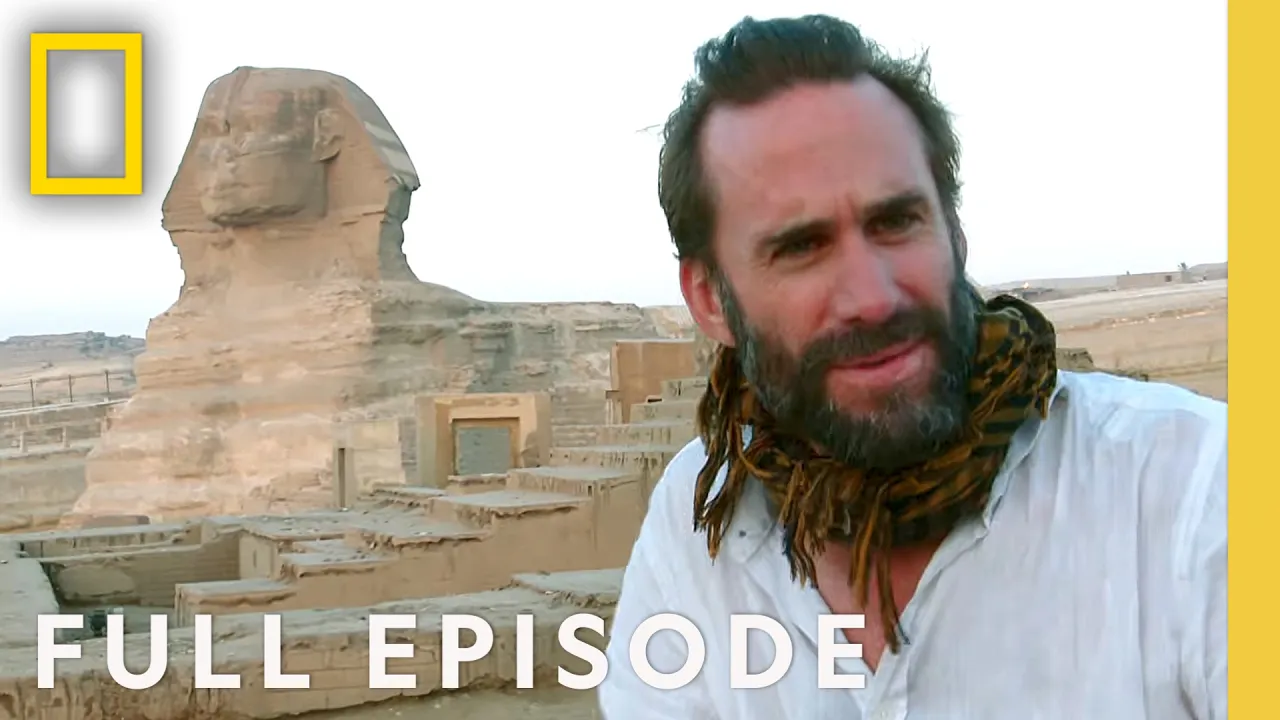
Another quarter of the way around the world in ancient Egypt the setting Equinox sun hits two of the most iconic structures on earth, the Great of Sphinx of Giza and the Pyramid of Khafre are both believed to have been built 4,500 years ago. On the Equinox the setting sun merges into the Sphinx's shoulder with the Pyramid of Khafre behind. The alignment of all the Giza pyramids to the setting sun in the west is incredibly accurate, within 1/15th of a degree. The ancients may have achieved this using the simplest of tools. FABIO: One possible way of orienting structures to the point of the compass is using the Indian circle method.
This method consists of an upright pole and observing the shadow that is cast by the sun between sunrise and sunset. And you would mark the movement of this shadow on the ground. Then you would take a rope of the same length as the wooden pole that you used, and you would tie it around the pole and draw this circle on the ground. This intersect at two points, and if you draw a line between these two points you've got a line that is marking the east west direction. When you look at it from above it does seem to fit perfectly with the point of the compass.
This method is so simple and so powerful, so accurate that it could actually be used by any society anywhere in the world. NARRATOR: On the day of the Equinox the sun's journey continues onwards onto Europe. Bathing in Mediterranean and light. On the island of Malta something incredible is happening. The rays of dawn penetrate a pre-historic temple a 1,000 years older than the pyramids with breathtaking precision, striking the center of the ancient alter dead on. FABIO: They were specifically targeting the Equinox, pinpointing the exact position of sunrise at the Equinox is incredibly difficult. And that makes it even more amazing that some societies did manage to do that.
NARRATOR: It's a miracle of astronomy and architecture, made five and a half thousand years ago. FABIO: The people in Malta were building these fantastic great massive structures, and building so many of them on such a small archipelago that this is unheard of anywhere else in the world. at Mnajdra is one of the oldest temples in the world. Built with stones weighing 30 tons each, the equivalent of five elephants. FABIO: They clearly were not that primitive, they clearly have the skills, the ability, the knowhow. It's fantastic to think that this built to align with the Equinox.
NARRATOR: For the last ten years, archaeo-astronomer Tore Lomsdalen has been focused on figuring out exactly how they did it. TORE: Every time I come here I'm amazed and I think about the knowledge they must have. They go and build it's unique in the world, NARRATOR: There are three separate temples at Mnajdra, arranged in a clover leaf shape. They're aligned in different directions, with one facing east to the Equinox dawn. TORE: They knew what was going on in the sky. They oriented it towards the east in the horizon to be able to observe how the sun moved through a solar year.
NARRATOR: As well as the days getting longer and shorter through the year, the precise spot on the horizon where the sun rises also moves. In December, it rises at its most southerly point. At mid-summer, it reaches the furthest north. The Equinox sunrise at due east will be right in the middle of the two extremes. FABIO: That middle point would be close enough to the Equinox for them to build a structure that was aligned to it. NARRATOR: Tore believes the temple builders use this method to keep track of the sun throughout the year, that Mnajdra was a calendar built in stone.
A tantalizing clue lies at the winter solstice position. TORE: This hole could have been a marker for the builders when they build Mnajdra to align to the rising sun at the winter solstice. It's so perfectly aligned. NARRATOR: There may have been a similar marker for the Equinox. But this method isn't very accurate, especially on a steeply sloping cliff top like Mnajdra. By the time the sun is high enough to see, it already has drifted to one side. FABIO: You are going to be finding a point that isn't exactly due east, it's going to be slightly to the left or slightly to the right of east, which builds in this error into the method.
NARRATOR: This method was likely only used for the design of the first temple, believed to be a single chamber facing the horizon. The Equinox sun would have entered the temple at a slanting angle to hit the alter at one side, rather than dead on. But over time the temple was rebuilt with new astronomical knowledge. TORE: There was an evolution in the astronomical knowledge and development of how they wanted to have the temple oriented directly towards the Equinox sunrise. NARRATOR: And surprisingly that new knowledge may have come at night. NARRATOR: In Malta the ancient astronomers needed a new method to align their temple precisely to the rising Equinox sun.
The answer it seems lay in the stars. FABIO: They were using particular stars that rise at the exact location as the sun rises at the Equinox. It is very accurate markers for this event. NARRATOR: Astronomers believe they use these pillars to mark their observations. There's a cluster of holes that's thought to represent the stars and the Pleiades constellation, also known as the seven sisters. They're bright and prominent in the night sky. By chance, the Pleiades rise at due east, the same place as the Equinox sun. but while the sunrise moves along the horizon, the stars come up in the same place every night, because they're 30 million times further away than the sun.
FABIO: Almost every night of the year you just spot where the Pleiades are rising and you will know the sun will rise at that exact spot on the days of the Equinox. NARRATOR: The showpiece of the new temple would be the huge central alter to catch the rising Equinox sun. TORE: They develop more awareness and this whole temple was built to center around the Equinox. NARRATOR: It took more than 1,000 years to reach the final design. The alter was at the back of a completely new chamber, so deep into the temple the sun could never full reach it, except on the Equinox.
Pre-historic humans sent a message we can still read today. TORE: See the brightness, look how beautiful. NARRATOR: The Equinox sun still comes right down the central corridor to bath the alter piece in light. TORE: Look at the passage. All the sun is increasing. It's gone 100% today. MAN: Woah. NARRATOR: The light hits its target with extraordinary precision. FABIO: At the Equinox this corridor has just the right length to create this effect where the sunlight just hits the bottom of this altar in the back. It's fantastic that this was an intentional alignment. NARRATOR: Some of the first builders built for the Equinox.
TORE: 5000 years ago they made these temples. This is absolutely their altar and it's amazing. NARRATOR: Just one hour after Malta the Equinox sun reaches across Europe to rise on stone age Ireland. 1,500 miles from Malta, the same effect, the dawn light hits ancient stone at the back of the chamber, and a carved symbol of the sun. this is Loughcrew in County Meath, a stone age site like Malta and almost as old, dating back 5,000 years. A farming society was greeting the arrival of spring. FABIO: They were building those relationships they had to the cosmos into the structures that they were building or into the art that they were painting.
descends to a second carved image of the sun. pre-historic people marking the Equinox as a matter of life and death. FERROZINE: What you are basically doing is ensuring that the sun will shine or will do what it's supposed to do in order for your crops to grow. You're addressing the cosmos in order to be able to ensure your own existence and your own survival. NARRATOR: The Equinox leaves Europe far behind. The dawn light races across the Atlantic Ocean and finally hits America. In north western New Mexico, the sun climbs ever higher over endless desert. Archaeo-astronomer Anna Sofaer has been drawn to the Pueblo ruins of Chaco Canyon for more than 40 years.
ANNA: I am stunned by the beauty of Pueblo Bonito. It is so gorgeous. Look at just those doorways and the perfect right angles to the edges. Look at the way it's held up for so long. Isn't that incredible? That people built this 1,000 years ago. NARRATOR: This is ancient territory, spanning more than 30,000 square miles of the American south west. In the early 12th century these were the lands of the ancestral Puebloan people, one of the most sophisticated civilizations of the ancient south west, who believe they have been lead here from the north, the spiritual home of their ancestors.
The ancestral Puebloans reshape the canyon with hundreds of structures that seem to grow organically from the rock. And their obsession with the Equinox lead them to construct one the greatest single buildings of ancient America, the iconic Pueblo Bonito. NARRATOR: In the brutal high desert landscape of New Mexico, Anna Sofaer explores a mysterious ancient structure. This is Pueblo Bonito, one of the biggest single buildings in ancient North America. Built in a place too barren to support the numbers who could live here. ANNA: This room shows you how large the interior rooms of Bonito were. We're standing on the top of the first story and we are in the second story, and then above those (inaudible), those wood posts you see the third story.
And you get a little look at what was the fourth story. So it's a massive building. NARRATOR: The sheer scale sparks the greatest mystery of Pueblo Bonito. Thousands came but very few stayed to live. ANNA: It's really difficult to think of people living here, if you imagine two stories above you you're enclosed, you cannot have a fire, you can't have a hearth. It's a great puzzle, what were they doing? What we're looking at is a site that was built for religious purposes, for very powerful beliefs. And those beliefs are based on relationship with the cosmos.
NARRATOR: They came to Chaco Canyon to worship the sun. Paul Pino is an elder of the Laguna Pueblo, a modern community directly descended from the original Puebloans. PAUL: The culture that created Bonito, that culture is not gone. It continues today in the Pueblos here in New Mexico. My grandchildren are part of that culture, living every single day, they're a part of it and they will pass that onto their children. NARRATOR: Cameras are not permitted inside Pueblo ceremonies, but in this rare footage worshippers are leaving a kiva, a circular underground structure where rituals and meetings are held.
PAUL: I believe that when the people lived here, they performed a lot of their ceremonies much the same as the ceremonies that we do today. There's that continuity from the past to the present. NARRATOR: Pueblo Bonito alone has 36 kivas, with room for up to 50 people in each. The Puebloans saw order in the way the sun moved and mapped it onto Pueblo Bonito. On the Equinox the sun rises in the east at the end of the enclosing wall. Sunset happens in the west at the other end of the enclosing wall. ANNA: This wall that's the exterior wall of the building on the south side is so exactly east west that on the nights on Equinox you can view the sun setting on the trajectory of this wall.
NARRATOR: And Pueblo Bonito is only the largest building in an entire ritual landscape. The whole canyon marks the Equinox. There are 14 great kivas, like Casa Rinconada. The giant circles could each take 400 people, almost 6,000 in all. ANNA: The kiva is so important in the ancient Chaco culture. This is the ceremonial site for most of their activities that were related to the sun. NARRATOR: The kiva had a heavy earthen roof. In the dark interior, worshippers would only see the sun through the niches in the walls. ANNA: It was organized to the cardinal directions: north, south, east, west.
Over there, the north side of the building as a rectangular structure with two doorways that are aligned to the rising of the Equinox sun. NARRATOR: Everything is aligned to the compass within a few degrees. The doorways of this rectangular structure open east and west, so the rising Equinox sunrise shines through both and floods the interior with light two days a year until the end of time. PAUL: The sky and the earth were created at the same time in our belief. The sun was created to give light to the world, so the sun and the earth work together to provide nourishment for the people.
sun bursts into kivas across the canyon. PAUL: It must have been, at its height, something phenomenal to see. ANNA: What we are exploring are sites where people were gathering in order to have this experience of space, but also this connection with the cosmos. PAUL: The alignments represent a particular order in how things are done and sometimes in this modern age, that order is missing. And we mess up our world. NARRATOR: The Pueblo marked the Equinox with one final spectacular display. This is Fajada Butte: a scared overlook where most likely only the elite astronomers of their civilization could ever go.
On its side, Anna found three sandstone slabs, appearing to be set by hand against the rock face. There was a spiral pattern carved into the rock. She was just in time to watch a dagger of sunlight appear from nowhere. ANNA: The precision of that within a few minutes of, I think it's four minutes of solar noon. NARRATOR: On the west face, another spiral pattern: this time a double. ANNA: It has a dagger of light going up through the right lobe. Again, noon Equinox. FABIO: What makes Chaco canyon unique with respect to the Equinox, is that it shifts the emphasis from the sunrise or the sunset and puts it at noon.
ANNA: It's like clockworks. It's like all of that is happening at once. The sun dagger site marks Equinox. These two sites mark Equinox noon. It's the same that we see in the buildings, the same people, the same mindset to align themselves to the sun, the power of the sun. 1,500 miles from Chaco, the Maya built structures that dwarfed even Pueblo Bonito, and they created the greatest solar effect of all: the climax of the sun's entire journey. NARRATOR: In the ancient city of Chichen Itza, in Mexico, thousands of people have gathered from far and near. In a few hour's time at this ancient pyramid, they will witness quite possibly the single most spectacular effect ever created with the Equinox sun.
FABIO: This is not your average alignment to sunrise of sunset. This is a complicated 3D effect that involves the light of the sun hours before it sets to construct this dynamic shadow play that is uniquely Mayan. NARRATOR: A 1,000 years ago, the vast Maya empire was centered here in Mexico's Yucatan peninsula. But their civilization was already 3,000 years old. It has become a byword for sophisticated learning, astronomical knowledge and, above all, stunning buildings. This is called El Caracol, Spanish for The Snail, because of its distinctive shape. FABIO: It has this dome shape at the top.
When you look at it from our modern, Western perspective, it looks just like an observatory. So maybe people were sitting there inside this structure, looking for the sun or the moon or the planets. NARRATOR: For site director, Marco Antonio Santos Ramirez, El Caracol was of central importance to the Maya. FERROZINE: Astronomical observations and knowledge was restricted to a specific elite, for example. And by doing that, what the Mayans achieved to do is maintain power. So your power was maintained through the knowledge of how the sky operated. NARRATOR: By the time Chichen Itza was built, Maya astronomers already knew exactly how the sun, moon and planets would move.
El Caracol is not so much an observatory, as a calendar made in stone. The slits in the walls were deliberately placed to record the passing of the sun on certain vital days. A pair of slits records a specific sunset on the Equinox or the Solstice. NARRATOR: Marco's colleagues have been capturing the effects throughout the year. Reconstructing the detailed knowledge base that the Maya had built up over centuries. NARRATOR: The Maya knew the Equinox was vital for the survival of crops. To guarantee their survival, the Maya believed that Gods had to be placated at the Equinox.
And at Chichen Itza, powerful Gods was Kukulkan: a winged serpent who flew ahead of the rain God Chac, bringing in the wet season, as his tail moved the wind and swept the earth clean. The Maya built their pyramid in his name and carved his image into its façade. NARRATOR: At the Equinox, Kukulkan will be celebrated with a spectacular light show. NARRATOR: On the day of the Equinox, tourists at Chichen Itza wait for the spectacular moment that marks the arrival of the new season. GROUP: Kukulkan. NARRATOR: It's now just minutes away and tension is rising. Clouds threaten to ruin the crucial moment.
The crowd prays they'll see the true extent of Maya religious power. MARCO: To create this effect is very complicated and yet they've done this almost 1,000 years ago without any of modern mathematics or computer technology. NARRATOR: The pyramids key feature is this sloping edge on the north west corner. Each of the steps protrudes a little in a triangle shape bump. The Maya realize that these would cast shadows on the nearby staircase and they could use them to conjure their illusion. NARRATOR: The whole effect will happen in three dimensions. The sun is moving in a curve across the sky.
The edge is sloping down and sideways and the staircase is a flat plain at a different angle. So the Maya architects had to solve a highly complex problem. FABIO: This must have required amazing skills. What they must have done is create a small scale 3D model, made of maybe wood or clay, and actually go out there and use the actual light of the sun on the day of the Equinox to cast light on this model and play with it until they found exactly the effect they were looking for. NARRATOR: The basic shadow was a line of triangles, but if the Maya changed the shape of the sloping edge, it would change the shape of the shadow.
They could use their model to get the effect they wanted. The Equinox moment is almost here. NARRATOR: We cannot be certain what effect it must have had on the watching Maya people. It must have been part wonder, part terror. NARRATOR: Kukulkan himself had appeared on the face of the earth. It's not the shadows that count, but the light. The brilliant outline of a serpent's body slithering down the staircase to join his head at the base. NARRATOR: For the Maya, this was the ultimate expression of the Equinox. Kukulkan had descended to earth to banish the dry season and bring rain and new life.
FABIO: In modern society, we have lost touch with the environment that's around us and that includes the sky. But in particular we've lost touch with the Equinoxes, which would be the true moments of transition between the warm half of the year and the cold half of the year. NARRATOR: Leaving Mexico, the sun passes over the Pacific Ocean and finishes its Equinox journey. Civilizations long forgotten, unknown to one another celebrated this day. For the ancients, the sun was the giver or life. First they needed to understand its journey, then they wanted to harness its power. Developing the first knowledge of astronomy and engineering to do it.
Chasing the Equinox, created a cosmic magic. Captioned by Cotter Captioning Services.
More from National Geographic


Get daily recaps from
National Geographic
AI-powered summaries delivered to your inbox. Save hours every week while staying fully informed.