I Studied 100 Viral AI Apps, Here’s How They’re Printing MILLIONS

Chapters14
The creator explains studying many viral apps and the takeaway that simplicity and three key factors fuel success.
Steven Cravotta analyzes 100+ viral AI apps and reveals that simplicity, ruthless marketing, and strong LTV drive millions in recurring revenue—plus a fast, practical road map to build your own app.
Summary
Steven Cravotta dives into why many viral AI apps succeed despite not being feature-heavy. He spotlights eight apps (like Cali and Reframe) that rely on one core feature, long onboarding, and a hard paywall to convert users. Cravotta emphasizes that top revenue drivers are not the tech complexity but the marketing machine: massive content generation, relentless A/B testing of pricing, and aggressive paid advertising to scale LTV. He walks through concrete onboarding and paywall strategies used by Cali, including a three-screen priming flow and a free-trial transition that culminates in a paid plan, plus how these apps harvest higher LTV by favoring yearly plans. The video also includes a practical roadmap: validate quickly (2–4 weeks), build a simple MVP with vibe coding platforms (RoR, Emergent, Bolt), then hire a developer to finish polish via Upwork. Cravotta stresses that successful apps master distribution, not just product features, and they test content at scale with hundreds of Facebook ads to sustain growth. He teases additional resources—an hour-long guide and a mobile app tech stack—available via links in the description. Finally, he invites founders to join a founders’ group to share ideas and tactics. All of this is framed as a repeatable blueprint: ship fast, test relentlessly, and monetize aggressively through annual subscriptions.
Key Takeaways
- One core feature with a long onboarding and a hard paywall is a proven pattern in apps like Cali and Reframe, enabling rapid monetization at scale.
- High LTV enables aggressive paid acquisition; apps push yearly plans (e.g., Cali at $30/year, Reframe at $99/year) and offer free trials to maximize upfront revenue.
- To validate ideas quickly, use market signals (Google Trends, social buzz) and aim for a 2–4 week MVP built with vibe coding platforms (RoR, Emergent, Bolt).
- A three-screen paywall strategy that primes users before showing the actual purchase prompt boosts conversion versus a hard upfront paywall.
- Content volume matters: hundreds of active Facebook ads and robust content generation drive organic–to–paid feedback loops that sustain growth.
- The real bottleneck isn’t development but content creation and marketing; invest heavily in scale-worthy content and paid media testing.
- For execution, hire developers on Upwork to polish and integrate analytics, Superwall for paywalls, and run AB tests to refine pricing and onboarding.
Who Is This For?
Essential viewing for aspiring mobile app founders and AI app developers who want to replicate viral success without building complex products. It’s especially valuable for those who want a fast, low-code MVP and a scalable marketing playbook.
Notable Quotes
"Most of these successful apps are not complex at all, but they're making millions because they do these three things that most founders ignore."
—Cravotta highlights the core pattern behind successful viral apps.
"The onboarding is long, the paywall is hard, and there’s one core feature—that’s what these apps are doing."
—Summary of the common playbook across Cali, Reframe, and others.
"Charge a yearly plan. Make it a yearly plan on your app so that you're collecting a majority of the money upfront."
—Example of pricing strategy used by the apps.
"Marketing is 90% of the success of any mobile app."
—Cravotta emphasizes distribution and ads over pure tech.
"If you show your paywall before doing all this, before a questionnaire, the user is simply going to bounce."
—On the sequencing of onboarding and monetization.
Questions This Video Answers
- How do I replicate the onboarding strategy used by Cali and Reframe to maximize conversions?
- What is the role of yearly subscriptions in maximizing LTV for AI apps?
- Which vibe coding platforms are best for a quick MVP in 2024?
- How can I scale a mobile AI app with Facebook ads without burning through cash?
- What should a three-step paywall priming flow look like for a new app?
AI appsMobile appsSubscription modelsOnboarding strategyPaywall optimizationLTVFacebook adsContent marketingVibe coding platformsRoR Emergent Bolt
Full Transcript
I spent the last few months analyzing over 100 viral AI apps that are generating millions of dollars in revenue. And what I found is pretty surprising. Most of these successful apps are not complex at all, but they're making millions because they do these three things that most founders ignore. So, in this video, I'm going to show you these AI [music] apps and break down exactly why they went viral and are able to pull in millions of dollars every single month. And then afterwards, I'm going to show you a road map that anyone can follow to build their [music] own successful app and hopefully see results like these because why not learn from the best?
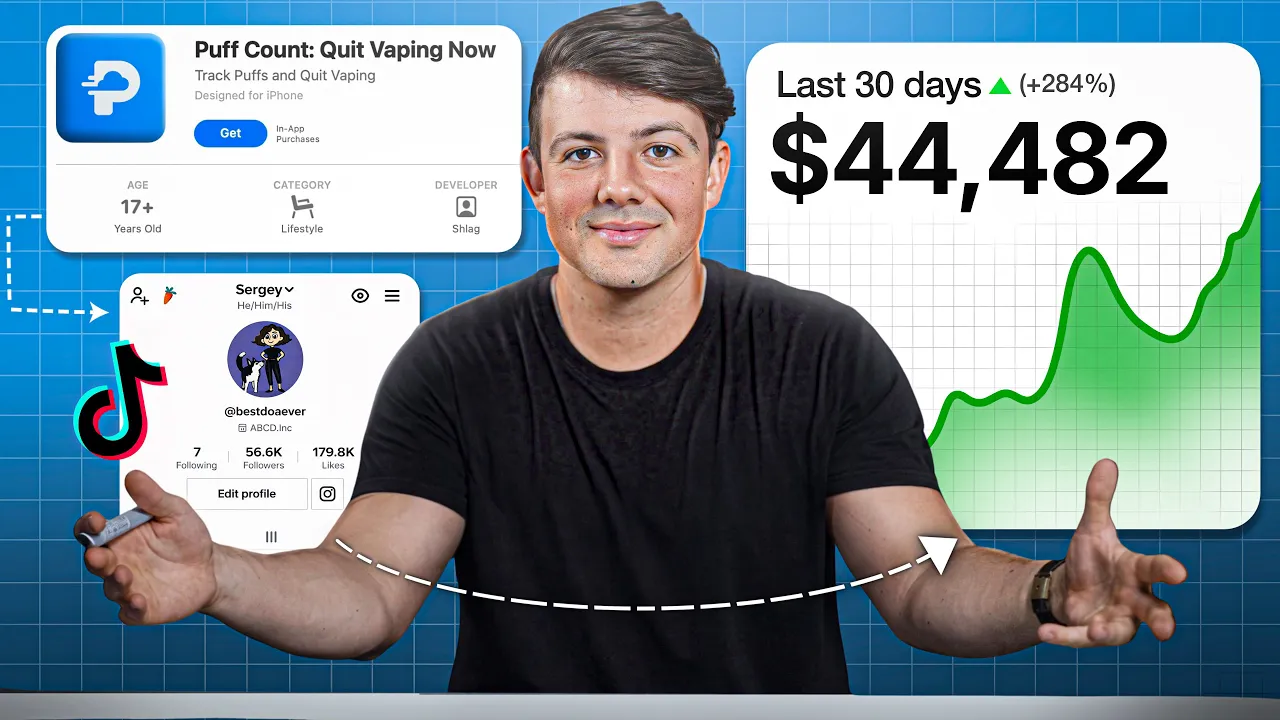
That's what I did and that's how I've been successful with my own mobile apps. And no, you don't need any prior experience building apps or knowing how to code. And hopefully this will shed some light on why mobile apps are one of the best business models out there because once you build it one time, it lives on the app store forever and it will generate you recurring revenue. All of these apps are subscription apps. They're charging weekly, monthly, yearly subscriptions to all of their customers. For context, I've built and scaled multiple apps, like my previous one, PuffCount, which only took me a few hours a week to manage, and it was making $1,300 per day in recurring revenue.
And the app that I'm working on right now, Posted, is doing over $150,000 every single month. So, yes, I know what works. And this is actually the strategy that I use to be successful with my mobile apps. Once I started looking at other apps that were crushing it in the space and learning from them, that's when my apps really took off. So, without further ado, I'm going to show you these apps. Let's get into it. Okay, here we have it. The full viral apps breakdown. I have studied hundreds of viral apps and I picked eight here to show you.
I have absolutely everything about these apps. Their sensor tower links, their onboardings, their pay walls, their Facebook ads. We're going to analyze each and every single one of these apps. Some doing 2 million a month, some doing 300K, 700K, 600K. These apps are insane and I think it's going to surprise you how simple these are. And that's what I want to start with is keep it simple. There's one core feature in each one of these apps which means anybody can build a simple app with one feature with the new AI tools and vibe coding platforms that are available to us.
Now I also want to mention that they all have a similar build. They all have a long onboarding and a hard pay wall. And again the only thing you need to be successful is to identify pain points and make sure that those pain points are marketable just like these apps have. interrupting this broadcast real quick to remind you to like the video. If you like this video, it's going to tell the YouTube algorithm that you want to see more content like this. Content that actually teaches you something instead of the brain rot cat and gaming videos that we're all used to watching all the time.
So, drop a like on the video and if you have a question, drop it in the comments. I'm going to be responding to every single comment for the first 24 hours. Appreciate you. Back to the video. So, let's jump into these. First, I want to show you all of their sensor tower links. Again, I have this all linked in this document. If you want this document, the link is going to be in the description. You can download it for free. So check that out. As you can see, Lerna doing 2 million, 700K on Lazy Fit, Rock Identifier 300K, Coin Snap 700K, Impulse 700K, Cali 2 mil, I am Daily Affirmations 600K.
All these apps have verified revenue by sensor tower. And this is average. Honestly, these are these numbers are probably a little bit low. So let's break down one of these apps real quick. And I think we should start with Cali because they're crushing it. They're doing $2 million per month. Cali is a masterclass at onboarding simple features and a payw wall. So let's take a look at their app itself and we can go ahead and walk through their entire onboarding. Let's speed this up a little bit and we can also check out their features. So you see in the onboarding they make you go through a questionnaire.
They have an intro screen. Where did you hear about us? yada yada yada. Again a super long onboarding to get that buy in from each user that sunk cost bias. As you can see they're spending so much time letting the user customize their experience on Calai. They're letting the user spend time in the app before they approach them with the payw wall, which is coming up here in a second. The user is spending over 3 minutes just in the onboarding. And I I want to break this down real quick. I want to pause right here.
If you show your payw wall before doing all this, before a questionnaire, the user is simply going to bounce. If they open your app and the first thing they see is a payw wall, you're not going to convert anyone. But if they open your app and you ask them questions and you build their experience and they bought into your app, they're like, "Okay, yeah, I'm thinking about my problem a little bit more. I'm customizing my experience." and then you show them the pay wall. They are much more likely to convert. So, let's go through here.
Another cheeky cheeky thing that they do, and I see this in a lot of apps, is they ask for a rating in the onboarding before the user hits the payw wall. You're asking the user to rate the app before they hit the payw wall. So, this is why Calai has so many ratings. They have such a high rating, 4.8 stars on the app store. So, again, push notifications, boom, referral codes, all that jazz. And then finally, they set you up with the custom plan and the payw wall. They make you set a goal, commit to it.
Let's get to the payw wall here. In my opinion, this is the best way to run a payw wall. Right now, they do a threecreen payw wall. The first two screens are priming screens. Check this out. After that questionnaire, they bring you to this screen. It says, "We want you to try Calai for free." This is not the paywall screen. This is a priming screen. So, they click this button. It says, "Try now for $0." Boom. which takes you to the next screen and says, "We'll send you a reminder before your free trial ends." Okay, continue.
Which takes you to the next screen and then boom, this is the real payw wall screen. Only when they click this button are they prompted to put in their payment information and then purchase the trial. And they have a nice reminder here of the process. This builds so much trust with each user. So, they've gone through the three-minute onboarding, they've customized their plan, and now they are building trust with these payw wall priming screens. We want you to try for free. We'll remind you now. Trust us. Try it out for free. They make it an absolute no-brainer.
Anybody who's downloading this app would be stupid to not try the free trial because they make it so easy and they make it so transparent for you. And then of course, boom, you're let in to the app and they have the simple simple features. Any one of these apps that you look at, their onboarding is going to be the exact same. Let's take a look at Reframe for example. I'll show you real quick just to show you that their onboarding is simply the same. very very long extensive onboarding breaking down your problems questionnaire. Even the design looks the exact same as Calai.
So boom, we'll scroll over here again. Create your custom plan, design your trial. They got the payw wall, hard payw wall, of course, reminder before the trial ends. And then boom, people subscribe and they're let into the app. The reason I show you those two onboardings and the hard payw walls is because every successful app in the store is doing this. Extensive onboarding, hard paywall, one core feature. That's it. That's all these apps are doing. As long as you validate the idea, which we're going to get into in a second, that is going to be a killer app.
Where these companies truly set themselves apart is the marketing. As you can see, each one of these companies is actively running Facebook ads. So again, each app has a painoint that they are solving. They have one core feature where they really set themselves apart is their content generation and their scaling with paid ads. This is why these companies are making hundreds of thousands if not millions of dollars per month. All of them are running Facebook ads. All of them crush it in their content generation. Let's take a look at some of their Facebook ads and see how many ads they're running.
Learn 700 active ads. Calai 500 active ads. just lazy fit workout. 640 active ads. These companies are printing money because they do more volume than you. They're posting more content. They're validating that content organically and they're running it on paid. And of course, if you want to do the same and you want to get a ton of content that you own forever to run on paid ads, then you should launch a deal on Posted. On Posted, you can launch a deal for free. You only pay for the content that you love. only pay for the content that you approve.
And again, you own all of that content for life. So you can scale it on paid ads, on Tik Tok ads. You can post it anywhere you want. It is your content forever. You can start for free. You can start your free trial. And once you get into Posted, you can even run a CPMbased deal where you're only paying creators based on the amount of views they get. Posted is the fastest way to get a lot of content done in bulk so that you can scale on paid ads like all of these other apps. The link to Postit is going to be in the description.
Okay, so hopefully that's clear. You need a lot of content. All these companies are running a ton of content on paid ads. And they're not running this content because it's not profitable. I promise you that. They're not just spending random money on hundreds of pieces of content. They're not doing it. But you know why these ads are profitable? Because these companies have maximized their LTV. And what is LTV? It is the lifetime value of each user. These companies have been AB testing their pay walls. I promise you that to find the absolute highest price point that they can.
And because they have such high LTVs, they are able to outspend their competitors on paid ads. Cali is pushing you for the yearly plan, which is $30 per year. They're collecting $30 upfront after 3 days from every single user immediately. Reframe pushing you towards the yearly plan. You only get the free trial if you go for the yearly plan, which is $99 per year. Lazy Fit, the app doing 700K per month. Guess what? They're pushing you towards the yearly plan. You only get the free trial if you go for the yearly plan, $40 per year.
There is a reason all of these apps are only offering the free trial on the yearly plan. It's because it maximizes the amount of money you collect back faster. They're offering you the free trial and then you convert on the yearly plan, which maximizes the value of each user. The higher your LTV is, the more you can spend on paid ads, which is why all these companies are running Facebook ads. They're all running hundreds of pieces of content on Facebook ads because it's profitable. They're building money printing machines. All of these apps are simple. The building process, making these apps, is not the hard part.
This is the hard part. Generating content that converts, scaling with paid, maximizing your LTV, all of this takes AB testing. This is what sets apart the successful apps from all the duds in the app store. So hopefully now you understand that it doesn't take some super complex idea to build a successful mobile app. The most important part is marketing, shipping fast, getting feedback and iterating. So let's put together an implementation road map. How can anyone do this and scale like these other apps? Step one is building fast and cheap. Again, you need to pick an idea that solves a problem.
You can validate that idea by looking at these competitors, right? You can go on Google Trends and you can type in and you can see the search volume on Google. That's always a good indicator. And of course, you should always look on social media. Make sure that your general concept for your app goes viral on social media in some capacity. Okay? Pick an idea that solves a problem. Validate it with market research. And then build it quickly. Don't spend more than 2 to 4 weeks building an app. You don't need to anymore. You need to get ideas out there, start getting feedback, start generating revenue so that you can understand what works and what scales.
Now, you can build a simple MVP with these vibe coding platforms like ROR or Emergent or Bolt. They're all the exact same. You type in what exactly you want to build, and it will build it for you. A simple MVP. And this will get you 70% of the way there. Building on any one of these platforms will build you a nice frontend. You're not going to get the complex features that you might want, but it will get you 70% of the way there. You'll have a nice shell for your app. And then to finish off the last 30%, whatever bugs you have, getting it into the app store, making it compliant, whatever it may be, just hire a developer on Upwork.
I dropped a full video on hiring developers. If you build a simple MVP on these vibe coding platforms, you'll get 70% of the way there, and you will only have to pay a developer on Upwork 500, a,000, 2,000 bucks maybe, to finish off your product, to implement all the analytic software to implement Superwall for your payw wall. Just hire a developer. Do it faster. Why spend months of your life trying to figure out how to debug and get all these precise little things in your app? You don't need to do that. Just vibe code it on one of these platforms and then hire a developer to finalize it.
And lastly, don't make it perfect. Every single app that I have launched has had bugs. All of these apps have bugs. They have bad reviews. Now, of course, I'm glazing over this pretty quickly, but if you want the full hour-long guide on how to build, scale, and exit apps, I dropped a full video on that. It will be in the description. I covered absolutely everything on building successful apps very quickly. So, be sure to check out that video. And on top of that, too, I put together the ultimate mobile app tech stack. This is absolutely every tool that you need from research to design to development to optimization, marketing and scaling.
I put together the entire tech stack that you will need to build and scale your entire app. It's all here. This will also be in the description for you. And now to recap on the marketing, we need to produce a lot of content. Volume is the key point here. We need to post a lot and we can test that content organically. We can post it organically on our own social media profiles. See what gets the most views and then we scale that on paid. And of course, you need to maximize for your LTV. So charge as much as you possibly can and take a page out of these successful apps books.
Charge a yearly plan. Make it a yearly plan on your app so that you're collecting a majority of the money upfront. Building a successful mobile app is not about building the next Facebook, the next Instagram. It's not about having the best technology. It's not about having a million features. It's about finding real pain, building fast, iterating fast, and mastering distribution. Mastering content creation, mastering marketing, mastering paid ads. That is how all the most successful apps are winning right now. Marketing is 90% of the success of any mobile app. If you enjoyed this video, I put together a group of driven app founders and we meet three times every single week to chat everything apps.
We chat about ideas, we chat about building, we chat about marketing, we share tips and tricks with each other. So, if you want to be a part of that group, shoot me a DM on Instagram. Just send me a message, tell me what you're working on, and I'll add you into the group. Hopefully, you enjoyed the video. If you stuck around this long, I would appreciate a like and subscribe to the channel because I'm going to be dropping more videos just like this all the time. Catch you on the next one. Peace.
More from Steven Cravotta
Related Videos

Social Media Marketing Full Course 2026 | Social Media Marketing Tutorial | SMM Course | Simplilearn
 Simplilearn
 05:04:51

How LLMs Work? | How Large Language Models Work | What Are LLMs? | LLMs Explained | Simplilearn
Simplilearn 00:09:59

![Digital Marketing Full Course 2026 [FREE] | Digital Marketing Tutorial For Beginners | Simplilearn thumbnail](https://rewiz.app/images?url=https://i.ytimg.com/vi/O8dbND5jrOI/maxresdefault.jpg)
Digital Marketing Full Course 2026 [FREE] | Digital Marketing Tutorial For Beginners | Simplilearn
Simplilearn 05:30:20
![Social Media Marketing Full Course 2026 [FREE] | Social Media Marketing Tutorial | Simplilearn thumbnail](https://rewiz.app/images?url=https://i.ytimg.com/vi/XMnsLPIUfWs/maxresdefault.jpg)
Social Media Marketing Full Course 2026 [FREE] | Social Media Marketing Tutorial | Simplilearn
Simplilearn 07:03:54


Get daily recaps from
Steven Cravotta
AI-powered summaries delivered to your inbox. Save hours every week while staying fully informed.