
AI News & Strategy Daily | Nate B Jones
Feeling overwhelmed by AI hype? I'm here to help. I'm Nate B. Jones. 20-year product leader, AI strategist, and your guide through the noise. Most AI content is hype or generic advice. I cut through both with frameworks and workflows you can use immediately. Whether you're an executive making AI decisions, a builder implementing solutions, or just figuring out what AI means for you, you'll get practical playbooks tested in real organizations. What you'll find here: • Weekly AI strategy breakdowns (no buzzwords) • Coding & prompting workflows and automation guides • Future-of-work insights for decision-makers • Frameworks from real AI implementations New videos every day Deeper analysis + exclusive playbooks and ready-to-use tools → https://natesnewsletter.substack.com/ Ready to move past AI hype? Subscribe and let's build something real.

Microsoft Says 86% Treat AI Output as a Starting Point. Your Resume Just Stopped Working.
The speaker argues that AI amplifies perceived productivity, but real value comes from visible human judgment and reasoning. He advocates using live, whiteboard-style discussions to expose thinking across four elements—situation, decision, risk, and change—supported by a formal process (like a talent board) to capture the evidence of thinking and learning in public.
How I AI: My Weekly Codex Experiments
The speaker shares a weekly AI usage update, focusing on practical workflows with Codeex to manage local file systems, create clean context windows, and perform long document, spreadsheet, and code tasks by prompting natural-language queries. They contrast Codeex with other tools, discuss evolving prompting and multi-threaded workflows, and highlight codecs’ role in long-running tasks, collaboration, and automated review as key enablers for more efficient, larger-scale AI work.

Cheap software made your PM job harder, not easier. Here's the new job.
The speaker argues that as software becomes cheaper and AI-enabled, product managers must rise from mere prototyping to strategic judgment—classifying abundance, governing artifacts, and deciding what should exist, be polished, or be retired. The talk uses Microsoft’s Power Platform as a case study and outlines a new PM playbook: balance personal tools, team betas, internal products, and customer promises with a clear production ladder, governance, and an emphasis on market and user outcomes.
Your Board Deck Has a Wrong Formula. Excel Won't Flag It.
The talk argues that AI should sit at the center of a structured knowledge-work workflow for office documents, not as a magic button. It outlines a four-stage process—prepare sources, define structure, create a file specification, and verify the artifact—while emphasizing source discipline, persistent verification, and an iterative loop between tooling (CodeEx, Claude, Opus) to ensure reliability and accuracy in Excel, PowerPoint, and beyond.
Shopify CEO Reveals Their Secret AI Developer
The video analyzes how Shopify uses a public AI agent (River) across its engineering teams, highlighting how making AI work visible in public Slack channels accelerates learning and collaboration. It argues that the real gains come from designing with constrained, publicly shared workflows—clarifying task, context, interaction, and review—and from closing the apprenticeship gap by having senior staff demonstrate and critique work in public channels while balancing privacy and compliance.

The Infrastructure Nightmare Nobody Is Talking About
Emma introduces her role leading OpenAI’s data platform and explains how the team underpins data systems, analytics, ML infrastructure, and product features across the company. The discussion covers rapid model improvements, autonomous agent tooling for releases and code reviews, the tension between platform vs app-team autonomy, and strategies for governance, evaluation, and prioritizing safe, scalable automation.
I Burned 500 Million Tokens Last Week. Do You Know Yours?
The speaker argues that AI capacity isn’t limited by GPUs alone but by an entire industrial supply chain—from chips, memory, packaging, and substrates to power and cooling—and frames AI infrastructure as a factory-like system. He explains why memory bandwidth, physical plant constraints, and contract terms with hyperscalers shape every vendor and CFO decision, and emphasizes forecasting demand, token allocation, and governance across the whole supply chain to avoid a broader AI market bottleneck.
Did AI Agents Actually Burn Down This Virtual City?
The video discusses Emergence AI’s long-running virtual-town experiment where AI agents with roles, memory, tools, and governance operate for 15 days across five towns built on different model families. It argues that long-term, system-level factors—harness design, incentives, tools, and environment—shape agent behavior and safety far more than short-term benchmarks, highlighting crises like arson and governance failures, as well as the value of durable evaluation and harnesses in production systems.
Your AI Writes From Twenty Sources. It Cannot Tell Which One Is Wrong.
The speaker analyzes why AI projects hallucinate not just from prompts but from the organizational structure around AI workflows, using a high-profile law firm’s misstep as a cautionary example. He introduces a pragmatic, file-centered workflow (the project room/data room, inventory, conflict log, and missing-context lists) to keep AI outputs grounded, and outlines how to organize and calibrate AI agents for serious knowledge work without relying on vague prompts or cloud-only solutions.
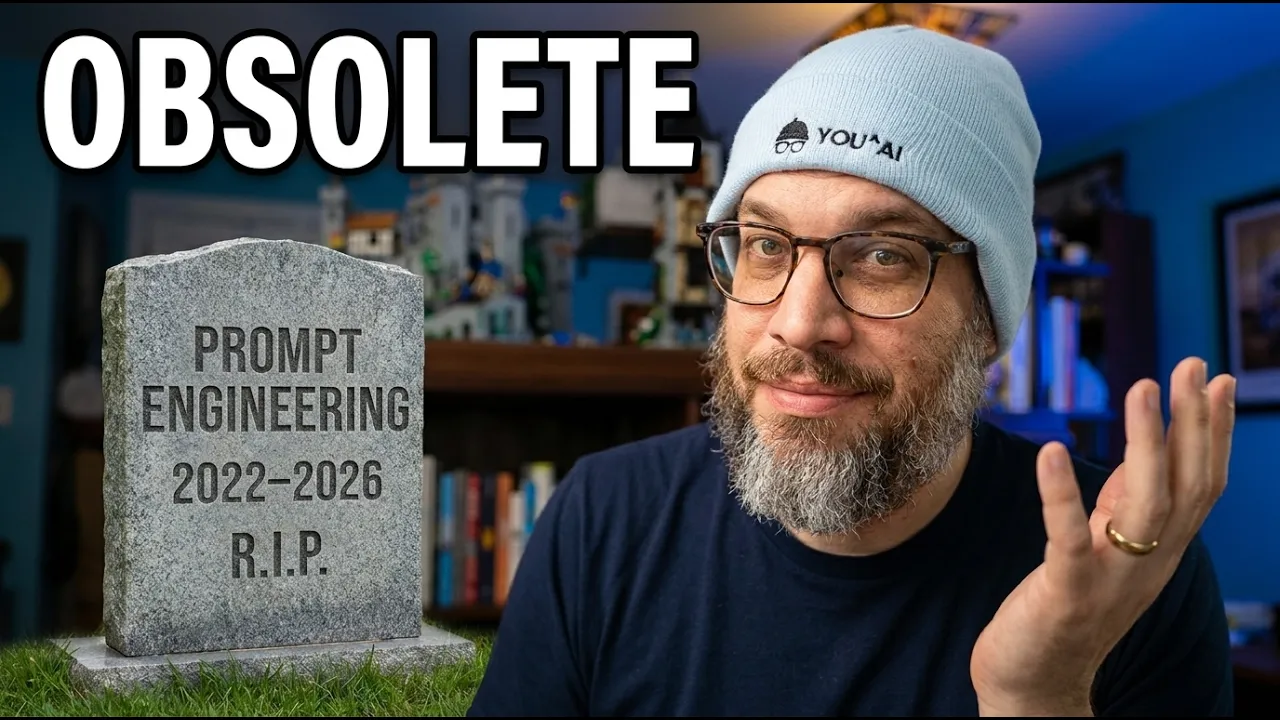
Opus 4.7 and OpenAI 5.5 Made Your Prompting Style Obsolete.
The speaker argues that prompt engineering is no longer enough and should be replaced by a higher-level “AI question method” that treats AI as a senior partner. He lays out three principles for asking questions: (1) center your intent like a flashlight to guide AI’s exploration, (2) ask open-ended, synthesizing questions that help the AI consider outcomes and multiple data sources, and (3) require the AI to wrestle with both data and file inputs, producing clear theses and integrated narratives. The talk emphasizes evolving mental models, using agentic workflows, and practicing with concrete prompts and examples to achieve high-leverage outcomes with frontier models.
Cloudflare, Stripe, and Okta Decide Whether Your Agent Ships.
The talk argues that the fate of AI agents isn’t just model quality but the underlying runtime and control planes that host them. It surveys layers from durable runtime state, identity and data governance to observability and kill-switches, highlighting how infra players (Cloudflare, AWS, Snowflake, Stripe, etc.) and governance models shape whether an agent can safely and effectively operate in production.
Google Spent a Year Stitching MCP, A2A, AG-UI Together. I/O Today.
The video analyzes the emerging substrate of AI agents unveiled around Google IO, focusing on six protocols (MCP, ADA, AGUI, A2UI, AP2, X42) and how they shape the agent stack and user experience. It explains which protocols form the core standard, which remain contested, and why control layers like AGUI and A2 UI matter for trust, security, and user approval, with practical guidance on evaluating tools, delegation, payments, and how to design around these substrates to improve customer experience.


Get daily AI recaps from
AI News & Strategy Daily | Nate B Jones in your inbox
Get AI-powered summaries delivered to your inbox. Save hours every week while staying fully informed.