Google Took WPBeginner From 2.6M Clicks to 27K - Here’s Why

Chapters8
The chapter outlines WPBeginner's drastic traffic drop from Google (from about 2.6 million clicks to tens of thousands) and sets up a discussion on potential causes and how to avoid a similar fate.
Edward Sturm analyzes WPBeginner’s traffic collapse, weighing algorithm updates, promotional content concerns, and pruning strategies as a path to recovery.
Summary
Edward Sturm breaks down WPBeginner’s dramatic drop in Google clicks—from 2.6 million in May 2021 to about 27,000 in June 2024—using a mix of data points from Semrush, Ahrefs, and social posts. He foregrounds the role of Google’s updates, notably the September 2023 Helpful Content update, and debates whether AI, independent-publisher bias, content decay, or keyword cannibalization can explain the collapse. The discussion leans into user signals and content quality, highlighting WPBeginner’s long, promotional articles as potential misalignments with Google’s era of bite-sized, user-focused content. Lars Lofgren’s comments and LinkedIn post provide a backbone for the most likely corrective actions: aggressive site pruning, shifting toward core WordPress topics, and a move to shorter, conversion-focused SEO pages. Sturm also references Lars’s two-hour episode on pruning and emphasizes the importance of reevaluating strategy, reducing page count, and tightening the editorial format to serve readers faster. The piece ends with an invitation to the audience to share alternative explanations, underscoring the value of community insight in diagnosing a complex rankings decline.
Key Takeaways
- WPBeginner’s traffic collapse aligns with multiple Google core updates, not just the post-ChatGPT era, suggesting systemic issues beyond AI-driven clicks.
- WPBeginner’s October 2023–June 2024 page-velocity spike and subsequent drop coincide with the Helpful Content update, complicating attribution to a single cause.
- Self-promotional, top-of-funnel content can perform in the short term, but broad, promotional coverage harms long-term rankings and user trust when readers expect learning over selling.
- Contents decay was acknowledged by WPBeginner and reportedly addressed, yet the ongoing decline implies deeper structural issues beyond outdated articles.
- Keyword cannibalization likely contributed but cannot explain a drop of over 2.5M clicks, given the concurrent alignment with algorithmic changes.
- Lars Lofgren advocates aggressive site pruning (cutting to 200–500 pages) and a shift to bottom-of-funnel, conversion-focused SEO pages to recover authority.
- Prominent domain authority (DA 80) provides WPBeginner a strong foundation for a comeback if they pivot to concise, high-value content and transparent promotion.
Who Is This For?
This analysis is essential reading for WordPress-focused publishers, SEO strategists, and content teams facing traffic erosion after Google algorithm shifts. It offers concrete diagnostic angles and pruning tactics to consider when a long-standing authority site loses visibility.
Notable Quotes
"A few things stand out to me. They have major audiences on YouTube, Twitter, et cetera. So, that alone wasn't enough to save the site."
—Shows social presence isn’t guaranteeing resilience against algorithmic changes.
"After their first big hit, which coincides with the September 2023 Google helpful content update... there is a tremendous spike in organic pages."
—Links page expansion around a pivotal algorithm update, hinting at possible misalignment.
"The first step is to have a very candid conversation about the P&L internally."
—Highlights the need for financial pragmatism before content strategy fixes.
"Go down to the core at least until the domain is healthy. Sever the leg to save the patient."
—Lars’s pruning philosophy: trim complexity to restore health.
"Write shorter, more direct posts. No long intros. Give the answer right away above the fold."
—Advocates for a compact, conversion-focused content format.
Questions This Video Answers
- What caused WPBeginner’s traffic to tank after 2021?
- How does Google’s Helpful Content update affect niche blogs like WPBeginner?
- What pruning strategies can a high-DA site use to recover SEO?
- Should publishers shorten blog posts to recover rankings after algorithm shifts?
- How can WordPress tutorial sites compete with affiliate-promotional content without hurting SEO?
Google Helpful Content UpdateWPBeginnerLars LofgrenSite pruningConversion-based SEOContent decayKeyword cannibalizationAI impact on searchNapLab SEOWordPress tutorials
Full Transcript
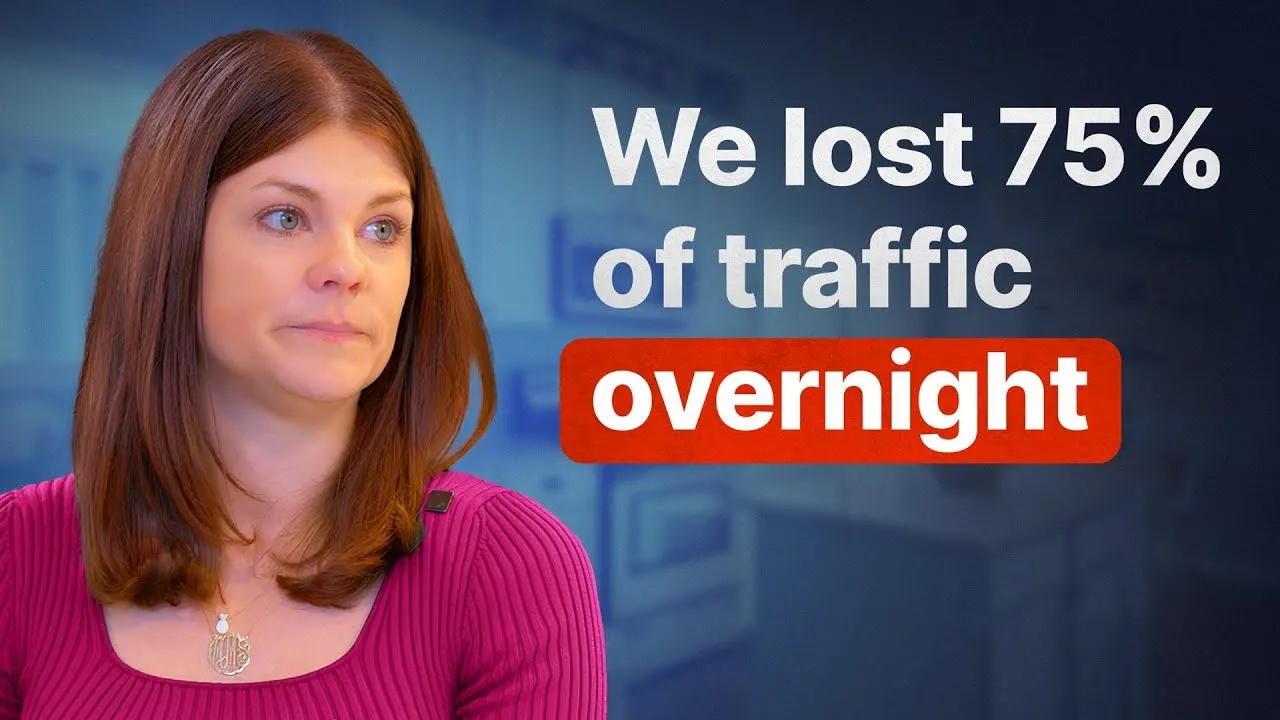
So heartbreaking to see one of the all-time great blogs in the website category taken out back and old yellowed by Google. Who is it? WPBeginner. In May 2021, this is from Semrush, WPBeginner was at 2.6 million clicks a month from Google. I remember hearing on a podcast that the founder of WPBeginner became a billionaire from this company, but now WPBeginner is down to 32,000 clicks a month from Google. It went down and down and down from 2.6 million clicks a month, its all-time high in May 2021, to just Oh, actually even further, to 27,000 clicks a month now in June.
If you have been learning WordPress over the last 10 years, you probably came across WPBeginner. If you spent some time learning WordPress over the last decade, probably came across this website, this blog, this company. It gives beginner-friendly tutorials, guides, tips, resources for building and for managing websites with WordPress. And as I just described, it ranked everywhere. That's why you probably came across it if you were trying to learn something with WordPress. But not anymore. So, on this episode of the show, we are going to talk about what might have caused this downfall, how you can avoid it, and then can WPBeginner fix it?
How might they fix it? The opening line for this podcast is from Lars Lofgren, who's been on the show several times before. I love Lars. He posted about this on X, and then he posted about this on LinkedIn as well. So, this is now from his LinkedIn post on WPBeginner. He said, "A few things stand out to me. They have major audiences on YouTube, Twitter, et cetera. So, that alone wasn't enough to save the site. Maybe their social engagement isn't high enough. It is low on their channels, which is pretty typical for B2B channels though.
Their total pages did spike from 2,000 to 18 to 20,000 shortly after their first big hit. Now, their pages are down to 3,000 recently. Big red flag. Maybe it's just a reporting issue though. Usually, when I see stuff like this, someone did a dumb programmatic play. No idea if that's the case here. So, on Ahrefs, looking at organic pages against organic traffic, we see that after their first big hit, which coincides with the September 2023 Google helpful content update that destroyed so many niche blogs, after there is a tremendous spike in organic pages. They're very close together, but since it lost so much organic traffic around the same time as the same Google update that crushed so many other niche blogs, it's hard to say if this spike in pages, which came after on this graph, is related, or if it's a bug, or if it's something else.
So, we're going to start with possible causes for WPBeginner's downfall, then go into what I think are the most likely causes. Possible causes: AI is stealing clicks. They have a lot of top of funnel content, a lot of tutorials, a lot of guides, tips, resources. So, AI is stealing clicks. That is a possible cause. However, they lost a lot of traffic, organic traffic, before the December 2022 launch of ChatGPT. And AI stealing clicks doesn't explain their rankings being lost. They lost rankings just as steadily as they lost organic traffic. So, if AI was just taking clicks, you would expect their rankings to remain relatively steady.
That did not happen. Another theory is that Google just hates independent publishers. I read that as a theory as to why they have lost all of their organic traffic, but the reality is plenty of independent publishers still rank. I had on the founder of NapLab, which is the biggest mattress SEO affiliate, and they are actually, according to SEMrush, they are at an all-time high with their organic traffic. They are doing even better than when their founder came on this podcast a couple of months ago. And you can listen to how this founder created and built NapLab and why it's the biggest mattress SEO affiliate.
Episode 898 of this podcast, how NapLab built an SEO moat, 103,000 keywords, no shortcuts. That's the founder of NapLab talking about what he did. So, I don't think it's just Google hates independent publishers. Another possible cause is content decay. They have too much out of date content. And actually, WPBeginner put up a post about content decay. They said that it was a problem for them, and they said that they updated their articles, and they fixed it. They fixed their content decay. That's what they said. And they said that they updated their articles and that they fixed content decay or made a big effort fixing content decay.
And so, I don't think it's that, either. Another real possible option is keyword cannibalization. They have too much content saying the same thing, and so nothing is ranking or worse pages rank, and then because these bad pages are ranking, the pages get taken out of the index, and they keep losing and losing and losing. And this could have played into things a bit. But, I don't think that keyword cannibalization alone explains a loss of 2.6 million clicks a month to 27,000 clicks a month, especially considering that their drops in organic traffic time up with Google core algorithm updates.
So, I don't think keyword cannibalization is a root cause. Could have played a part, but I don't think it is the root cause. Let's get into what the most likely causes are. Going back to the comments of Lars's post about WPBeginner on X, I thought there were a lot of good comments there. This is from a user Joe Youngblood, whose content I really like. He He posts some good stuff, and I want to invite him onto this podcast. I need to send him an invite. He said, "In Google's defense, it's mostly them listing their own plugins number one on every post." And this is a recurring theme that people complain about, that they have too many posts that are overly promotional.
These overly promotional posts result in bad user signals over and over and over and over and over again. People are going back to the search results to click on something else because they don't like the posts that they're on. Or worse, they're becoming accustomed to WPBeginner delivering content that they don't like, that's too promotional. And so they don't even click on it in the first place because they don't like the brand. And if you are consistently learning WordPress, going deep on different topics, you might just identify this as a brand that you no longer want to engage with.
And so you stop clicking on it in the SERPs, in the search engine results pages. Here's some more comments related to this. This is from somebody named Donovan, who said, "Thank God WPBeginner has always been a spammy piece of poop." And actually, Joe Youngblood added to his first post and said, "You should disclose that it is you ranking yourself first for whatever the best post is." And WPBeginner doesn't do that, which annoys him to no end. So basically, they're not disclosing that they are putting themselves number one. They're not being transparent about the self-promotion. Another user, Swift Lunatic, commented, "I'm sorry, but I only ever read about plugins they have to offer.
The blog is built around those plugins. I don't really get any insights about anything other than using their premium plugins, which you need to purchase, and that is not really helpful content. Lars countered with, "I've got a lot of value out of their WP tutorials and helpful articles." And then, Swift Lunatic said, "I'm new to reading the blog. I see great and detailed posts, but they seem to be promoting their plugins and how to use them, not really much value when I don't use the plugins." So, people are saying the same thing over and over again about the blog.
And in fact, here's somebody saying that he avoided them in the SERPs altogether. Somebody named Christian in these comments said, "WP Beginner didn't bring any value. I always avoided their blog due to spammy and low-quality suggestions. They might work on it, yes, but to sell ads or plugin affiliates, not to give any real value." So, here's somebody just saying, "I avoided the brand in the SERPs." My take on all of this is self-promotionalisticols and overly promotional content is known to work. That's the reality. I will not claim that self-promotionalisticols don't work, overly promotional content doesn't work, but the thing is, it works best in small quantities and brands get hit in large quantities.
Plenty of brands get away with it until they don't. And you see this all the time, brands go hard with self-promotionalisticols, they go hard, they they pump out so many, and then they get hit. But, there are other brands that do it sparingly and it's fine. So, again, overly promotional content in small quantities, A-OK. That's my take. The nuance is, if it's promotional content for keywords where people expect you to be promotional, that's totally okay. But, this is more overly promotional content for top-of-funnel keywords where searchers don't want to be promoted, they want to learn something.
They don't want to be promoted to, they want to learn something. The last, very likely cause is fluffy posts. I actually think this is the biggest one. It's long posts that have so much fluff where it takes forever to get your answer. Here's somebody else in the comments of Lars's post, somebody named Celeste, who said the first 2,000 words were usually what is WordPress? Why should you blog in WordPress? How do blog in WordPress? And then the answer. So after 2,000 words and you're scrolling and sifting, you would get your answer. And I remember this being the case myself, having to look through so much content to get an answer that at best would be thin.
It's not going to give you the answer that you're looking for. It's going to be a thin basic answer. I think these long introduction blog posts where you have to dig and scroll and sift for your answer, I think it's a bad format and it doesn't work anymore. People don't want it. Look at what Google prioritized in its algorithms at the same time that WP Beginner was losing traffic. Google was prioritizing short user-generated content that's one, more trusted because it's UGC, and two, shorter and easier to consume. Now, of course, people are gaming UGC all the time, but at the time when it was being prioritized in the SERPs, that wasn't the case as much.
It was less promotional, trusting more, and just way shorter. You got your answers so much faster. Shorter and easier to consume. And then the last thing to mention is rather than pausing and reevaluating as WP Beginner kept losing organic traffic, it looks like they put out a ton more pages. Again, we're not sure why that was or if it was a reporting bug, but the best thing would have been to say, "Okay, something isn't working. Let's just pause for a month or two and just kind of reevaluate and think about what we're doing. Why might this be the case?" So, can they rebound?
I'm going to start with Lars and then I'm going to give my take. This is from Lars on LinkedIn. He said, "The first step is to have a very candid conversation about the P&L internally. If revenue is still dependent on Google, assume revenue does not come back anytime soon and cut costs aggressively. Work backwards from there. Even if a source of cash is available, not sure I would tap it. There are probably better places to invest that cash given the current Google environment. He said, "If there hasn't been a very aggressive site purge in the last 24 months, do one now.
I'd start with a target of 80% of the site. Get down to 200 to 500 pages in total." And we had a mega episode, a 2-hour plus episode with Lars Lofgren, David Queda, and Gagan Gutra talking about the Google helpful content update. And Lars explained in great detail how he performs purges and pruning. And so if you want to hear that and you are in a similar situation, I would really recommend this episode, episode 989 of this podcast, Google's helpful content update destroyed the internet. What actually happened? And again, Lars goes deep into pruning and purging and his methodology and his reasoning.
And there's a lot more talked about in that episode on how all these niche blogs got hit by Google helpful content updates. Lars continued in his LinkedIn post said, "Google hammers sites when they overexpand. I might consider cutting everything that isn't related to WordPress. Go down to the core at least until the domain is healthy. Sever the leg to save the patient. More like all limbs in this case. I am fully aware of how much revenue is in the adjacent category of website/hosting, but that seems out of reach at this point. So it's possible that like HubSpot, WPBeginner extended their topical authority too much into spaces where they just didn't have real authority that wasn't core to their business.
I got to say, I'm with Lars on pruning and consolidating. Rewriting as well. Write shorter, more direct posts. No long intros. Give the answer right away above the fold. WPBeginner has a domain authority of 80 out of 100. That's incredibly high. They can rank for a lot, but I want to add that they should change their SEO format. If they want to promote with SEO, that's normal. That's great. But do it with shorter use case pages that are made for converting. What they have been doing is they're using top of funnel content to promote too much on pages where people are expecting to learn.
Instead, do bottom of funnel SEO. Conversion based SEO landing pages. This is what I teach in my SEO course, compact keywords, targeting people who are literally looking for what WPBeginner sells. There are people who are searching in so many different ways for what WPBeginner sells. Find the keywords that they are searching, make short conversion based SEO landing pages for these keywords, and you are not shoehorning promotion in because these pages are meant as promotion. These pages are meant to sell, and the searchers are expecting to be sold. You're not treating top of funnel as bottom of funnel, which by the way is an It's one of the biggest problems in SEO is that people get the intent wrong.
SEOs are getting the intent of keywords wrong. That's one of the biggest problems in SEO. You find keywords instead that have high intent, where the intent is to be sold. And then you're not making these long fluffy blog posts, you're making short conversion based SEO landing pages. Exactly what I teach with the thing on my shirt, compact keywords. If you're watching on YouTube, I've a blue compact keyword shirt on. This is what I teach in my course. It's the best form of SEO. That's why I preach about it nonstop. compactkeywords.com, by the way. If you haven't checked it out yet, you're going to love it.
So, in short, it looks like WPBeginner got hit by algorithm update after algorithm update, which were likely prioritizing users who don't want to dig through thousands of words of self-promotion just to get an incomplete answer. And so, these algorithm updates were instead serving these searchers content that was quick to consume and less promotional. And it could be that simple. Or maybe I'm wrong and it's something completely different. Thank you Lars for his write-ups on X and on LinkedIn. And thank you to the commenters. If you think I am completely wrong about this, maybe it's something different, let me know in the comments.
I'm curious what the community has to say. I'm curious what everyone has to say. I want to know. But that's my take from what I am seeing so far. RIP WPBeginner for now, but again, they can make a glorious comeback and I hope that happens. This is episode 1082 of this podcast. 1082 days in a row doing this show. This is my daily search engine optimization podcast. If you watch this on YouTube, thank you so much for watching. If you listened on Spotify or Apple Podcasts, thank you so much for listening. And I will talk to you again tomorrow.
Bye now.
More from Edward Sturm



Get daily recaps from
Edward Sturm
AI-powered summaries delivered to your inbox. Save hours every week while staying fully informed.