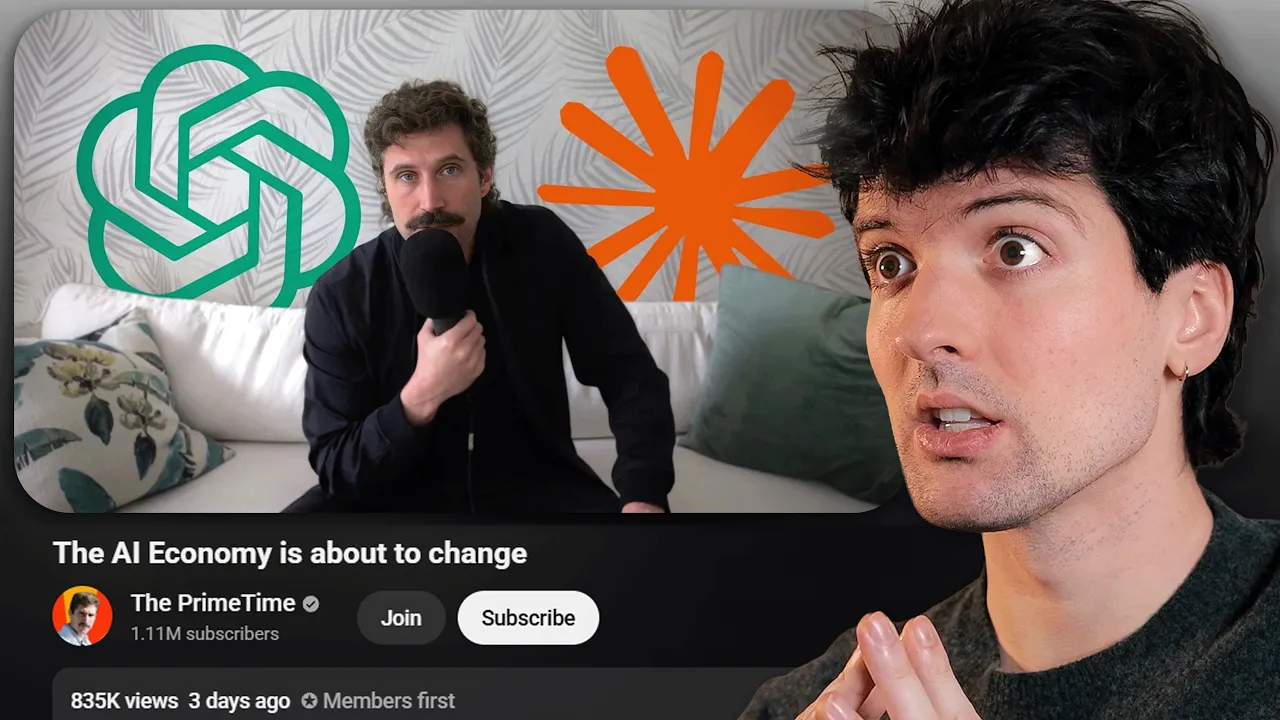
The AI Economy is about to change

Chapters6
Anthropic tested pricing changes by removing access to Claude on the $20 plan, revealing a subtle price elasticity strategy that can profit from limited access rather than raising list prices.
AI economics are tightening: pricing tests and token-based costs are reshaping big players, with Google keeping a long-run advantage.
Summary
The video from The PrimeTime argues that the AI economy is entering a tighter phase. The host highlights Anthropic's painted door test, which removed certain features from the $20 Claude plan to observe willingness to pay and actual usage changes. He contrasts this with the harsher math of inference costs and model pricing, noting that OpenAI’s massive investment runway creates pressure to monetize more aggressively. Microsoft responds by shifting Copilot pricing to token-based usage, linking cost to the model chosen and reducing free-capacity accordingly. The narrator also points to Google, arguing that their enormous, steady AI investment (well into the hundreds of billions annually) still proves profitable and less pressured by investor timelines. Uber’s claim of spending an entire year’s AI budget in four months is used to illustrate how generative AI adoption is accelerating but costly for enterprises. The speaker emphasizes that AI will not remain free forever and that real-world economics will drive pricing and access. He closes with a push-pull view: AI is powerful and exciting, but the market must balance innovation with sustainable economics and value creation.
Key Takeaways
- Anthropic ran a painted door test by removing Claude code access on the $20 plan, nudging some users to pay more or leave but revealing revenue implications.
- OpenAI reportedly has a $120–$122 billion investment runway, implying monthly costs of roughly $5–7 billion to operate for the next 18–24 months.
- GitHub Copilot pricing shifted from access-based to token-based usage to reflect varying costs between cheaper and pricier models.
- Google continues to invest massively in AI (hundreds of billions annually) and remains profitable, giving it long-term capital to weather short-term market swings.
- Uber disclosed spending its entire yearly AI budget in four months, highlighting intensifying AI adoption and cost pressure on enterprises.
- Overall, the video argues that AI usage is trending downward in terms of free availability but will adapt through pricing and model economics rather than disappearing.
- Pricing and cost structures are now central to AI adoption, with inference costs and model selection driving real economic decisions.
Who Is This For?
AI product managers, ML engineers, and startup founders who need to understand current pricing shifts and macroeconomic pressures shaping enterprise AI adoption.
Notable Quotes
"The cracks are starting to show. The foundations looking a little bit shaky."
—Opening frame about the AI economy facing stress and uncertainty.
"They’re making money off of every request."
—Commentary on monetization via inference costs.
"Google’s also competing on the frontier. Google’s also attempting to win the market."
—Argues why Google can sustain AI investments long-term.
"Uber just got done claiming that within four months they spent their entire year's budget on AI."
—Illustrates extreme AI spending by enterprises.
"Sure, it may be in a couple years, but you know what? They’re going to find a way to make this thing viable."
—Balanced outlook on eventual economic viability of AI.
Questions This Video Answers
- How does Anthropic's painted door test affect pricing strategy for AI products?
- Why are major platforms moving to token-based pricing for Copilot and other AI services?
- What is Google's level of AI investment and why does it matter for the market?
- How does Uber's reported AI budget usage influence enterprise AI planning?
- Will AI services stay free or become paid over time, and what economics drive that shift?
Anthropic Painted Door TestClaude pricingOpenAI investment runwayMicrosoft Copilot pricingGitHub Copilot token pricingGoogle AI investmentUber AI budgetAI economicsInference costPricing strategy in AI
Full Transcript
All right, fellas. It's happening. The cracks are starting to show. The foundations looking a little bit shaky. I'm talking talking about the AI economy, the token economy. Uh the first one comes courtesy of course of Anthropic, everybody's favorite, the good guys, am I right? I love their lawyers. What ended up happening just a couple days ago is Anthropic did something called a painted door test. At least that's the term I've always heard. I think I've seen other people use fake door test where you actually show alternative pricing on your page to see, hey, how much more money could we make if we charged people more?
How many more people would leave the pricing page? So, let me give you a a hypothetical. Let's say that you raised the cost of your product by 10%. And a,000 people visit your pricing page. Typically, you'd get a 100 customers out of your thousand customers. But now, with your raised prices, you only get 95 customers. But of those 95 customers, you make more money. So you say, "Hey, the area under the curve is worth it. We're going to lose a couple customers, but we're going to gain more money." This is kind of the idea of a painted door test.
But Anthropic did something a bit different. Instead of doing a price change, they just simply removed clawed code usage from the $20 plan. See, in a typical painted door test, after someone says, "Okay, we'll pay this price." They're like, "JK, bro. You're super special to us, so you get actually a reduced price because we love you." Well, this one, there's an entire group of people that when they visited this page saw they couldn't use Claude code for $20 a month. They paid $100 a month. It just tricked some small percentage of people. I don't think anyone's surprised by this.
And the people that are surprised by it, you always hear kind of the same thing. Well, they're making money off of inference. like every time they do like a request call, of course they make money. It's like, yeah, I guess if you measured how much a shoe cost by only paying the employee to sell the shoe, then you're like, "Yeah, you're making money off of every shoe. They're making money off of every request." Yeah, that makes sense, but you're not actually considering the real cost. Remember, people that used Opus 45 are now using Opus 46.
Nobody's using Opus 47. A kind of tarted model. No, no one really likes that one. But that means all the cost that went into 45 if they didn't recoup that in inference cost 45 just cost them money. And this is obviously what's happening. Open AI got 122 or $120 billion investment and that's enough money to run for 18 to 24 months. That is like 5 to7 billion every single month in the hole for the next 18 to 24 months. They had to do this test because they have to know how much money they can make because if they don't make some sort of change, they're going to continue to lose billions of dollars.
Now, if this just happened by itself, I'd say, "Hey, Claw just needs to make more money. They need to start becoming more competitive because they're competing against OpenAI." And then I'd be like, "Okay, that's that's just that." But this isn't the only case of this happening because just a couple days ago, guess who else decided to make a bit of a price change? Microsoft. Oh, beautiful Microsoft. I love Satia. I love co-pilot. Isn't co-pilot is this is this the greatest? You're probably confused when I say co-pilot because you're probably thinking of like one of their 50 services.
I I'm talking about the GitHub the GitHub co-pilot in this case. See the GitHub copilot you used to pay some sort of amount of money and then you could perform actions on behalf. You had some sort of amount of actions you could execute. Well, what's the problem with that? Not every model cost the same. If you're thinking about composer too fast from cursor, that thing costs like nothing. When you're thinking about Opus 47, that costs a lot more. We're talking like 20 times more the cost. So obviously Co-Pilot, they had to make some sort of reduction.
And that's what they did. You no longer just get some amount of executes. You get token usage because if you use a more expensive model, well guess what? You got to use more of your tokens. Therefore, you won't get as many calls out of it. This is a change. It needs to become more economically viable. But before that, to pay for all my tokens, sponsor time. Look at all these engineers sitting at their neat little desks. It takes dirty work to keep a code base clean. Every day, sickos are out there committing unreed code. And when that happens, llinters won't save you.
You need someone like me. Let's go. Feature free scrumbag. Who you calling scrumbag? What's this slop you're trying to push? Unnecessary comments. Global state nested turnaries. H my bad. I didn't even read the code yet. You disgust me. Step away from the keyboard. Just let me explain. Is that a mouse? HE'S MERGING A PROD. YOU HAVE THE RIGHT to remain silent. Anything you push to GitHub Canon will be used against you. You have the right to a debugger. But if you cannot afford one, a public stack trace will be made available to you. And one more code criminal off the streets where they belong.
HR. Look, I didn't even I know I didn't review any of the code, but I was going to have Code Rabbit review it from the start with oneclick fixes install enforcement. I don't need Merge Cop. I would never merge unreviewed code, but a first pass with Code Rabbit always makes things go faster. Actually, you can try it too at code rabbit.ai. Next week on Merge Cop. The Diffler's out there, and I'm going to be the one to deprecate them. See, the difference between Microsoft and Anthropic is Microsoft makes money. I know, crazy concept for Anthropic, but Microsoft makes a lot of money.
Whether you like it or not, they're one of the biggest companies in the world. And therefore, they can actually kind of take like a bit of a nose dive for a while accumulating users. But even at this point, they're going, "Hey, we can't we can't do this. We got to make more. This this is silly. What's going on here? This doesn't even make sense according to Microsoft. Now the real winner honestly from all of this is Google. Classic Google. They are pouring like a hundred plus billion dollars a year into AI and they can just do that.
And guess what? After they pour hundred billion, $200 billion into AI, they still make money. That's wild. Like they can do so much money for the next year after year and they don't have to worry about will investors still find me attractive? That's probably why you're not getting the same level of hype coming from Google that you get from these companies. Like, just think about that for a second. Google's also competing on the frontier. Google's also attempting to win the market. Google's also trying to convince everybody that their AI is the best AI, that they're going to be able to shepherd it and take it into the future despite the fact of inventing the T and GPT and somehow fumbling the bag and not being the first one to market.
Nobody knows the answer to that one. And AI is really expensive. Uber just got done claiming that within four months they spent their entire year's budget on AI. Gee, I can't believe this is happening. How could you tell every employee to maximally use AI? By the way, we're judging you on AI usage. Oh my gosh, you're using too much AI. How'd that happen? What the hell? You're not supposed to be using a year budget in 4 months. What are you even doing? What are people doing with all those tokens? I don't even know. Like, I don't think we're going to be like, "Well, back it up everybody.
Uh, we're not going to use AI anymore. You're going to have to go back to hand coding everything because AI is just not economically viable. No, no, no, no, no, no, no, no, no, no, no. They will find a way. Sure, it may be in a couple years, but you know what? They're going to find a way to make this thing viable. But for now, we're starting to see the cracks. Things just can't be as free as they once were, and the amount of usage you're going to be getting is clearly and obviously going down.
I don't want to be the person that's like, "Oh, Mr. Anti-AI for all reasons." Like that's why I make this video to show you how ridiculous their marketing is. This is why they do such hyped out marketing. This is why Daario is constantly telling you, "Hey, you're out of a job here very, very soon. You you you Yeah, we're going to take your job." I feel super bad about it. Oh, I just feel so bad about me taking all of your money. I'm so sorry. It's so dangerous. But this is the reason why they're doing it.
They need to raise money. This is why Google doesn't do it. They don't need to raise the same kind of capital that uh Daario and Sam need to raise. I think there's plenty of great uses for AI. I I do use it on the regular. Even though I participate in Daario's least favorite activity, hand coding every single I'm a tried coder. Okay, I like triad coding, but I also like AI. There's plenty of times that it's actually super convenient. And so ultimately, I just hope to kind of bring a a bit of a more middle ground to things because tech is exciting.
Like think about this for a second. We get to build like anything that your mind can come up with. Like that is such an incredible privilege to have. Most of the world was spent dying because you stepped on some piece of metal that you didn't see. And oh, sucks. You got tetanus now. Looks like you're dead. Dysentery on the Oregon Trail. Yep. Too bad. Shouldn't have been doing whatever you were doing, which was called living cuz now you're dead. Instead, we actually get the opportunity to build all this stuff. And for me, this is the most exciting time period to ever live in because now I get to just have any kind of personalized experience.
Like a quick pro tip, you're learning something, dude. If it's open source, clone down the repo, open up AI and say, "Hey yo, based on the code, give me an example of how to do this. Explain that. Explain this." It's like personalized documentation. Super cool. Anyways, I wanted to end on a high note, you know, uh, just because I just feel like the yapping that's going on is just so kind of jaded. The name is the tokenogen.
More from The PrimeTime

Get daily recaps from
The PrimeTime
AI-powered summaries delivered to your inbox. Save hours every week while staying fully informed.