What Is AI Visibility? The 3 Types Every Marketer Needs to Know | 1.3. AEO Course by Ahrefs

Chapters11
Introduces the three types of AI visibility and why understanding them matters for strategy.
AI visibility isn’t binary—understand the three types (cited, mentioned, not visible) and prioritize what moves your business most.
Summary
Sam Oh leads the third lesson in Ahrefs’ AEO course, reframing AI visibility beyond a single link. He outlines three visibility types: cited and linked, mentioned but not linked, and not visible at all, with examples of how each affects traffic and brand awareness. The video dives into real data, noting that only about 28% of AI mentions include a link, with platform-by-platform differences (Perplexity ~51.6% links, AI mode ~36.8%, ChatGPT ~26.9%, AI overviews ~10.7%). He shows how links tend to appear on higher-traffic queries, citing Perplexity (78% of impressions with links) and Gemini (71% impressions with links). Even unlinked mentions matter because they train LLMs to associate your brand with topics, boosting future visibility. A Branded web mentions study (75,000 brands) links mentions to AI overviews with a strong correlation (0.664) to AI visibility, suggesting the long game matters. Sam highlights different AI response types—step-by-step guides, direct answers, and video citations—and explains how each favors different business models, from service providers to publishers to creators. Finally, he invites viewers to use Ahrefs Brand Radar to measure how their brand stacks up across AI platforms and to identify gaps to address in module two’s AEO strategy.
Key Takeaways
- Only 28% of AI mentions include a link, meaning most brand appearances in AI responses are unlinked.
- Perplexity links appear in ~51.6% of mentions, AI mode ~36.8%, ChatGPT ~26.9%, and AI overviews ~10.7%.
- Links on higher-traffic queries dominate impressions (Perplexity 78%, Gemini 71%), even though they’re only a subset of mentions.
- Unlinked mentions still train models; branded mentions correlate with AI visibility (study: 0.664 correlation with AI overviews).
- Branded training data in AI responses compounds over time, reinforcing brand associations across topics.
- Different AI outputs (step-by-step guides, direct answers, video citations) create separate value paths for publishers, service businesses, and creators.
- Ahrefs Brand Radar lets you compare mentions, citations, impressions, and share of voice to identify gaps for improvement.
Who Is This For?
Essential viewing for marketers and content publishers using AI search. It clarifies why you should care about unlinked mentions as a long-term branding play and how to measure and close gaps with Ahrefs Brand Radar.
Notable Quotes
"What does winning in AI search actually look like? AI visibility isn’t binary—it’s a spectrum."
—Sam Oh sets the framing for the lesson by reframing visibility as a spectrum rather than a yes/no condition.
"On average, only about 28% of AI mentions include a link."
—He presents the core stat about how often AI responses link back to sources.
"Branded web mentions had the strongest correlation with AI visibility, a 0.664 correlation with AI overviews."
—Cites the 75,000-brand study to support the long-game value of unlinked mentions.
"Links tend to appear on higher-traffic queries, even if they’re only in a subset of mentions."
—Illustrates why citation links punch above their weight in impressions.
"If you’re a publisher, training data visibility is your long game—every article AI sites surfaces reinforces your authority."
—Describes how publishers benefit from being sources for factual answers and training data.
Questions This Video Answers
- How do AI mentions translate into real business value beyond click-throughs?
- What’s the difference between cited-and-linked vs. unlinked mentions for SEO and branding?
- Which AI platforms should I prioritize for my brand visibility strategy?
- How can I use Ahrefs Brand Radar to identify gaps in AI visibility for my site?
- What types of AI responses (step-by-step, direct answers, video citations) are best for my business model?
AI VisibilityCitationsUnlinked MentionsBrand RadarAhrefs Brand RadarPerplexityGeminiChatGPTAEOTraining Data
Full Transcript
Hey, it's Sam Oh, and welcome to the third lesson in module one. Now, in the last two lessons, I covered how AI search engines find and cite content and how each platform works differently. But there's a question we haven't answered yet. What does winning in AI search actually look like? Because most people hear AI visibility and they think it means one thing, getting a link in an AI response. But that's just one piece of the puzzle and honestly, it might not even be the most valuable piece for your business. So, in this lesson, I'm going to break down the different types of AI visibility, show you the data on how often each one actually happens, and help you figure out which type matters most for you.
Let me walk you through the three types of AI visibility and I want you to think about which one applies to your business as I go through each. The first is cited and linked. This is the one everyone thinks about. AI includes a link to your page in its sources. The user can click through and land on your site. This is the best case for direct traffic and it's the easiest to measure. The second is mentioned but not linked. AI says your brand in its response but it doesn't give the user a link to click.
You don't necessarily get the direct traffic or any traffic, but the user now knows your name. And if they're interested, what are they going to do? They're going to search for you. This is basically a word-of-mouth recommendation at scale. And the third is not visible at all. AI doesn't mention you. It doesn't link to you. You're just not in the conversation and this is actually important to know because you can't fix what you don't know is broken. Now, here's the thing. Most people assume that when AI mentions your brand, it's probably including a link. Well, not exactly.
On average, only about 28% of AI mentions include a link. That means roughly seven out of 10 times your brand comes up in an AI response, there's no link attached. And it varies a lot by platform. Perplexity is the most generous. About 51.6% of mentions get a link. AI mode is around 36.8%. ChatGPT is at 26.9% and AI overviews, only 10.7%. So, if you're mostly tracking AI overviews, almost nine out of 10 times your brand shows up, there's no link. Now, you might think that means most AI visibility is low value since there's no click.
But here's something that might surprise you. When we weighted these mentions by search volume, basically how many people are likely asking similar questions, the ones that do include a link tend to appear on much higher traffic queries. For example, on Perplexity, links show up in about 78% of total impressions even though they're only in 51% of individual mentions. On Gemini, it's even more dramatic. Links appear in 71% of impressions despite being in only 16.8% of mentions. So, the takeaway here is this. Citations are relatively rare, but when they happen, they tend to happen on the ones with the most eyeballs.
But that doesn't mean unlinked mentions are worthless. Far from it. Think about how LLMs actually work. They learn by reading the web and every time your brand name appears on a credible site connected to a specific topic, that becomes another training example. The more the model sees your brand associated with a topic, the more confidently it mentions you when someone asks about that topic. It's like when you hear peanut butter, you think jelly. Or when you hear Tesla, you think electric cars. LLMs build these same associations and unlinked mentions are what feed them. And there's real data to back this up.
In a study of 75,000 brands, branded web mentions had the strongest correlation with AI visibility, a 0.664 correlation with showing up in AI overviews. That's stronger than backlinks, domain rating, referring domains, or any other traditional SEO metric. So, even when AI doesn't give you a link, just being mentioned is building your brand's presence in the model. It's the long game and it compounds over time. Now, there's another layer to this. Not all AI responses look the same and the type of response matters for your business. For example, some queries trigger step-by-step guides like how to fix a leaky faucet, how to set up Google Analytics.
And if you're a service-based business or you create how-to content, these can be opportunities if you can get AI to recommend you as an expert. Then you have direct answers like what's the capital of France? If you're a publisher or informational brand, being the source AI sites for factual answers can build massive authority. But you're probably won't get a click from these since AI gives the answer directly. And then there's video citations. We covered this in the last lesson. YouTube is one of the most cited domains across AI platforms. And if you're a creator, your videos can show up directly in AI responses and some people prefer watching videos over reading text.
So, here's what I want you to take away from this lesson. AI visibility isn't binary. You're not just visible or invisible. It's a spectrum and the type of visibility that matters most depends entirely on your business. If you sell a product, you want your brand showing up when people ask about your category. For example, a query like best golf balls surfaces tons of different brands and models and someone can literally click through from the AI response, land on a shopping results or the manufacturer's site and buy something right away. That's a citation doing real work.
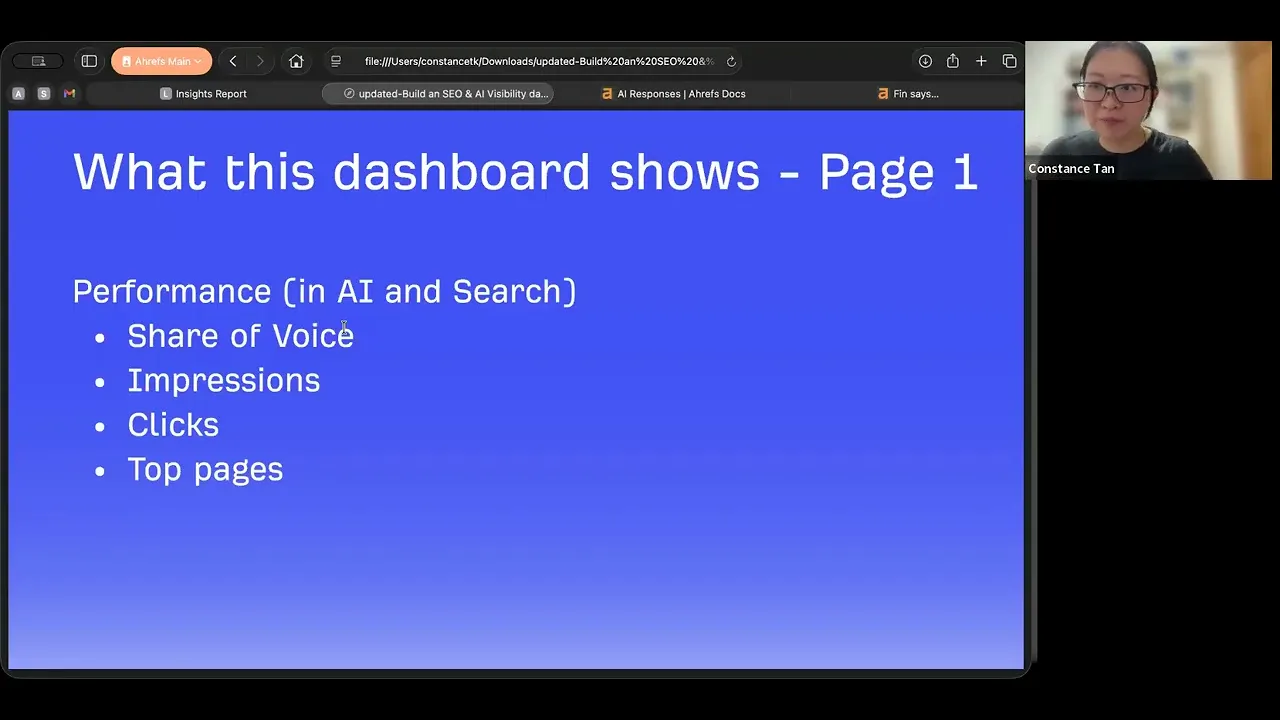
If you're a publisher or content creator, training data visibility is your long game. Every article AI sites, every video it surfaces, reinforces your authority in the model. And if you're not yet visible, well, that's why you're taking this course. Now, if you want to see where you stand in AI search, go to Ahrefs Brand Radar and search for your website. And right away, you'll see how you stack up against competitors across different AI platforms. And you can filter by mentions, which are when your brand is named but not linked. Citations, which is when AI actually links to your site.
Impressions and share of voice. The gap between your impressions and your mentions is your opportunity. If AI is responding to queries about your topic but not naming you, that's exactly where you need to focus. And that's exactly what we'll be covering in module two, where we'll cover AEO strategy, research, targeting, and gaps. I'll see you there.
More from Ahrefs
Related Videos
I Found The Layer OpenAI and Stripe Are Fighting Over.
 AI News & Strategy Daily | Nate B Jones
 00:23:17
Artificial Intelligence Tutorial For Beginners 2026 | Learn AI Basics From Scratch | Simplilearn
 Simplilearn
 00:22:48


How Generative AI Is Changing Online Behaviour and What It Means for Marketers
 Exposure Ninja
 01:01:58
Get daily recaps from
Ahrefs
AI-powered summaries delivered to your inbox. Save hours every week while staying fully informed.