The Worst is Almost Over

Chapters6
The chapter argues that the AI funding boom is unsustainable and that cracks are appearing in the market, citing falling DDR5 prices and OpenAI’s jittery leadership signals as signs of an impending adjustment that could finally benefit consumers. It also plugs a sponsor and frames the discussion around the window closing on irrational AI infrastructure spending.
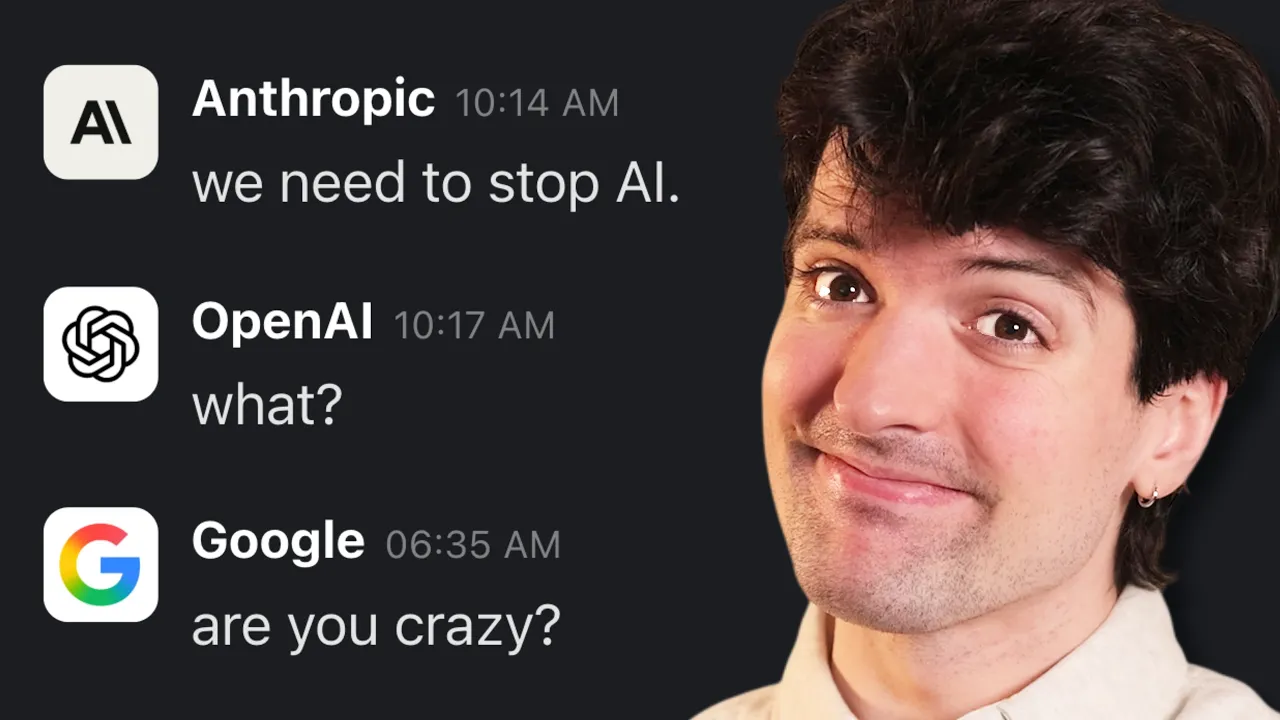
LinusTechTips argues AI hype resembles a tulip bubble, with OpenAI leading a costly, unsustainable race that may finally calm into a consumer-friendly value moment.
Summary
Linus Tech Tips’ video paints a cautionary picture of AI funding as a financial house of cards that’s starting to wobble. Linus argues that DDR5 price drops and real revenue gaps expose how fragile the current AI investment boom is. He cites OpenAI’s astronomical valuations and energy costs as key pressure points, while noting that even giants like Microsoft, Nvidia, and Google face market corrections. The host contrasts OpenAI’s perception of ubiquitous AI with the more diversified revenue streams and profitability of incumbents like Samsung. He also flags that OpenAI’s recent 40% memory capacity commitment and ensuing rethink have spooked investors, potentially easing the race to scale infrastructure. Despite the turbulence, Linus believes AI isn’t going away—products from Meta to Google will push AI deeper into everyday experiences, just not at the unsustainable pace of today. He envisions a future where a more rational, winner-takes-some-model emerges and declines in speculative hype follow. The segment closes with a sponsor plug for Proton Mail, underscoring a privacy-first stance amid a data-driven AI era while teasing a memory-performance tip from their past videos.
Key Takeaways
- OpenAI’s $852B+ valuation is outstripping revenue reality, given OpenAI’s billions in annual burn and relatively modest profits for a tech giant.
- DDR5 price declines are presented as a tangible market correction that could temper AI hardware inflation and help consumers.
- Energy costs have become the single biggest expense for AI infrastructures, influencing profitability and project viability for major players.
- OpenAI’s abrupt ‘40% of memory production’ commitment and later reversal is highlighted as a cautionary signal that unsettles multi-year AI investment plans.
- Meta and Google are viewed as structurally better positioned because their valuation rests on product usefulness beyond AI and non-AI revenue, potentially dampening bubble-related volatility.
- Nvidia remains a core supplier with robust demand for chips, while other AI equities face more pronounced pullbacks.
- The video suggests the AI boom may settle into a more sustainable trajectory where infrastructure scales to actual demand rather than speculative capital.
Who Is This For?
Essential viewing for tech enthusiasts and investors trying to understand AI market dynamics, the sustainability of big-tech AI plays, and why consumer AI might finally become more price-competitive.
Notable Quotes
""the cracks are starting to show in a way that I don't think anyone can ignore anymore.""
—Linus frames the overarching warning about the AI funding frenzy.
""OpenAI... are practically knocking on the trillion dollar door""
—Highlighting OpenAI’s lofty valuation versus revenue reality.
""Revenue and profits are not the same thing""
—A core business point differentiating valuation from real profitability.
""I think the bean counters are on the verge of getting back in the driver's seat""
—Forecasting a shift toward more rational investment decisions.
""There’s light at the end of the tunnel and it might not be a train""
—Optimistic note on market stabilization despite turbulence.
Questions This Video Answers
- Is OpenAI truly worth a trillion-dollar valuation given its revenue and profits?
- What caused DDR5 memory prices to drop, and how could that affect AI hardware costs?
- Will Meta and Google’s AI integration influence the broader AI infrastructure market?
- Why did OpenAI's 40% memory production commitment spark investor concern?
- How do energy costs impact the profitability of AI companies like OpenAI and Oracle?
Full Transcript
Any geek with a calculator has known for months that while AI is here to stay in some form, the financial house of cards that has propped up the recent explosion in investment is at best unsustainable and at worst threatens to destabilize the world economy. But the cracks are starting to show in a way that I don't think anyone can ignore anymore. video cards reports that DDR5 prices have begun to drop in markets around the world. And while many AI leaders claim that we are not in a bubble, in an interview with the Verge way back in last August, OpenAI CEO Sam Alman himself acknowledged that when bubbles happen, smart people get over excited, acknowledged that the way that some money is flowing into the AI space is not rational, and also said someone's going to get burned.
I mean, of course, he doesn't think it's going to be him, but his credibility took a pretty big hit recently when he told two of the biggest DRM producers in the world, "Yes, I think I'll buy 40% of your total production capacity. Here's a letter of intent to that effect." Followed by, "Actually, lol, never mind." What? That's the big business equivalent of, "Oh, oh, yes, Mr. Furley. I know it's the first of the month, but don't worry, the check's totally in the mail. So, let's talk about why I think that we are right now at the beginning of the end for the irresponsible money that's getting dumped into AI infrastructure and why I think this will finally be a break for consumers after months of beatings.
Now, to continue my own beatings until Segue improves to our sponsor, Proton Mail. Even if you're not looking for an alternative to your current email provider, maybe it's time to start. Many providers can use your inbox to track your behavior. Learn more about Proton Mail using our link down below. Let's start with the very basics. What is a bubble? Probably the best plain English definition that I could find came from Investopedia, who defines it as an asset's price rising far above its real value because many people rushed to buy it, hoping to sell it at a higher price.
The earliest recorded example is tulip mania. A period during the mid600s when tulip bulbs became the status symbol duour in Holland, causing values to soar uncontrollably with rare specimens apparently rivaling the price of a fine house on the Amsterdam canal. When the inevitable crash occurred, it wiped out as much as 99% of the total market valuation, leaving many speculative investors deeply indebted. That doesn't mean that tulips became worthless. They've just fallen a little bit behind relative to other assets. With that out of the way, then what makes AI a bubble? Well, the biggest one is the valuations of the companies who are leading its development.
In no particular order, anthropic 380 billion, XAI, 200 plus billion. Open AAI an eyewatering $852 billion. Like seriously, they're practically knocking on the trillion dollar door, which isn't inherently a problem. There's plenty of legitimate members of the Tea Club. But here's the thing. With some notable exceptions, those other members also have Mondo revenues to go with their Mondo valuations. Samsung, for instance, while totally participating in the AI boom in the form of HBM memory manufacturing for GPUs, also happens to have revenues that exceed $220 billion US a year. How has their value fallen below OpenAI?
I mean, in fairness, OpenAI did recently boast that they have exceeded revenues of $2 billion a month and hit this milestone faster than internet era defining companies like Alphabet and Meta, which is definitely impressive. But, uh, let me let you in on a little secret. As someone who runs a business, I am acutely aware that revenue and profits are not the same thing. See, Samsung is making over $28 billion a year in profit. Open AI is doing about that in revenue while still burning billions of dollars a year after over a decade of operation with no end in sight.
So what's their plan? More consumer AI subscriptions. Open AAI says this is going to require massive investments in infrastructure to flood the world with intelligence as cheap and ubiquitous as electricity. After which I assume the plan is to leverage their position to squeeze their locked in customers for profit. it. I mean, they already have 900 million users. That's about one in every 10 men, women, and children on the face of the earth. Sure, they can go after the other nine, but I kind of have a hard time believing that that's going to be the difference between losing billions and making billions.
Enterprise tools are an interesting path. Except that paying customers are the most likely to be critical of an AI that, for being honest, is nowhere near true artificial general intelligence. And as for how it's going so far, the integration of enterprise AI has been, let's call it, uneven at best. Personally, I find it more of an irritant than a help from a day-to-day perspective. But even if I accept the premise that widespread corporate adoption of AI is inevitable, how much of let's say my internal tools helper LLM or my customer service chatbot would I really outsource to OpenAI instead of just hosting locally on a quantized open- source model?
And so far, I've completely ignored the threats from commercial competitors like Anthropic and probably more importantly, Google, who hasn't just been sitting there. So then, wait, why have I only talked about Open AI so far? I guess it's because kind of like you see in crypto, where as Bitcoin goes, so does the rest of the industry. Open AI tends to act as a pretty decent proxy for the current vibes around AI as a whole. And right now, things aren't looking so good for them. Let's look at some examples. CNBC reports that amid concerns that expansion ambitions were too great for the potential revenue that would follow, OpenAI slashed their spending expectations, targeting just 600 billion by 2030.
That uh might affect their ability to buy 40% of the world's memory, which in turn would take some of the pressure off of competitors who are trying to keep pace. Energy costs. This is another big one. It's the single biggest expense for AI companies outside of the hardware itself, and they have soared over the last half a decade. It wouldn't be a problem if it wasn't a trend that has only accelerated due to the ongoing code orange state of current global affairs. Case in point, OpenAI's abrupt complete cancellation of the Sora 2 video generation app.
By all accounts, it seemed to be just plain costing them way too much money to run. Then there's Oracle, who meanwhile has been cruising from high to high, announcing a partnership with OpenAI to build AI infrastructure. They've boasted that demand for AI infrastructure continues to exceed supply, and they had an exceptional quarter. And yet, according to The Independent, they just laid off as much as 18% of their global workforce amidst a broader organizational change. Now, their stock has actually jumped about 5% between conceiving of this video and sitting down to write it. And it's probably going to move some more by the time the editor gets their hands on the footage.
But that doesn't change that the overall trajectory is pretty rough. And they're sitting at about half of their all-time high back in September. Microsoft is actually going through a similar correction, sitting just 9% over the highest point it reached in November of 2021. Now, not every AI company is a similar story right now. Nvidia is still selling golden picks and shovels faster than they can possibly craft them. And Google and Meta have both taken much smaller hits, more in line with the kind of thing that happens during times of geopolitical uncertainty as money flows away from tech bros and then towards weapons bros or their evolved hybrid tech weapons bros.
Anyway, that's a little off topic. Point is, I don't think AI is going away. Meta got up on stage at ARM's AI CPU launch last month to talk about their vision for AI's integration into their products and it's clear that they are going full steam ahead. Every facet of the Meta experience is going to have AI in it to the point where whether you like it or even think about it, their 3 billion plus daily users will be using AI every day. And that is going to take a lot of infrastructure. Infrastructure that isn't built yet.
But I don't think that the Open AIs of the world are the ones that are going to own that infrastructure. I could be wrong, but I see Open AI as more of like a Dropbox like company, one that will probably survive the bubble pop due to its ubiquitousness and its brand value, but that might struggle to convert free users to paid users and ultimately have to settle for a niche role in the industry that they defined. Meta and Google, on the other hand, have something in common that I think has shielded them from the brunt of the bubble's deflation so far.
They aren't simply landgrabbing as much infrastructure as possible in hopes that it'll be useful someday. Their valuation is based on their products usefulness outside of AI and revenue that they derive outside of AI. So when OpenAI stumbles, which they seem to be doing now, a bit of that competitive pressure gets lifted and their infrastructure investments can maybe return to a more as needed scale as they continue to find uses for this admittedly sometimes very cool and useful new technology. Really what it comes down to for me is I think that OpenAI's 40% DRAM decommmit episode has rightly spooked a lot of the folks who have been making multi-year, multibillion dollar investments, assuming that the future revenue that they were building for was some kind of guarantee rather than just a signature on a worthless piece of paper.
And now that that realization has happened, I think the bean counters are on the verge of getting back in the driver's seat, which will hopefully see investments in AI return to a more reasonable level as the winners determine what kind of real revenue they can actually derive from AI services. With all that said, I do still think it's going to take some time. Tulip prices didn't crash overnight either. So, uh, hey, hang in there everyone, guys. I think there's light at the end of the tunnel and it might not be a train. Oh, you know what else is at the end of the tunnel?
This cool not slop t-shirt. ltstore.com. And also the segue to our sponsor, Proton Mail. There was a time before you had a computer, a tablet, or even an email address. A time when you maintained some level of privacy. But the fact of the matter is that in this digital landscape, it is assumed that we just don't have the privacy online. And we've kind of come to accept that. Something like your email address acts as a lynch pin for just about everything you do online, which makes it a perfect hub for the big corporations to track your behaviors.
And then that information can be used for things like uh training AI. Proton Mail doesn't participate in any of that nonsense. There's no ads, tracking pixels, or email scanning. Their platform focuses more on protecting you than profiting. Your inbox should be for you to use, not for you to be used. So, protect your digital privacy by checking out Proton Mail using our link in the video description. If you guys enjoyed this video, you might like the one we did recently showing that you don't actually need the most expensive DDR5 memory to get peak gaming performance.
More from Linus Tech Tips













Get daily recaps from
Linus Tech Tips
AI-powered summaries delivered to your inbox. Save hours every week while staying fully informed.