I tested every new Apple Product!

Chapters10
Examines the new Neo at the bottom of the lineup, its aluminum build, strong keyboard/trackpad, and the key compromises that enable the low price.
Mrwhosetheboss digs into Apple's 2026 lineup, praising the ultra-cheap MacBook Neo but warning about headlining compromises, while declaring the MacBook Air the real sweet spot and debunking hype around Pro power.
Summary
Mrwhosetheboss breaks down Apple’s 2026 refresh with a laser focus on value and performance trade-offs. The new MacBook Neo starts at $599 and feels surprisingly solid despite cutting corners like no backlight, a slower SSD, 8 GB RAM, and an A18 Pro from iPhone 16 Pro—yet it remains aluminum, with a sturdy hinge, pleasant keyboard, and the same Mac-like trackpad. The Air upgrade brings meaningful improvements: an M5 chip, the new N1 networking, 512 GB base storage, and noticeably faster speeds, making it the most recommendable laptop for most users. Pro models get the heavy-hitting M5 Pro/Max and 1 TB minimum storage, coupled with up to five times the graphics performance on paper (though the real-world gain is nuanced). Apple’s EU power-brick policy also hits the spotlight here as a surprising omission. In the tablet and display corner, the iPad Air sticks with an M4, larger RAM, and the same price, which makes storage the clear value lever, while the Studio Display family expands with a cheaper Studio Display XDR that finally adds 120 Hz and built-in audio/video features. The iPhone 17e slots in at $599 with 256 GB and the A19/N1 combo, but its camera hardware lags behind the iPhone 17, signaling its role as a business-focussed device. Mrwhosetheboss also teases his favorite productivity setup using Opera browser with split-screen tab islands for uber-flow workflows. Overall, the video weighs the Neo’s price-to-performance crunch against the Air’s solid all-round usability and the Pro line’s headline-grabbing but situational gains.
Key Takeaways
- MacBook Neo at $599 trades backlighting, faster storage, and RAM for a significantly lower price, using an A18 Pro from iPhone 16 Pro and 8 GB RAM.
- Air upgrade brings M5, N1 networking, 512 GB starting storage, and double-speed storage, making it the best all-round Apple laptop for most people.
- MacBook Pro line jumps to M5 Pro/Max with 1 TB minimum storage, promising up to five times faster graphics in marketing, but real gains depend on tasks and are not uniform.
- EU market policy removes the power brick from MacBooks, affecting value perception and total cost of ownership, especially for high-end models.
- Studio Display gets a 27/28-inch trade-off with the Studio Display XDR at 3,299 USD, 120 Hz mini-LED panel, built-in mic/webcam/speakers, and the classic Pro Stand finally retired.
- iPad Air receives an M4 chip, 12 GB RAM, and remains $599, with storage as the primary driver of value rather than new features.
- iPhone 17e offers 256 GB for $599 with A19/N1 and 60 Hz display, but cameras lag behind the iPhone 17, positioning it as a business-friendly option rather than flagship for consumers.
Who Is This For?
Tech enthusiasts and Apple power users who want a clear read on what changed in 2026—what’s worth upgrading to, what’s worth skipping, and how pricing, storage, and performance trade-offs affect real-world use.
Notable Quotes
""Frankly, I've never used a $599 laptop that feels this good.""
—Highlights Neo’s surprising build quality and user experience despite low price.
""There is no laptop grade M series chip here. This is actually using a phone chip, the A18 Pro, plucked straight from an iPhone 16 Pro""
—Explains Neo’s core performance compromise.
""Up to five times faster graphics, no caveats, no asterisks""
—Notes how Pro graphics gains are marketed, with caveats discussed later.
""RIP" to the $999 Pro Stand as the Studio Display Stand option is included now with the XDR model"
—Commentary on Studio Display ecosystem changes and pricing shifts.
""This has actually made a big difference on the latest iPhones, so we'll probably have the same effect here""
—On the N1 networking chip's impact across devices.
Questions This Video Answers
- How much should you pay for a MacBook Neo and is the cut in performance worth the savings?
- Is the MacBook Air M5 worth upgrading to over the Neo or Pro models in 2026?
- Do Studio Display XDR features justify the price compared with the older Studio Display or Pro Display XDR?
- Should I buy the iPhone 17e or stretch to the iPhone 17 for better cameras and features?
- Will the iPad Air with M4 and 12 GB RAM be enough for students or professionals this year?
Apple MacBook NeoMacBook Air M5MacBook Pro M5 Pro/MaxApple Studio Display XDRStudio Display (60 Hz)iPhone 17eiPad Air M4N1 networking chipEU power brick policyA18 Pro chip
Full Transcript
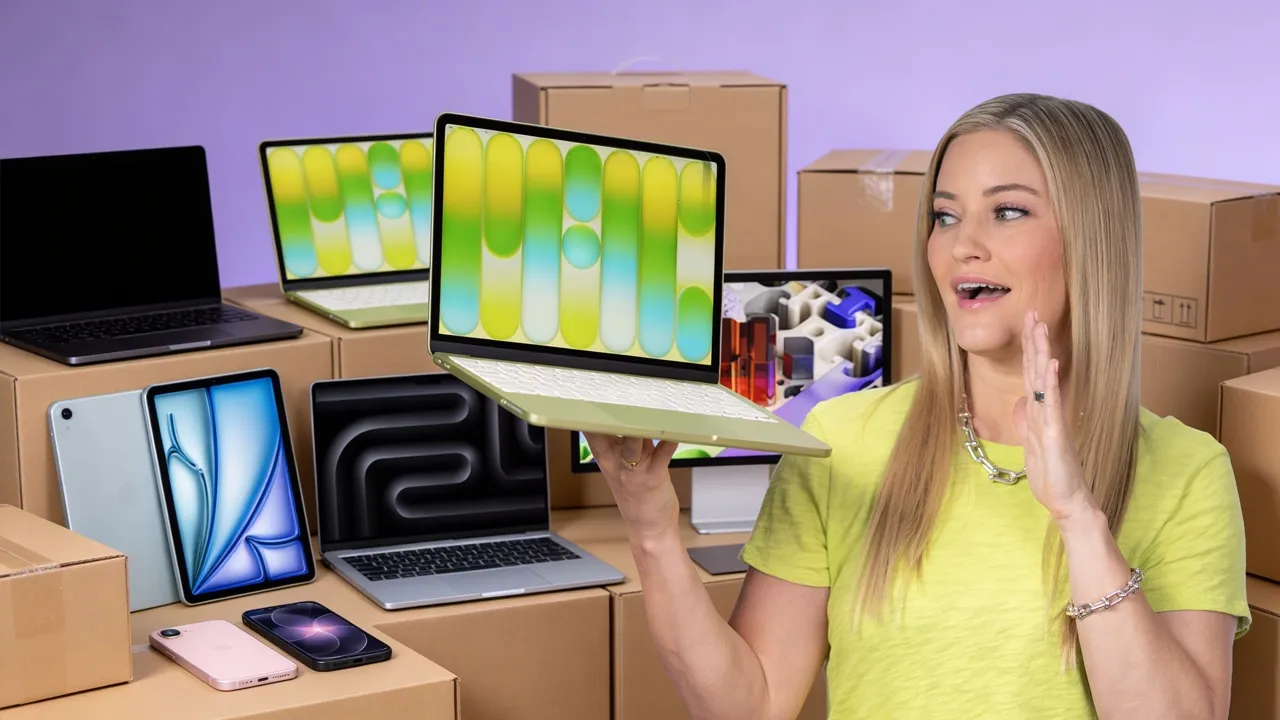
Apple has just announced new 2026 MacBooks, iPads, displays, and even a new iPhone. And they're kind of weird. There's an unusual amount of focus on the affordable end while at the same time making the extreme stuff much more extreme. So, let's find out why. At the very bottom end, then, this is the new $599 MacBook Neo, which sits as the new entry point into Apple's laptop lineup. a lot more affordable than the $1,999 MacBook Air, which in itself is a lot more affordable than the new top-of-the-line $2199 MacBook Pros. But the obvious question is, how is Apple suddenly randomly selling a MacBook that costs half the price?
Well, it's not the build quality like I was expecting it to be. This thing is still made of aluminium like the other MacBooks, and it still feels fancy to use. The hinge is sturdy. The keyboard is satisfying to type on. Even the trackpad still has all of the multi-touch gestures that I'm used to from the MacBook Pros. Frankly, I've never used a $599 laptop that feels this good. And I wish more companies would make colors like these. I love them in person, especially this Citrus, which makes me feel like I'm 6 years old again, marveling at my dad's iMac G3.
So, it must be the display, right? Well, no. What's here is sharp. It's punchy. It could do with being a little brighter. topping out at 500 nits, but that is still just as bright as the almost twice the price MacBook Air. There's a couple of smaller things that are cut like Touch ID. You don't get it on the base 256 gig version of the Neo, but you do get it on the higher storage version. The battery, they claim 16 hours on this compared to 18 on a MacBook Air. And the ports, there's no Mag Safe here.
And weirdly, only one of these two USBC ports is fast enough to connect up to a monitor. The other is slower, but you can use either of them to charge the thing. Really though, there are two compromises that I think truly matter. The first is that the keyboard on the Neo has no backlighting, which I think you will notice even if you don't tend to work in a cave. Pretty much any time that you try and get something done in a dimly lit car or late at night. Backlighting is a given feature at this price on other laptops.
I can imagine quite a few people being surprised when their Neo arrives at their door without it. And then the second thing is performance. There is no laptop grade M series chip here. This is actually using a phone chip, the A18 Pro, plucked straight from an iPhone 16 Pro, which might on its own have been able to fly under the radar, but it's the fact that that is paired with slower SSD storage speeds than the Air and half the RAM, 8 GB here compared to 16. All put together, this is a distinctly less agile machine.
I can feel it when I use it. Some things do take a second or two to load up and you can see how this thing would get overwhelmed if you pushed it. Gaming 2 was also a little choppy, but if you're buying a MacBook Neo for gaming, I think you've got bigger problems. So clearly the performance cutbacks are the main way that Apple has made this laptop so affordable. But it's just they've done it in such a considerable way that if you're anything even resembling a multitasker, you would feel the benefits of the pricier MacBook Air exactly as Apple intended.
That said, I do think this laptop makes a ton of sense. Like the MacBook Air has crept up in power every year since the first M1 version, and that now means we are at a stage where there is a vast difference between what you can do on that laptop and the Google Docs and YouTube that the average school kid or university student actually needs to do on it. So, the Neo exists to cut back on that performance to minimize that gap, passing on a lot of those savings to the buyer, especially if you use the education discount and end up getting it for $499.
And you can see the ripple effect that this has on every Apple laptop because there is now a very clear entry-level option. Apple doesn't need to worry anymore about hitting that sub $1,000 price tag with the MacBook Air. So, while this used to start at $999, the new MacBook Air is now $1099. and I could see that climbing over the next few years quite substantially. That said, it's still really hard to argue with the amount of laptop that you get for that. This new MacBook Air has an M5 chip instead of the M4, which in itself is nothing major.
It's like 10 20% more power really. There's Apple's new N1 networking chip, which improves Wi-Fi and Bluetooth. This has actually made a big difference on the latest iPhones, so we'll probably have the same effect here. And then the main thing is that this new MacBook Air gets double the starting storage now at 512 gigs. And that double storage is now twice as fast, too. So, while I don't love this whole trying to disguise what is effectively a price hike by just removing the option to buy the lower storage version, this is still the most recommendable laptop in the world.
While the compromises of the MacBook Neo are pretty obvious, and the price of the new Pros is pretty prohibitive, the MacBook Air is not really missing anything for most people, unless you're like the lead editor for the next Avatar movie. And to be honest, they don't need more effects. They just need a better title font. He clicked the drop- down menu and then he just randomly selected Papyrus. Speaking of the MacBook Pros, at the very top of Apple's lineup, these have just had what's essentially just a more extreme version of the Air Treatment. So, the same N1 networking chip and the same thing's happening with storage, too.
But it's twice as fast, and you get twice as much of it, going from the minimum of 512 gigs last year to a terabyte now. But you have to pay $200 more for the price. That said, 1 TB minimum on a Pro does not actually upset me because of how the MacBook Air has naturally drifted over the years from this ultra thin, ultra light laptop that can just about function to now actually very powerful machine in 2026. You're only buying a MacBook Pro if you actually are a pro. And if you are a pro, you're going to need a terabyte at least.
And then the chip upgrade for these laptops is supposedly pretty serious. They're now powered by the M5 Pro, which it depends what you're doing, but you could broadly think of this as around two times the system power and capability of the base M5, and then the M5 Max, which has the same CPU as the Pro, but then up to two times the graphics performance of even that. So, on paper, it is a monolithic chip with up to four times the AI performance compared to previous gen. That's probably not going to translate to a whole lot for most users, but the AI bros will be chuffed.
It's a big deal for people who want to be running large AI models locally. So, these are huge improvement numbers, but treat them with caution. If you watch the commercials for these new MacBook Pros, it literally says in plain text, up to five times faster graphics, no caveats, no asterisks. So, wow, that's insane. Five times compared to the M4 Pro and M4 Max just last year. That's what you'd assume it means, right? Given that they don't specify. Well, no, not exactly. Oh, so like five times compared to 3 years ago. So what people are likely upgrading from?
Well, um if you're performing this one specific AI image generation task, then maybe ultimately it's only when you delve all the way into the depths of the Apple press release that you find the graphics performance for M5 Max is up to 20% higher than M4 Max. So the number you're actually looking for is up to 20%. I guess I just want to make it clear that while I do think the MacBook Pro is an exceptional machine, I'm actually really excited to finally upgrade my whole team's M1 and M2 so we can get our videos out even faster.
I so much more appreciate it when companies just talk straight and they aren't trying to fool people with numerical smoke and mirrors. That combined with the fact that every single improvement here is quoted as an upto figure as opposed to any kind of absolute improvement, which if you think about it, doesn't tell us anything about how much you should actually expect to notice day-to-day. Up to 500% faster, could be 5%, could be 495%, they both fit that description. All topped off with the fact that if you live in the EU, you don't actually get a power brick with these MacBooks.
You have to buy it separately. I don't know what I expected. Now, what exactly this decision-making process is based on is not clear. But if you're buying a 16-inch MacBook Pro, which would usually come with a 140 watt power rig, then I don't think that is something that you're likely to just have lying around and is a fair bit of value that you're now missing out on. If the laptop was cheaper to accommodate, then I guess I get it. But at least here in the UK, it is not. And now, just before the new iPhone, there's also a new iPad Air.
So, this is Apple's mid-range iPad sitting about halfway between the iPad, you know, the one that's just called iPad. God, this is getting so confusing, and then the iPad Pro, and it's not a bad update, it's just unexciting. So, let me run through it real quick. It gets an M4 chip instead of an M3 chip, 12 GB of RAM up from 8, and then that same networking chip that everything seems to be getting now, while staying at the same $599 price. That makes it actually like very powerful for a mid-range tablet. But I just don't think that's what people are asking for.
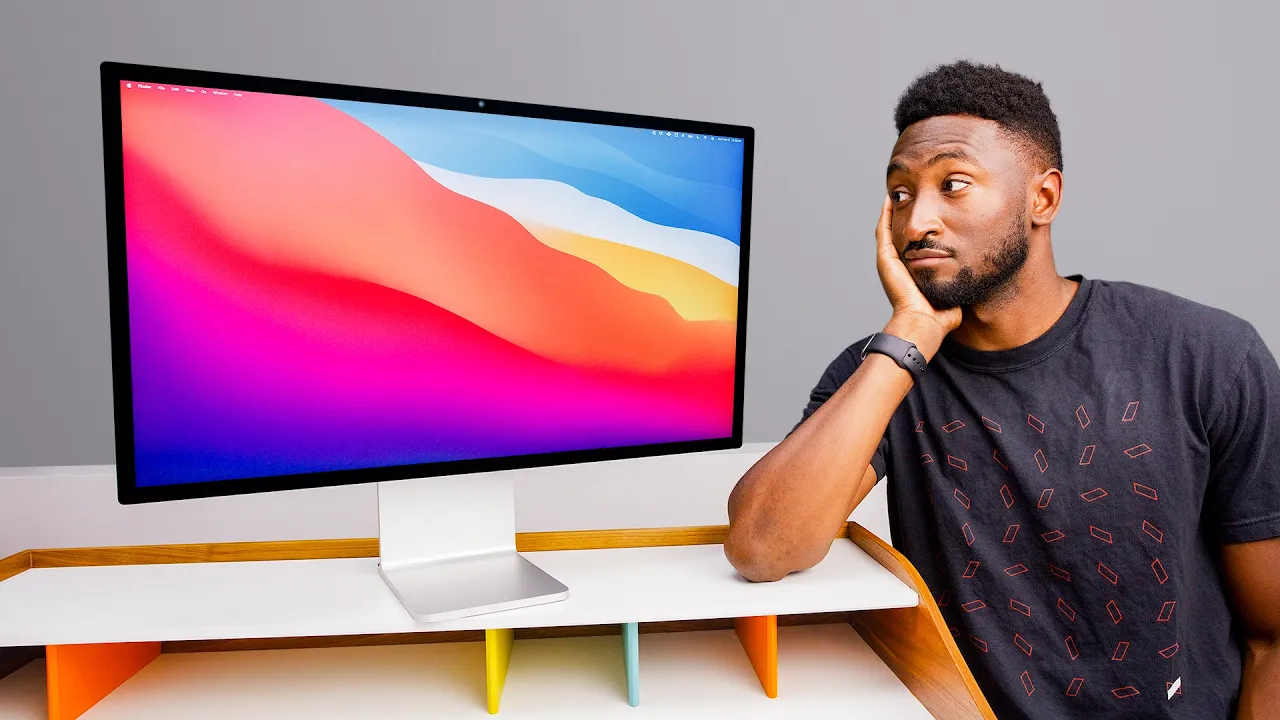
If anything, I think upgrading the storage from 128 to 256 gigs would make more of a difference to most Air users than all of those changes put together. But the storage is the secret source of Apple's pricing ladder. So, there's a reason for everything. And there's also two new monitors. There's an update to Apple's most affordable, insanely unaffordable $1,600 studio display, which I would say was a decent product when it first launched four years ago. But I'm not exactly impressed that in those four years, the only changes that we're getting now are two Thunderbolt 5 ports, which means you can daisy chain up to four of these monitors from one cable into a Mac, and then an improved 12 megapixel center stage camera.
Huge for Zoom enthusiasts. I hear there are literally dozens of you. So, pretty hard to recommend this one in 2026. The fact that it is still using that same 60 Hz fairly dated panel for that price means actually to be honest, it's a pretty good time to buy the old model for half of that. But then there is also the completely new Studio Display XDR. XDR meaning extreme debt required. Tim told me you can quote that. So, this is very much a monitor for professionals, but I think it's very welcome. Not necessarily because it in itself is fantastic value, but more because it replaces the very much not fantastic value $5,000 Pro Display XDR.
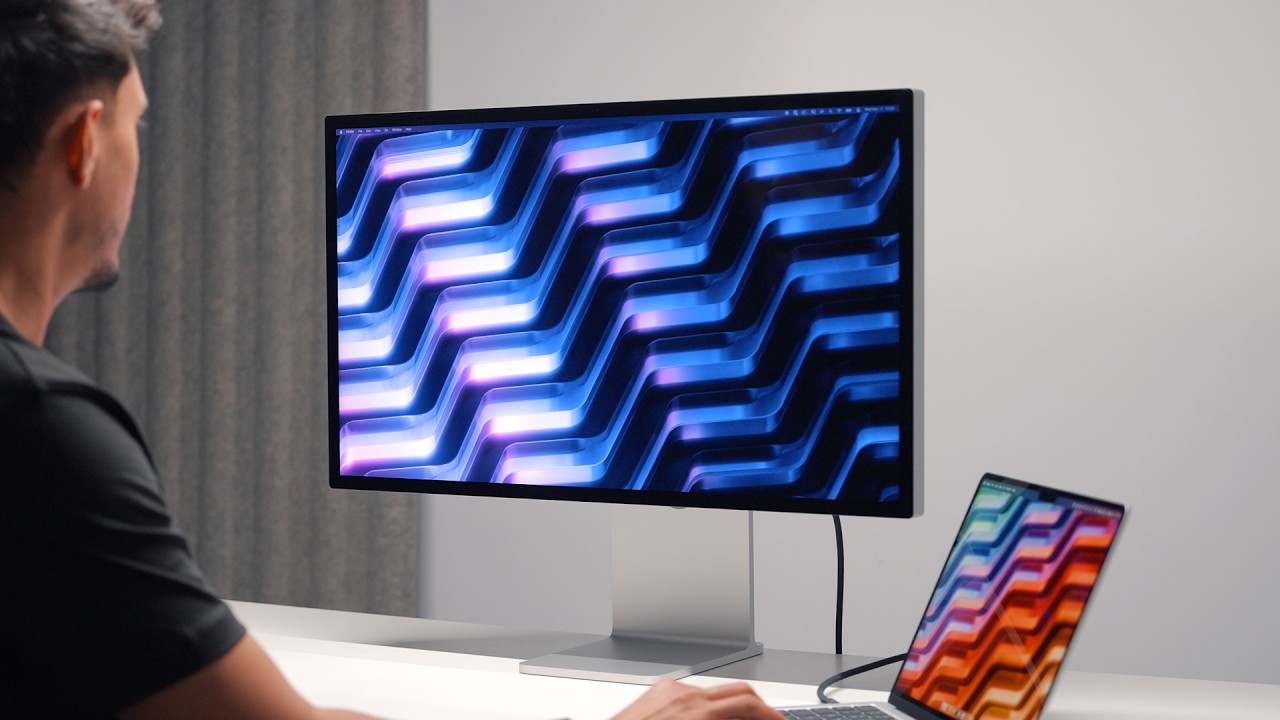
And unlike that monitor, this is $3,299. This has a 120 Hz refresh rate instead of 60. It uses mini LED tech for even more brightness and actually has a mic, a webcam, and speakers of which somehow the Pro Display had none of. All topped off with this tilt and height adjustable stand included. So, after 6 years of memes, we can finally put the $999 Pro Stand to rest. RIP. The only weird thing that for me is a real turnoff is the size. This Studio Display XDR is replacing a monitor that was 32 in, but in itself it's only 27, just like the normal studio display.
So, while it's good to have the option for a very high-grade monitor in a compact size, it definitely leaves this gap for people wanting something bigger. I definitely would. I work on a 40in ultrawide right now and it's amazing. And that leaves us with the new iPhone, the 17e. So, this is a one:1 replacement to the 16e and it serves as the $599 basic iPhone, $200 below the honestly pretty fantastic iPhone 17. So, it's got a lot to prove. What I am really happy to see is, say it with me folks, the storage has doubled to 256 gigs.
But unlike with all the Macs here, they've done that without raising the price, which feels especially rare given the whole memory crisis happening right now and might actually be why the rest of the changes feel quite minimal. In some ways, they have brought this 17e closer to the normal iPhones. Like, we get the latest chip, the A19. We get that N1 networking. The screen now is coated with the same ceramic shield too for protection and has that somewhat helpful but not game-changing anti-reflective coating that we saw on the iPhone 17s. Plus, Magsafe combined with much faster G2 wireless charging.
This is a very important change from the 16e, but kind of should have been on the 16e in the first place. And that combined with the very huge battery on this should make it a very reliable phone. But what it isn't is flashy. I think the 17E looks pretty dated now when you put it next to the iPhone 17 with these thick bezels and the fact that this is like the last remaining late bloomer still to have a notch. You don't get the bigger, brighter, faster 120 Hz display of that phone. This is still 60 and the cameras are pretty bad.
There's no ultrawide camera. You don't get the iPhone 17's upgraded selfie camera. This is just plain old traditional 12 megapixel. And even the main rear camera, it does still feel like an iPhone camera when you use it. You're still getting pretty much the latest in Apple's processing, but it's just that the actual camera sensor itself is very dated. It's close to the quality of the ultrawide cameras on other current iPhones. So, I think the reason this exists is business customers who just want to buy a few hundred or thousand iPhones don't care how great the cameras or the screens are, but ease of use, battery, storage, durability, that stuff matters.
And I'd actually say it's a very solid phone for that purpose. But if you were considering this for yourself, I would suggest you spend the extra and get the iPhone 17 cuz especially with sales, I would not be surprised if you can find that for just $100 to $150 more than this. And that would be the difference between something that feels lower mid-range and something that feels pretty flagship. Or just go Android and get a nothing phone 3. At this point, you can get that for the same money and it's a lot more phone. These videos are always such a scramble to make cuz we're trying to get it out as fast as possible but while making sure that everything is fact checked to our usual standards.
This has been a game changer though. I've been four-way split screening for uber productivity cuz now on the Opera browser, our sponsor, you can just keep dragging tabs into the mix and it splits them automatically. And I don't even need to leave that flow state to check things like my Gmail or Google Calendar. They are just chilling in the sidebar while keeping all of my research just so organized. With these upgraded tab islands, you can add labels and colors to really clearly separate what each cluster of tabs is for. And when you get used to that, you actually can't go back to any other way of working.
So link below to download the Opera browser for
More from Mrwhosetheboss







Get daily recaps from
Mrwhosetheboss
AI-powered summaries delivered to your inbox. Save hours every week while staying fully informed.