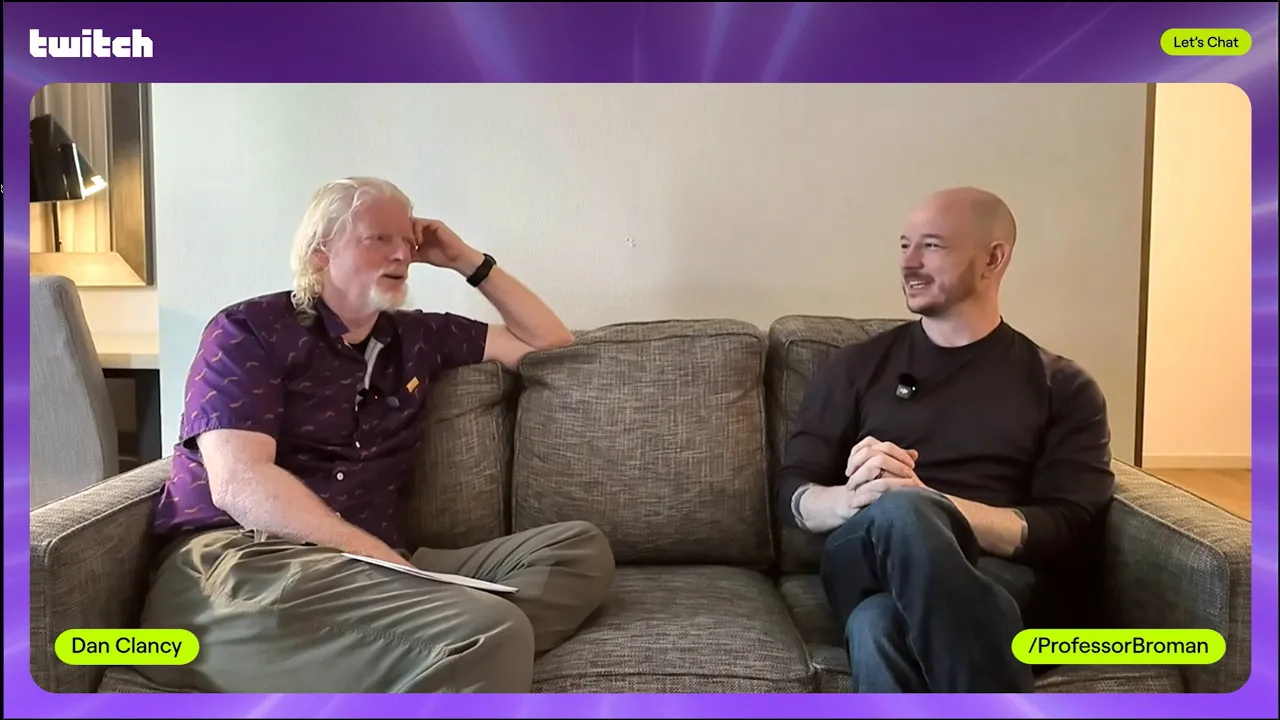
Dan Clancy talks to TheStockGuy | Let's Chat Podcast EP 6

Chapters10
Hosts introduce Lets Chat and the guest Jason the stock guy, highlighting his focus on live streaming, money education, and bridge building between communities.
Dan Clancy chats with TheStockGuy about honest money talk, embracing failure, and turning streaming into a sustainable life as a full-time dad who teaches finance with authenticity.
Summary
Dan Clancy sits down with Jason, aka TheStockGuy, to unpack a life built around money, family, and community on Twitch. He shares how moving from Florida to Delaware was driven by family priorities and practicalities, not just finances, and why he proudly calls himself a “part-time streamer, full-time dad.” The conversation digs into Dan’s path from overnight hotel work to trading and teaching money basics online, starting with a $5 mic and no camera in 2018. He explains why he pivoted from intense trading to broader market discussion, especially after the GameStop surge and the realities of a shrinking bear market in 2022. The highlight is his shift toward conversations about housing, mortgages, credit, and macroeconomics—topics his chat loves because they’re immediately useful. Dan reflects on the risks and rewards of quitting a day job to stream, emphasizing that viewers followed his authenticity and long-term approach rather than chasing quick fame. He also notes the power of short-form content to extend his reach, while praising his community’s role as the real engine of the show. Throughout, he’s candid about personal challenges—sobriety, autoimmune health, and the need to fail forward—modeling resilience for both aspiring streamers and investors. The result is a portrait of a creator who happens to be the stock guy, but who is really about real-life finance literacy, practical advice, and an inviting, no-nonsense vibe.
Key Takeaways
- Streaming can be a viable career when built on genuine interest and community, not quick riches (Dan quit his hotel job in July 2019 after averaging 45–50 viewers).
- Diversifying content beyond pure trading—into broad finance topics, housing, credit, and macro trends—reinvigorated Dan’s audience and growth (GameStop spike to steady, sustainable topics post-2022).
- Short-form content can dramatically amplify a creator’s reach when repurposing live-stream moments; Dan successfully grew on YouTube Shorts, TikTok, and Instagram by clipping live insights.
- Authenticity matters more than perfection; Dan emphasizes failing forward, sobriety, and transparent discussions about health and life to build trust with viewers.
- Family-first decisions can coexist with online success, as seen in Dan’s move to Delaware for family life and his framing of streaming as a flexible, supportive vocation rather than a rigid career path.
Who Is This For?
This is essential viewing for aspiring Twitch creators who want a realistic blueprint for turning passion into a sustainable career without sacrificing personal life. It also helps casual investors and anyone curious about how to discuss money and markets in a way that’s accessible and responsible.
Notable Quotes
""I’m a part-time streamer, full-time dad.""
—Dan sums up his personal philosophy and work-life balance, setting the tone for the interview.
""The market is rigged, but it’s rigged in your favor.""
—A core investing insight that frames his approach to long-term thinking over short-term bets.
""If anybody could do it, I know it’s you and I trust you.""
—Support from his partner during the risky leap to full-time streaming underscores the importance of belief and support.
""Failure is inevitable. You either learn from it or you stay stuck.""
—Dan’s candid view on failure as a learning mechanism informs his mindset and teaching style.
Questions This Video Answers
- Should I invest in the stock market right now, and when is the best time to start?
- Is renting or buying a home a better financial move today, given mortgage rates and prices?
- How can streamers monetize authenticity and build a sustainable career on Twitch without chasing trends?
- What are practical tips for turning a niche expertise (like personal finance) into engaging live content?
- How does one balance sobriety, health challenges, and a demanding online schedule while growing an audience?
Dan ClancyTheStockGuyTwitchLive streamingMoney educationInvesting basicsGameStop surgeShort-form contentDigital career pivots sobriety and resilience
Full Transcript
Hello and welcome to Let's Chat. Let's Chat is a live podcast where I talk with creators about live streaming and the ways that streamers and their community shape culture yesterday, today, and in the future. Um, I get on the game, have a good time, talk to chat, and just enjoy the moment. It's what the It's what the kids enjoy these days. You cannot lay the next brick without the one that comes before it. I mean it took me so much time. Time time is the most valuable resource in the entire world and I still want to collaborate with a lot of different communities and sort of be the bridge between them.
All right, welcome. It's great to be here and I'm very excited about today's guest. Um today's guest is someone I know well. Um uh his name is and let's welcome on the stream. Welcome the stock guy, or as I like to call him, Jason the stock guy. So, uh uh Jason, how's it going? It's uh it's it's going uh living in living in Delaware now. So, you know, I mean, living in Delaware. Yeah. Florida to Delaware. Wow. That's a big change. Well, you know, a lot of times we start these things with hearing your background and all that, but one of the things I wanted to chat about, and I'm going to jump into that.
I I'll just jump in because sometimes it's fun to kind of go with the flow on this. Um, one thing that I find interesting about Jason, he's not your typical streamer, and we're going to get to what he does, but one way where he's not the typical streamer is, you know, you might think of streamers as, you know, 20some, single. Jason's got himself a family um uh that uh he takes care of and um that's a big part of his life. So why don't you talk about that decision to move? What what made you move and and you know uh uh how's how's that going?
I mean, you know, obviously, you know, I think it's pretty obvious I I came to Delaware to uh to avoid t, you know, avoid taxes as much as poss. No, the reason I came was my wife, um, which obviously, like I said, family is huge for me. I like to call myself a a part-time streamer, full-time dad. Um, my wife really wanted the kids to experience seasons and, um, uh, wanted to be still somewhat near the coast and be near cities for her job and be away from it. So did a lot of research looking into um into the uh the the you know into the into the area and just like something that was still winter but more mild, something that was you know uh uh you know f you know a lot of open space for family and just kind of landed on Delaware and uh been here for 6 months and can't find a house yet.
So uh so I'm renting out another man's basement until uh until next month and then hopefully we'll have a house soon. All right. All right. Well, now I guess we should go ahead and kick it off and and tell people what it is you do on stream and we're going to chat about that before we get into how you got into it because I think it's kind of unique what you do on stream. So, why don't you tell us what you do on stream? uh what I do on stream. I mean basically in a nutshell I educate and entertain about uh money, finance, economics, you know, I try to teach people about uh investing markets uh you know uh you know how money works you know everything from credit cards to to financing to buying a house and and understanding that but doing it in a in a you know fun like engaging way and and you know try to make it in a way that sticks and and actually teaches people stuff.
All right. And and by the way, I will add this, Jason, he's um uh one of my highlights of TwitchCon. I think I've seen him at almost every TwitchCon. Um he is a regular there and it's always great to see him and uh it's a great breath of fresh air and and maybe I will get him to give me some investing advice later on in this show since uh he is wonderful at at capturing stuff and simplifying them down. So maybe later on we'll pick I know what we're going to do later on. We're going to pick your what you think are the best topics that everyone and I know I have some in my mind that I've seen you talk about, but we we'll go to that later so you can have that in your mind or what are the kind of the the best topics people have to think about.
But let's in let's start with how you got into this because I do think that is is very interesting in terms of how you became a streamer um in terms of your life leading you down this path. Um yeah uh you know I used to I used to trade stocks uh a little bit more and I used to do it in the mornings and I worked overnight at the time. I used to run a a big uh resort in uh in in Hollywood, Florida and uh I used to get off in the morning and had time and the markets were open and I kind of was okay at trading but it was more like a interesting thing for me and I used to do it and I was kind of lonely and I thought to myself, you know, maybe there's other people out there that also trade stocks, keep up with the markets and I could, you know, hang out and BS with them.
But it was Wall Street Bets, it was uh Finn Twit, and it was a bunch of like places that were just, you know, selling and pumping stocks and stuff. And I said, "That's not really my thing." So I said, "What happens if I go live? What if I just went live? Maybe other people would find me and we could just hang out." And that was really what started it. I had a $5 microphone and no camera and I heard about Twitch because of some Fortnite streamer that I'd heard about. What year was this? 2018. Okay.
Okay. And uh Yeah. And you were at the time you were doing your own investing, but you weren't funding your life through your investing. Obviously, it helped you, but you had a day job or it sounds like a night job that you were in terms of supporting your family. You were working somewhere else and you were trading and then you started streaming while you were trading. Yeah. So, I I I had my job, you know, I had got after I got sober and whatnot and got back on my feet and started working at Burger King, I worked my way up through hotels from a Bellman all the way up to a resort manager.
And through the time, you know, I I I I I loved money. I understood it. I understood kind of like how things work. And so, I started putting money aside and side hustles and started investing. And so, my investments grew. And then I started trading. And just like every new trader, I go in thinking, oh, I'm going to be that guy who trades and trades a bunch of stocks and becomes a millionaire. And of course, I lost my money the first time and then blew it up. And then I realized this isn't what it is.
You don't trade stocks to make money. You use the market to grow money, not make money. Um, but I still traded some on the side. I still do now for fun and try to find undervalued companies. But yeah, so I I used that and then streaming was just a hobby. It was just like it was just like, hey, you know, I'm going to find other people to hang out with when I do this stuff. Well, I think one of the great things about your story is this idea. People so often think of, you know, stock trading in um, you know, oh, working on Wall Street or, you know, going to this school and becoming a an expert.
And I think, you know, you're a great example of someone that um uh you know, is just a normal guy that like figured it all out. So, talk about that transition when you talked about working your way up and and figuring that out and also how you thought of yourself while you were going through that journey because I think there are a lot of people that can relate to that journey you lived um uh you know as you found who you were. You mean the journey from like like from like when I got sober up when you came to streaming?
Like in other words, you were like like so often when you think of someone who's an investor, you think of, oh, they worked on Wall Street, they, you know, went to this school and you were an investor that just like did it on your own and kind of built it up as you were talking about, right? You know, in other words, your journey before even before you started streaming. Well, I I don't have it all figured out. No, it's there's no such thing as having it all figured out. So, I I never I always remind myself I I jokingly call myself an idiot with a camera, but I think the the figuring it out part is is I haven't called you an idiot, Jason, but I I and I and I completely agree with you.
Trust me. But, uh but yeah, so like like you know, the market is rigged. It it's rigged, but it's rigged in your favor. So, the the the the best thing people can do is just when it comes to investing is just get out of their own way. You know what I mean? Like just, you know, buy into it. And when you start realizing that markets are long-term, you know, horizons and when you don't, you drown out the noise, whether it's a, you know, individual company, but more so the market overall, it's more so just about understanding how the dynamics work.
Stop trying to figure it out and just go with it. Go with what's proven. And I think that that's kind of like it took me a while to understand that because you get in thinking you've got the edge, you've got it, you know, you're going to be that next one. And so, you know, the way I I learned it was just, you know, okay, well, this is this is how the market operates. It it it it goes up over time. It it's it's about, you know, supply and demand and whatnot. And when it comes to individual companies, you know, again, I don't promote day trading and and and gambling and stuff like that, even though I do day trade, it's more so just being smart and and understanding what you're looking at.
And that sometimes that takes time to to develop the ability to read balance sheets and all that boring stuff. Did you did you do a lot of reading of the kind of traditional investment books or anything like that as you were educating yourself or how how did you how did you learn about it? I mean honestly there was this is going to sound funny. The reason I got interested there was a movie that came out a long time called Zeitgeist. Now, I'm not going to get into the whole movie because it was there's a lot of stuff on there, but like there was one little part, just something I watched at someone's house one day and I was kind of zoned out, but then I heard this thing about the Federal Reserve, right?
And it got me interested. I'm like, "Oh, I want to learn about how money works." And so I used this little like thing that I heard and I was like, "Oh." Oh, and so I learned about that and I learned about monetary policy and it got me into learning about economics and trade and and then it just was something that I kind of nerded out about and and then I just kept evolving with it and learning it and and it's just like it's a it's like a like somebody likes Warhammer or something. I like money, you know.
So, so one of the things when I was asking about this journey is I think especially as younger people watching this there's a lot of this idea of oh who are you going to be and you have to get this job to become who you're going to be and of course your path your journey has taken you down lots of paths right and and you know if I talked to you 25 years 20 years ago you never would have envisioned who you've become so just talk about that um as you're thinking about other people that are trying to figure out where they want to go and Now, often I think um I think often times people limit themselves and I think that's probably something that you had to do a lot while you were going on this journey is challenge your preconceived ideas of who you were and not limit who you could be.
Does that make sense? Absolutely. I I think if you're 24 years old and you have your life figured out, you're miserable. You're going to be absolutely miserable. There is absolutely no way you should have your life planned out for the rest of it at 23, 24 years old. you're you're you're still understanding who you are. But I think society has put this immense pressure on us to oh, you have to be here when you're 25, here when you're 30, here when you're 40 as how we define success. But, you know, you're still figuring out who you are when you're 22, 23.
You're not supposed to know what you're doing the rest of your life. You're supposed to make mistakes. You're supposed to experiment things. You're supposed to to to to to to live life. And then, you know, you don't have to be at a certain place at a certain time to measure success. Like people always tell me, "Hey, you're 41 years old. You can't make those jokes. You can't act that way." Says who? You. Oh, you're you're too old to do that. You're miserable. You you you seem miserable telling me how I should act to be whatever.
So, I'm enjoying who I am. And I think, you know, when you're younger, when it comes to careers in life, the same thing. Stop allowing society to force you into a career. and into a certain thing to measure your success. And it's something that a lot of times we don't understand until it might be too late to go back. Right. And I I that's why I always think it's good for people to see someone like yourself because when you see that then you you're like, "Oh, this is okay. I don't I can still become this person.
I don't have to be that person now." Um Okay. So, talk about streaming now. You started in 2018. Um uh when you started doing and you were doing it because you're Oh, let me stream. How many people were watching you like when you started the first few months? Surprisingly, I actually had a couple more people than the average because I was doing something niche and there wasn't a lot of people streaming about the stock market. There was like one guy in Argentina who had like a 100 viewers and there was a couple other people. So when I got on there, it was still an interesting topic.
And so I think my first month I was averaging like my first week I averaged like two or three viewers. But then within a month I was up to like eight viewers. So I was like, "Oh my god, I'm in the top 0.05%. 05% or something. Um, and then it was kind of steady, you know, for the first six months, uh, upwards of like, you know, averaging 20 viewers or whatnot. Um, but, uh, but it was one of those things where I wasn't doing it to a job. It was just for fun, you know what I mean?
So, I didn't really focus on the viewers. It was just how, wow, I've got people to hang out with, and it was fun. And I think that's that was the that's what really made it, you know, possible for me to get to the next level because I didn't go in with this sense of like impending time limit like I have to get this much in this time or else I'm a failure. Yeah. But I'm a big believer whenever I talk to people who are starting streaming. Um I think one of the mistakes you can make is that if you start streaming and you're focusing on well I want to be X in terms of where I can fund my whole life.
I'm, you know, I'm a star. I'm whoever it is versus, well, I'm doing this because I enjoy it and and, you know, I would be doing this anyway and have people watching me while I invest. Wow, that's a pretty darn cool. That's amazing. And that allows you to keep growing and investing. And so early on, I think you have to do it because you love it because it takes a lot of time to live stream and you got to love it while you're doing it. You can't just be doing it to get somewhere. Absolutely. Yeah.
And and and you know, like you said, a lot of people go in thinking, "Oh, well, you know, what do I got to do to to to be a successful streamer or to make this do this as a living?" And I think, you know, you give yourself unrealistic expectations, too, with seeing the giant streamers thinking that's where you measure success. Yep. Okay. So, how long before you you um uh it became your main thing? So, that's interesting actually. So, I was streaming, you know, up through 2018 to 2019. And then in the spring of 2019, I looked at my wife and I said, you know, I have 45 average viewers.
Now, please do not do what I did, just like I say when it comes to the way I trade stocks. This is just my story. But I was looking at her and I said, you know, I'm working at this hotel. I didn't get a uh a promotion to an operations level. And I was a little bit upset about that. And I looked at her, I said, you know, this streaming thing, I said, you know, I'm averaging about 40 to 50 viewers. I said, if I went outside now and I just started talking about money and finance and stuff like that, and 50 people just sat there and listened to me in and out, you know, but concurrently, maybe there's something there.
And so I said, you know, and by the end of a stream, there were 2,000 people that listened to you. There were 50 people at any given time. Yeah. But there were a thousand to 2,000 people that will have passed through and paid attention to you. And so I said, you know, maybe if I gave it like some serious, you know, thought, you know, some serious, you know, you know, time and and effort to it, maybe it'll work. And I said, and so I said, you know what? I I I I have the GI Bill.
I never finished college. Maybe I'll go back to college for two years. I'll do the streaming thing and do night classes. And at the end of two years, if I'm making at least 50% of what I was making at my hotel, then I'll keep doing this. If not, I got a degree. I'll go back with a degree and work on doing whatever. So, everyone said I was insane. They said, "No one is going to watch someone talk about the stock market and credit card rates and how to, you know, look out what to look out for when you buy a house on a gaming platform." You know, no one's going to watch that.
You're you're quitting your first real job. You don't have a degree. You're a recovering addict. You just, you know, whatever. And this is your first real job. You're going to quit that. You're insane. It's never going to work. This is dumb. No one wants to watch that live. And my wife was the only one. She said, "I don't know if this is going to work." And it does sound crazy, but if anybody could do it, I know it's you and I trust you. And so I I it took me a while. And then on then on uh July 4th, well July 5th, I quit my job and starting the next day, I became a full-time streamer.
Nice. And then it built from there. It built from there. And the funny thing is is 6 months later, COVID happened. And if I would have stayed at my hotel, I would have lost my job. You would have lost your job anyway. But instead, I was averaging over 1,000 viewers. And my income went up by 4x the following year than what I had made at my hotel. Right. Right. You you took the step off and and for you it worked. Sometimes people step off and it doesn't work and that's okay too because I failed many times.
This wasn't my first go. Trust me you were an expert at failing right there. Honestly, Thomas Edison has nothing on me when it comes to failing. Right. Right. Right. Very skilled at failure. All right. So now you've also been evolving your content lately. So talk about that in terms of how your your content has um uh you know changed and evolved over time particularly recently it seems like you you know you're broadening out the scope of the things that you talk about. Yeah. So, like, you know, it trading was fun and that's what started the stream and it was a lot of a lot of fun to do that, but it was like it wasn't just what I wanted to do because trading is just a small little thing I do.
It's like trying to put puzzle pieces together and seeing what happens, but it's only a small bit and I was kind of thinking, you know, I don't know if I want to do this. Then GameStop happened. Yep. And then it was the whole world came to my stream. I still don't know why they chose me. Uh, it was there and it was a blast. Um, and I was I wasn't prepared for it, but I don't think anybody really was to be the person that everyone came to. And I I wish there was some things I could go back and and and handle that situation better, but I did the best I could.
And then, you know, that got me thinking, you know, oh, I'll just people want to see trading. But then the viewership, actually do that for you. What happened during GameStop? Well, we were following it um you know about a month before and I actually bought AMC stock and we were following the whole thing and we were noticing you know we were keeping up with the updates and we were watching it live and it was gaining traction you know in the main in the mainstream media and so people kind of wanted to watch it live and see what was happenings but like not everybody was covering it and so people just said hey there's this guy on Twitch who's talking about it throughout the day and keeping up with it and I can keep up with it too because it's interesting and so we just kind of built that and then eventually everybody started talking about it and then they all just came to came to me, right?
Or my community, my stream. During GameStop, your average concurrent viewers was probably off the chart for you, Dan. No one in the history of Twitch has had a faster falling off than I have from that. And it's okay, but um I peaked at 75,000 viewers that day. And uh for that whole week, I was peing around 30,000 plus. It was kind of wild. I didn't know about ads back then. I wish I did. Oh, wow. When everyone was watching. Yeah, let's not talk about that number. I did the math. Yeah. Well, well, well, you know, look, we can keep our fingers crossed and hope there's a big financial crisis or something because that would be great for you, you know, Dan.
Dan, we I just got done spending 30 minutes telling people they should invest now and not wait for a But I'm not worried about that. Well, all right. Well, well, I'm just saying, but you're right. The views would be amazing. The views, the views. Um, uh, all right. Now, let's talk about that evolution over the last year or two. So, yeah. So, so 2022 was a a bare market. We had a recession and a lot of people who were caught up in the GameStop and the trading were new to it and they got wiped out, right?
Because they just really didn't understand that markets can go down. And so, people got bored with the GameStop thing. They weren't really into it. People got into their lives. People were trading and not understanding how it works. they started like blowing up their losing stuff. They they and I was like, you know, and I and I still did my thing, but I was like, you know what? I I I like trading, but I'm forcing trades. I'm forcing myself to trade when I don't want to. You know what I mean? Like I like to make a couple trades and then be done with the day.
I'm doing it all day because I think that's what people want to see. But it was wearing on me. It was killing me. And um and then uh I I found out about a a really aggressive autoimmune condition with me and my health was failing, too. And so I said, you know, I said, maybe if I let me just do what I want to do. Let me just do what I want to do and have fun. And I don't care if the viewers drop or not, I I'll enjoy it more. So I said, you know what?
I'll do my trades. And I want to focus more on the stock market overall, looking at companies, looking at you know trends, looking at uh you know uh overall economic headlines, talking about how they uh affect us, what's really going on internationally, nationally and answer questions for people and talk about things like housing rates and mortgage rates and how to do your credit card and how to do all this and just do more of an interaction with my chat. And so I started doing that and it's like I I love streaming again. There was a time there where I didn't like it anymore because I was doing what I thought other people wanted me to do.
And I learned younger in life to not try to do what I think other people want me to do and I'll be more happier. And I said that's how I started being in my life. Why not do that in my career and that's what I do now and I'm having the best time of my life and my viewership is back at an all-time high because people are having a good time with me. So I think what and by the way there was a question in chat and it's almost like the question in chat you were answering this as they were asking it.
They said you were changing your jobs a lot before. Do you think you'll pivot to something other than trading later? Do you think you'll finally get settled? And the reality is no. He was just as this person asked this question, it was great because you were talking about how, you know, you know, obviously trading is part of what you do, but really the questions that people have are so much more than trading. And even though you're the stock guy, you help them just think about these things that they have to deal with in life, you know, and with many of them financial, but not all of them financial either.
No, we we get a lot of talks. I have call-ins on Fridays that are great. We had somebody call in to ask questions about, you know, how should they deal with, you know, uh uh you know, whether it's financial with with with a loss of their family member or sometimes people call in. And one guy called in about a uh he wants to have kids and he's with somebody who clearly is not, you know, somebody who and and and then we realized through talking to him, not a therapist, but we just got to talking and we realized that he needs to kind of work on himself cuz he's kind of like, you know, and and we do that.
We talk about addiction a lot because I'm a huge proponent of of of, you know, you know, cuz I'm an addict, a recovering addict. Men's mental health is huge for me because I think that it's something that, you know, we're afraid to talk about as men. And not that women don't have, you know, their own, you know, they all we all have it as humans, but I think men because of how we are, we're afraid to talk about it and we're told not to. And it's something. So, I like to talk about that and be a big, you know, bigger on that.
Um, and just, you know, go I I explain everything I do in my life because it helps other people. I'm dealing with a a terminal condition. I'm I'm I'm buying a house. I've got kids, you know, and it's something that we all have. So, I think that talking about what's going on and being real and raw with it helps other people who may be dealing or may deal with something similar and don't really feel comfortable asking for help or advice and it just kind of is there. Yeah, it's interesting. One of the things I've thought about you is always that in some ways, you know, you have to overcome your channel name.
Yeah, it's true. I I wanted to change it, but I'm like, you know, no, because it still shows up more in the in the in the Google search, so I'll just keep it. Yeah, it's so interesting like you have not been limited by your ch you have not put yourself in the box that your channel name puts you in. you've let yourself evolve and um of course the name is still and then when people watch it they go oh he's not just the stock guy in some ways in some there's a music festival in San Francisco that that's called Hardly Strictly Bluegrass and people are think oh it's bluegrass like no it's hardly strictly blueg grass and in some ways you could almost play a game on that even though your your your channel is the stock guy but you're not just the stock guy like not just the stock guy is the way I think of you now and Um uh yeah, in some ways a lot of people talk about um they talk about Joe Rogan and they talk about left and right with Joe Rogan.
I think what they often miss is the appealing part of Joe Rogan is just sort of an everyman that just kind of talks about things. He may have different views, but they're people that respond. And I find you just share like try to be kind of an every man where people listen to you, watch you, and then you talk about your experiences and your views on whatever topic might be interesting. Okay. And not view it as necessarily the right answer, but just sharing your thoughts. Yeah. Um, and I and and I'm and I think people appreciate right, wrong, whatever, that I'm being honest about it because I'm at that point now where I've just been through so much in my life.
You know, life I just got bel deal dealt a very rough hand when I was born and it's just always been one just really a you know really terrible or not I shouldn't say terrible one unfortunate situation my entire life whether it was what I was born to you know what I grew up into the military addiction being you know uh recovery you know uh uh losing all my family members in one year and then you know whatever and then now streamer and marriage and kids it's like I've been through a lot so I'm kind of at that point where I have no reason to just to to sugarcoat things.
It's like if you ask me, I'll tell you and I'll give you the honest opinion, you know? I mean, it may not be the best. It may not be right or wrong, but I'm going to be honest. I have nothing to to keep from it. And I think some people appreciate that. And you've so lately, you've also been investing a lot more in your short form content. Um, and you've been like kind of intentional about that. And so, talk to me about how you think about um short form content now. So short form content like I'm again, you know, I wasn't brought up with tech.
I didn't really understand how a lot of this stuff works. I never really used social media too much. Uh and though and so like during GameStop, like I said, I didn't really take advantage of that. But you know, over the times I was like, you know, I see these people's clips all the time and then that's how I discover them. And I said, you know, maybe I don't know how to do this, but maybe somebody else can. And so we tried doing the long form YouTube. It didn't really take off in the algorithm. So we said, let's try the short form.
And so we went through a couple people and I finally found an editor and uh we we've decided to to put it out there and it really took off. I didn't really expect it, but I think it's because we've evolved from just doing finance and market and investing related stuff to also history whiteboards and you know um uh you know things about funny incidents in life or news headlines in a really interesting way and it's taken off. Uh we we did uh YouTube, Tik Tok did really well. uh we over 10 and something thousand on that and then YouTube shorts you know another 103,000 and we did Instagram last year where and that's been insane and I finally got approved on Facebook so we're slowly but surely I'm still trying to learn what clipping is and how that whole ecosystem works because I get a thousand emails a week from people that want to clip my stuff but yeah otherwise I think it it was a very for other streamers out there I think it's a very very important thing to uh to uh to consider because I think uh it's it really gets your face out there in your name brand out there.
Well, I think the interesting thing I often tell people this are thinking about it and some people who create short form content. Um, if if you had to just create short form content and you weren't live streaming, my money says it would be hard for you. I couldn't do it. But in fact, because you're live streaming and you can just be going and like and then you figure out, oh, here's the interesting things that I did in that two hours. um uh that's good for short form and it seems to work really well. This idea that live streaming really is just an upstream mechanism of doing lots of stuff and then you find the 10 things from that stream that are that you know are interesting.
Yeah, I that's why I think you like you said some like more short form there's probably a lot per stream. But uh the truth is is that my my content is not me. My chat my community is 100% carries my stream. I mean I mean I'm not even going to joke. they carry me because it's just us back and forth and it leads to so many impromptu moments and so many like random things and I think that's where it is. So it's I'm just I'm just the glue that holds them together. They're just a bunch of people that should be working that aren't because they're losing productivity watching and chatting but we have a good time and they're really it's just that interaction I think is what is the best part of of of my stream and I think for a lot of streams.
Yeah. by the way and I don't want to go through it now and I don't but I'm curious because someone in chat I was noticing was talking about copyright. Have you ever talked about copyright on your stream? I'm curious. Copyright in what sense? Like my the history of copyright, how it came into be, what matters and all that. Uh no, we haven't done a whiteboard on copyright. Be a good one for you. I I really do think that because a lot of pe it's the thing that I like about what you've been doing now is you take these complex things that people don't fully understand and in your whiteboard clips then you say okay let me explain why this exists right let me explain what this is and you make it simple right and then people like oh now I get it and so put that on your list of good things to talk about because I think it's one of those things that's fairly complicated that's nuance that a lot of people don't get right part of Yeah.
It'll end up diving into some uh tinfall hack cuz it's me, but we'll make it work. Yeah. Right. Okay. So, so let's pick now if you had to say of those kind of questions that people have. you you you know I I want you to come up with your top two or three or the ones that top out like the biggest sort of questions that like people have that you've talked about that they repeatedly come to you about and and then give everyone the simple answer not the complex not the long story. I mean the Dan I know I'm thinking of some that I think are the common ones.
I'm curious which ones you will pick. Well, I think the number one is is is should I invest in the stock market? And I think I think that's that the answer is yes. Yes. When now? You know what I mean? Like this idea that trying to time it. You know, people will say the stock investing in the stock market is gambling. Most people don't know what they're talking about. Gambling is when you're going against the odds. The chances of the stock market falling and never coming back up are almost zero. So, by not investing, you're actually gambling.
But hold on, Jason. What about the the trade-off between investing in the stock market versus buying individual stocks? Well, buying individual stocks, uh, it's very complex to look at like a a proven name versus like a a gamble, like a penny stock. But the more individualized you do, the more risk you're taking because if you buy something, you have to be right about it. You have to hope that they continue doing what they're doing. So, if you just invest in the total S&P 500, then you're not gambling. If you buy into a MAG7 company, you're you're you're you're gambling in the long run because there may be something I mean Enron, right?
You know, or others. If you're if you're investing in a specular stock, yes, you're gambling. In penny stocks, it's just a slot machine, right? So, there's different levels. I mean, and and and you give yourself different odds, right? Like it's like think of playing playing poker, right? You're you're playing poker. You're technically gambling, but you're not really playing against the house. The house is getting a rake each time, but you're playing against someone else. and you can be a better poker player, whether it's, you know, not necessarily knowing how to bluff, but knowing positioning and knowing sizing, it gives you a slight advantage, but you're still gambling at the end of the day.
So, when it comes to buying individual companies, I have those for my own reason, but I also keep up with them. And I notice if the company is continuing to grow, if it's losing space, if it's doing bad. But for the average person, you're just getting in your own way. Sure, everybody wants to have the next Nvidia or the next Bitcoin, the next whatever, but the chances of you getting that versus you losing money or when once you sell it moons, you know. All right, so first question was, should I invest in the stock? I know I was supposed to keep the answer short.
Should I should I invest in the stock market? Yes. When? Now? Okay, question two. I'll give you the the one up top. Rent or buy? Oh, you Oh, Dan, I knew you were gonna do something like this. All right, short answer. Rent or buy? Okay, I have questions for you. Are you single? Um, do you have a family? And like uh uh where is is the location? Well, I'm not going to go through all my life right now. No, not you. I mean, for the average person, you know, here's the thing. The the reason that it's a difficult thing is is everybody's been always told always buy, never rent.
And the reason is is that every single person who is involved in selling a house is making money off of you. So there's never a reason for anyone to tell you otherwise. They're only going to glaze the well, you're paying yourself equity and you're instead of paying someone else's mortgage, you're paying your own or this because everyone's making money off you. No one explains that a $500 $600,000 house at 7% interest, you know, you're going to pay, you know, you know, the bank because first off, you're if you have a mortgage, you're not a homeowner.
you're you're renting you're you're renting to own. I mean, if if you think you're a homeowner, miss a few mortgage payments, the bank will take it. Um, and you pay the bank first. People don't understand how amortization works. They don't understand how interest works. And so, they're thinking, "Well, I'm paying myself equity." Well, if you pay $6,000 that month, you pay yourself 200 equity. The other $5,800 is gone forever. It doesn't come back to you. You could rent for 3,000 a month. And guess what? Now you have $4,000 left over instead of 200, which is equity.
You're putting in a high yield savings account. You build that up for a year or two. Now you have a down payment on the house which means you pay less. But I'll just refinance. I will tell you the thing that I often tell people because the reality shockingly from a financial perspective it's not clear because of all the things like there's value in both. I always say if you want to in if you want to spend time improving something and you're going to put your sweat into it and get it so it's just right for you, then buying can be good because then when you decide you want to build a deck, you want this, you want that, right?
Then you're investing in your quality of life, right? Well, long-term buying is always the answer. Longterm buying is always the answer. But, you know, in the short term right now with the way rates are high and and prices are high, you're, you know, in my opinion, unless you find the right house and you don't care. That's why I say throw a couple hundred extra dollars at your principal every month and just cut years off of your your your thing. And there's so many other nuances like non-returnable capital and refinancing and stuff. All right. All right.
Those are the the two questions I thought were should I be in the stock? I knew that you were gonna get me on those two thing. Give me some. Okay. So um talk about like one of the things you you talked about earlier um uh talking to some representatives in Congress and other folks. So talk about how you have um what was that like as you bring guests on your show and and uh how's that been? I mean it was difficult in the beginning because a lot of people I don't know why my my joint chat just went off.
Um a lot of uh uh of uh people in in Congress in there were a little bit afraid of coming on Twitch for for whatever reasons. they were a little bit not afraid but concerned about you know different political topics but then I talked to them and said I'm the finance guy and so it was nice to be able to get some of them in and it's nice because I like to you know I don't do a political um slant I don't have a you're good you're bad you're this I mean I have my own personal things but that's not what people watch me for and by doing that I think people understand that I may make them uncomfortable I may have hard-hitting questions but there's no agenda so I've had a lot of them on here I had um uh Brian De who the former uh National Economic Council uh head under Obama and did the the the bailout for the cars.
I had Ro Kana on and then um uh I had him on then I saw a bunch of other streamers also got him on as well. We've had AOC on here. We've had uh CEOs. We've had comedians. I think it's really awesome because it gives the Twitch community uh the ability to to to hear from these people and hear what they have to say, but not somebody who's either going to be just trying to to to tell them they're bad or just trying to fluff them up. And so I think it's a different way and a different perspective and I keep it more about the finance side rather than like, you know, what are your intentions for that that um so that's nice.
And also my one of my focuses is always on their failures. I find that as somebody who fails a lot, ask my wife. Um that uh that uh we learn more from our failures than we do from um our successes. And I think whenever you talk to somebody in the business world, politics, finance, finding out where they failed and what they learned from that is very beneficial to the audience as well. So, I by the way, I'm a big believer in that, too. And I'm going to I'm going to give you a suggestion because uh your kids are much younger than mine, but I I didn't um I heard this suggestion after my kids were too old for me to benefit from it.
But this one person, what they did was every day when their kids came home, they asked them, "How did you fail today?" That just out the gate like that. Every day they asked, "What did you do today that didn't work out?" That's what they did. How did you fail today? With the idea of normalizing failure and accepting failure and leaning into taking risks. Okay. Right. Okay. Yeah. I do I what I do now is when I pick them up, I say, "What was your favorite thing that happened today at school? What was your least favorite thing that happened?
And is there anything you learned?" Um but maybe I could switch it up to be like, "How did you fail today?" And how did you fail? Part of it was it normalizes it. And I think this idea so often we don't even realize it when we because we get ecstatic about their accomplishments. Oh my gosh, you got this, right? And um uh oh, it was David Brooks recently who I saw something that was talking about this where he said every time you get ecstatic about their accomplishments that is implicitly sort of, you know, implying that, oh, I love you because of these accomplishments, of course, is not true, right?
I love you whether you get this or whether you try and you fail. And I do think one of the biggest challenges we all have to face is embracing and accepting failure and leaning into it as opposed to fearing it because I and I think that's more true now than ever that I think we're in a world where people worry about failing and what that means. Well, that's what holds so many people back. Everyone's so scared of failing and it's like, you know, it's why people stay in jobs that they, you know, I always say, you know, quitting your job to go do something that, you know, that you want that's better for you, whether it's mentally or, you know, or it's or it's, you know, money or whatever.
But everybody doesn't do it because they're afraid of failing. And I say, you know what? You know what's more scarier than the unknown is the is is seeing what you do every day or the way you are or whatever the relationship is or the job or the lifestyle or the health and knowing that's your life every day for the rest of your life and being miserable. That's scarier to me than taking a chance. And part of the reason people don't take chances is because they're afraid to fail. But the thing is is failure is inevitable.
It's going to happen. You can't be afraid of it. You know what I mean? Like it's like it's like I I got to get to my I got to get to pick up the kids up from school, but there's black ice on my on my driveway and I don't want to walk on it cuz I might slip and fall. Well, yeah, you might slip and fall, but you're going to get up. And if you slip and fall again, you get up and you just learn where not to walk and you get to the car to go do something.
Otherwise, you stay in your house forever. Like, you can't be afraid to fail. And if you do fail, you learn from it and you pick it up. People think success looks like this. It doesn't. It looks like this. I know, you know, it's a family-friendly thing and I don't like to talk about sobriety and and and addiction, but I I relapsed a lot of times before I got sober, you know, and but I did it and and and each time I didn't say, "Oh, I'm a failure." I said, "Okay, I slipped up." But what was my trigger?
What did I do that got me that did that? Let me not do that again. And eventually I I found success. And I think How many How many years has it been now? For what? So completely sober. Yeah. Uh January 26, 2019. So we're going on seven years now. Very nice. How's my wedding day? Yeah, my wedding was the last day I got trashed. Wow, that's great. That's great. you know, uh yeah, that's something to and that's a good example of, you know, you having to go through that kind of built that resilience. Well, that in life, I mean, you know, uh, that year was tough because I got sober in January of 2019 and then two months later, my dad died.
Two months later, my brother died, then my mother died, and then we lost our first child. So, the fact that like it's like the universe was like, "Hey, you think you're you're good now? Let me see how you handle it." And I was able to get through that year. But then the funny thing was the crazy thing was is that was the hardest year of my life. And then the next year was the best year I ever had in my entire life because that was when COVID happened. Not that CO was good, but my stream became successful.
This became my job and my daughter was born. And that's great. Sometimes that you know that that that that um that saying is is you know in Batman it's like sometimes the the the night is darkest before the dawn. And that's kind of how it felt. All right. Okay. So look, this has been great. So um Jason, thank you for joining. So everyone, thank you for tuning into the podcast. We stream it on Twitch with a live audience. Um, so join us at twitch.tv twitch for the next show where you can participate in chat. Follow at twitch for social for announcements, timing, and guests for future shows.
Don't forget to rate and review. And thank you again to Jason and see you in chat.
More from Twitch




Get daily recaps from
Twitch
AI-powered summaries delivered to your inbox. Save hours every week while staying fully informed.