How to Get Your First Agency Client (And How I’d Turn It Into $10K/Month)

Chapters10
How getting the first paying client confirms that the system works and shifts belief about what is possible.
Turn a single high-value service into a scalable, $10K/mo agency by starting with reputation management and stacking complementary offerings.
Summary
Adam Erhart shares a real-world path from zero clients to a sustainable, five-figure monthly agency. He emphasizes that getting the first client isn’t the bottleneck; choosing the right offer and target audience is. The core strategy centers on one service—reputation management for local businesses—priced at $197–$297 per month, with optional add-ons like an AI receptionist for $200 more. Erhart demonstrates how a simple, automated system (built on HighLevel) can generate reviews, boost Google rankings, and capture missed calls, turning a client into a long-term, scalable revenue stream. He walks through the math, showing how five to ten clients can reach nearly $12K to $20K monthly, and explains why the “paradox of choice” kills deals if you offer too many services. The concept of “services stacking” is introduced as a way to protect churn: once a client is stable, you add complementary services to increase per-client value. Finally, Erhart argues for a lean, repeatable process—start with one service, prove it works, then expand—along with a concrete sales script and a link to a free masterclass and trial to accelerate implementation.
Key Takeaways
- One-service focus works best: start with reputation management at $197–$297/month to prove the model and build momentum.
- Five clients at $197/month yield roughly $1,000/month; ten clients push toward $2,000/month, showcasing scalable growth.
- Adding an AI receptionist at $247/month increases per-client value and reduces missed opportunities, moving a client from a basic service to an integrated solution.
- Stacking services (reputation management + AI receptionist) turns your role into essential infrastructure, not a vendor, stabilizing revenue.
- The math of scale shows five to ten clients can realistically hit $10K/month if you package services strategically and maintain retention.
- Avoid the paradox of choice by offering a single primary service and expanding only after you’ve secured trust and proven results.
- Delivery is simpler than expected: the core setup is connecting a Google Business Profile and launching a review-request sequence, with most setup done in under an hour per client.
Who Is This For?
Essential viewing for aspiring agency owners who want a proven, low-volume/high-value path to $10K/month. It’s especially helpful for those who struggle with choosing services or getting their first client, and for anyone curious about automation-led scaling.
Notable Quotes
"Getting your first client isn't the hard part. Knowing what to sell and who to sell it to is."
—Highlights the central challenge before revenue starts flowing.
"One service, a real price for it, five clients, stack the services once they trust you, keep them for years, do the math, repeat."
—Core recommended pattern for building a sustainable agency.
"And the service that I'd start with is called reputation management, where you help local businesses get more five-star Google reviews on autopilot."
—Identifies the primary offering and its value proposition.
"With five clients at $197 a month each, that's just under $1,000 per month."
—Demonstrates the scalable math behind the approach.
"The setup is connecting their Google Business Profile listing and then launching the review request sequence. Full stop."
—Describes the simplest delivery pathway to results.
Questions This Video Answers
- How can I start an agency with low upfront risk and still hit $10K per month?
- What is reputation management for local businesses and why is it effective?
- How do I use HighLevel to automate client onboarding and review requests?
- What does service stacking look like in practice for a small agency?
- What should my first client conversation look like if I’m starting from zero?
Adam ErhartReputation ManagementGoogle ReviewsHighLevelAI receptionistAgency growthClient onboardingService stackingBusiness automationLocal marketing
Full Transcript
Most people who try to start an agency never get a single client, not one. And almost all of them make the exact same mistake. I know that because that used to be me. I still remember the first time a payment came through from a client, $60 for some basic social media work that I put together a couple weeks ago. And I just stared at my phone because the money had shown up without me doing anything that day. That was the moment that I realized that this was actually real. Looking back, that was the moment that everything changed.
Quick background so you know this is coming from somewhere real. I built three seven-figure agencies where with over 1,500 businesses, run thousands of campaigns, and today I do it all as a one-person agency with zero employees. And in this video, I'm going to show you the math behind how getting clients and getting paid actually works. And the exact path that I'd take today if I was starting over from scratch to turn that first client into 10K a month. Because once you see it laid out properly, you'll realize this. Getting your first client isn't the hard part.
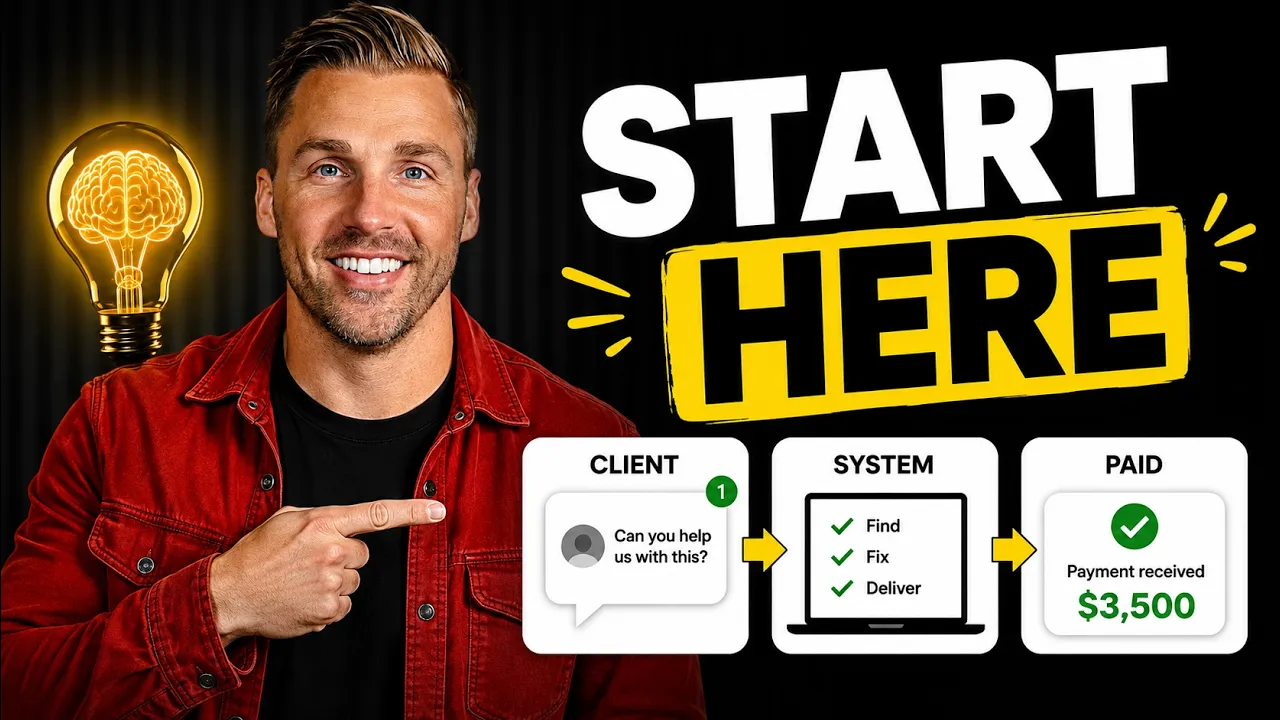
Knowing what to sell and who to sell it to is. But here's what getting your first client actually does. It proves that the system works because the moment money hits your bank account for something that you built, you stop wondering if this is real. You stop asking, "Can this actually work?" Because it just did. You now know that this works. And once you know that it works once, getting that second client is just doing that again. And scaling up to $10,000 a month, well, at that point, you're just doing math. So, let's do the math.
I want to show you something that completely changed how I think about business. It breaks down every possible way you could hit $100,000 a year. And I still share it today because it shows every path. And more importantly, it shows you which ones are actually realistic. Look at these top numbers first. 10,000 customers for a $10 offer. Well, if you're starting from zero with no audience, no email list, no ads budget, that is a very long road. Now, let's look at the bottom. 50 people buying something at $2,000 gets you there, too. Same destination, but a completely different volume game.
Now, let's look at the monthly income version. And again, let's look at the top of this list. $2 a month. Do you know how many people need to stay subscribed to do a $2 offer in order to hit $100,000 a year? 5,000. And that assumes zero cancellations. In the real world, people cancel. Which means you've got to replace them constantly just to stay in place. And that's a treadmill, not not a business. And even the more reasonable numbers lower down the page, like 200 people paying $42 a month, well, means you need 200 people to find you and trust you enough to pull out their credit card and keep paying you every single month.
That requires you to become a full-time marketer focusing almost exclusively on just getting more customers. So, what is the path of least resistance look like? Fewer clients, higher value, do good work, and keep them long-term. I know, suspiciously simple. But watch what happens when we put numbers on it. 50 clients paying $197 a month, that's over $118,000 a year. Now, I appreciate that 50 clients sounds like a lot, especially if you're starting from zero. So, let's shrink this down. Five clients at 197 a month, that's nearly $12,000 a year. That's your first proof that this is real.
Now, you might be thinking, "What do I actually sell that someone's going to be willing to pay me $197 a month for?" And this is exactly where most agency owners go off the rails. They start building this giant menu of services, website, social media, ads, SEO, email, content. But when you offer everything, the client has to mentally sort through and then decide what to choose. This is called the paradox of choice, and more often than not, it leads to clients walking away without choosing anything. So, the solution is to pick just one service. Just one.
And the service that I'd start with is called reputation management, where you help local businesses get more five-star Google reviews on autopilot. And here's why I choose this service specifically. Think about the last time that you tried a new restaurant or called a plumber or anything. Well, you probably checked the reviews first. Almost everybody does. And a business with 4.8 stars and 200 reviews, that feels safe. Whereas one with 3.9 stars and 11 reviews makes you kind of hesitate. I mean, you might still call them, but you're already a little bit unsure. Now, here's what that looks like from the business owner's side.
Most of them know that their reviews aren't great. They think about it, they tell themselves they'll sort it out one day, but then a customer calls or a job comes in or something breaks. And asking for reviews just gets pushed to next week and the week after that, the week after that. Not because they don't care about them, but because they're running a business. So, this just keeps falling to the bottom of the list. So, their Google listing just sits there, slightly out of date, not enough reviews. But the competitor down the street who figured this stuff out, they keep pulling ahead every single day.
That is the gap, and that's exactly where your agency steps in. You charge between $197 and $297 a month to run a review automation system on their behalf. They get new reviews coming in regularly, their Google ranking improves, new customers start calling because of it. You did the setup once, and then the system does the rest. Let me show you exactly what this looks like. Here's what the client's customer sees after their appointment. A short, friendly message, one link, they tap it, and they're on Google leaving a review. That's the whole experience on their end.
It's clean, it's simple, takes about 15 seconds. Now, here's what makes that happen. Let's hop into my computer and I'll show you inside HighLevel, which is the software that runs this whole system. You log in, go to the automations tab in the left-hand menu, we'll click review system. I've already got this fully built out for you. Then we'll just select the simple automation, which is more than enough to start. Now, stay with me here because this is one of those things that looks technical for about 60 to 90 seconds. The automation sends that message automatically after every appointment or completed job.
Just one link direct to Google, no filters, no routing. Every customer gets the same request. You set this up once per client, and it runs on its own from that point forward. You've already seen what the message looks like from the customer's end, but this is what it looks like inside the software with custom variables. So, it automatically personalizes the message with things like the customer's first name, which HighLevel automatically pulls in, so every message feels like it was written just for them. You set this up once per client, and again, after that, every new customer they serve gets this message automatically on schedule without either of you doing anything.
You'll see here where you set what kicks that message off. Usually, it's a completed appointment or a closed job. Basically, anything that tells the system, "This customer was just served. Now, send the review request." Once this is on, it just runs. You don't touch it. Now, if you're looking at this and thinking something like, "I've never set up software like this before," it's completely fine. Most of this takes about 15 to 20 minutes per client. And by your third client, you're going to be doing this in under 10 minutes. Here's what your client's dashboard looks like after a few weeks of this running.
There's new reviews coming in, star ratings climbing, and right next to each review, a response box where they can reply to every review, positive or negative, without logging into Google. There's no separate passwords, no navigating three different platforms, just one inbox and everything's inside. So, clients love this part because for the first time, it actually feels manageable. Run this system for a client over a few months where it's sending a request after every completed job, and if even a fraction of those customers actually leave a review, you're looking at 10, 15, maybe 20 or more new reviews per month.
Run that out 90 days, and the difference on their Google listing is visible to anybody who looks. That's not just a report that you're sending them, that's a real change in their business that their customers can see. That's the whole setup. I know it sounds like more than that, but really isn't. So, good. Now, let's run the actual math. With five clients at $197 a month each, that's just under $1,000 per month. 10 clients, you're just under $2,000 a month. With 25 clients, we'll call it 5K a month. At this point, the software is doing most of the repetitive work, which is kind of the whole point of software.
Now, here's the part that most agency owners skip, and it's exactly why agencies stall out. The math looks great at 25 clients, but what happens when two cancel in the same month? Now you're at 23. Panic a little. You rush to sign new clients. That's the feast and famine cycle that makes this feel unstable. The way you protect against that is something I call services stacking. Once a client is set up on reputation management, the natural next conversation is, "By the way, how are you handling missed calls?" I had a client once, a landscaper, who told me that he never missed calls.
Turns out, he was missing around 40% of his calls. He just didn't know it because nobody was tracking it. The moment that you show a business owner what's actually falling through the cracks, the next question is always, "How do we fix that?" That's when you introduce the AI receptionist. Here's what that looks like. A customer calls the business after hours, the phone gets answered, they get asked a couple of qualifying questions, they get booked onto the calendar. There's no voicemail, there's no missed opportunities, there's no extra staff on your client's end. Basically, you can add this service for another $200 a month, and the setup is about the same as what I just showed you.
Under an hour, one time, then it just runs. So, with review automation at 197 a month, and an AI receptionist added at 247 a month, well, now you've got one client paying you $444 a month. All for a setup that took you less than an hour. And now they're not canceling because both services are working. The reviews are building their reputation, the receptionist is capturing leads that they were previously losing. You're not just a random vendor anymore. Now you're infrastructure, part of the business. And 10 clients at that stacked rate is $4,440 a month. Now, I want to address something directly.
A lot of people watch a video like this and think, "What if a client says yes, and then I can't actually deliver results?" First of all, that fear is real. But here's what's actually happening when you feel it. You're imagining the delivery is harder than it actually is because you haven't seen it yet. So, your brain fills in the blanks with something incredibly complicated and sophisticated. Usually, with some kind of mental movie where everything breaks [clears throat] at once and somehow it's all your fault. The reality, though, is that the setup for reputation management is connecting their Google Business Profile listing and then launching the review request sequence.
Full stop. There's no ongoing creative work, no custom reporting you have to build from scratch. The system generates the results automatically. Your job is just to make sure that it's turned on. The software's job, HighLevel in this case, is to make sure it works. Honestly, the hardest part is just remembering your login details. You don't need to have done this 100 times before to get it right the first time. You just need to follow the steps. And the steps are what I just showed you. Write this down. I help type of business in city get more Google reviews automatically so they never lose a customer to a competitor again.
That is the sentence you say when someone asks you what you do. Just fill in and type of business and the city, and that's your whole sales pitch. Most people never get their first agency client because they're trying to build something massive before they prove that anything works. They want that 10K a month or 20K a month plan before they've had that first $197 a month conversation and they picked the wrong model. High volume, low price, constant hustle just to replace what you're losing. The path of least resistance and therefore the most profitable is the opposite.
One service, a real price for it, five clients, stack the services once they trust you, keep them for years, do the math, repeat. You could spend the next six months trying to sell 10,000 people a $10 offer or you could have five conversations this month and see if one of them becomes your first client. Everything I just showed you, the review automation, the AI receptionist, all of it, runs inside one software called HighLevel and it's what I've used for years to build this entire system. And if you're going to do this properly, this is where you start.
There's a free trial linked in the descriptions below this video, so go get access, log in and start copying and pasting over my entire agency system, which you're going to get immediate access to. And if you want me to walk you through exactly what to do once you're inside, how to find the right business and niches, what to say, how to set this up step-by-step, I put together a free masterclass that I've linked up right here that's going to show you the entire system. So, tap or click that now, I'll walk you through the whole thing.
More from Adam Erhart









Get daily recaps from
Adam Erhart
AI-powered summaries delivered to your inbox. Save hours every week while staying fully informed.